
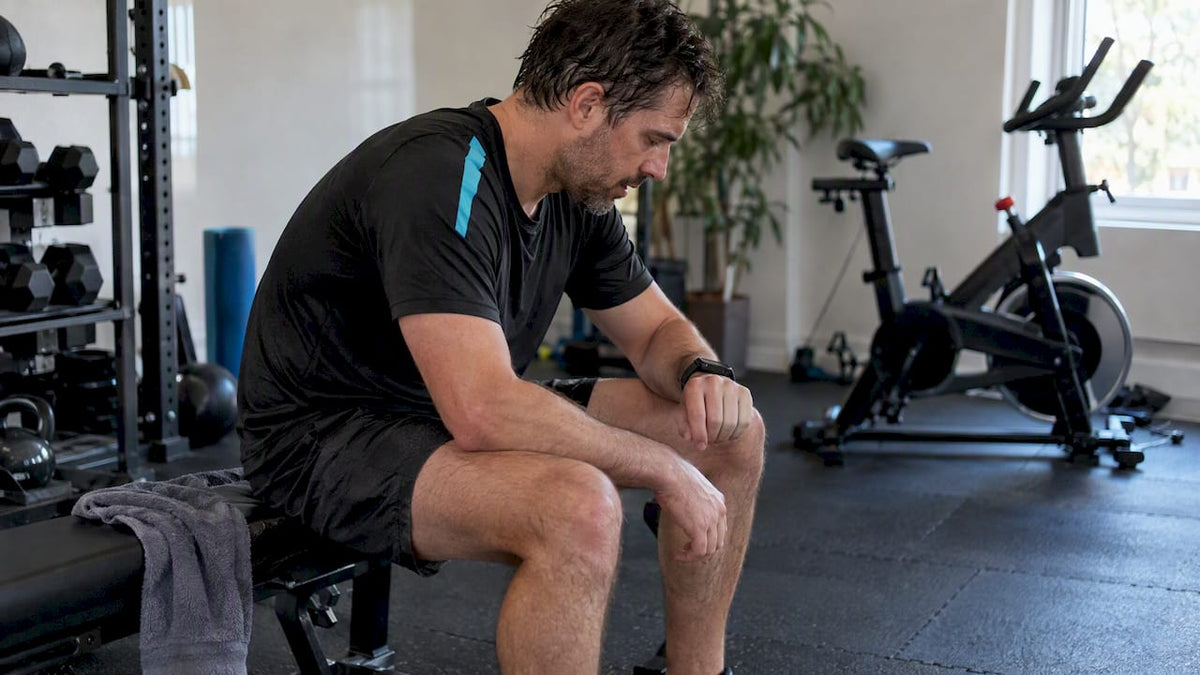
Heart rate recovery (HRR) is the speed at which your heart rate drops after you stop exercising, and it is one of the clearest windows you have into how well your autonomic nervous system is working. A drop of around 18 beats per minute or more within the first minute is commonly treated as a practical sign of good recovery for many adults. Measure yours once today using a consistent protocol, then track the trend rather than judging a single number.
TL;DR:
- Heart rate recovery of 18 beats per minute or more at one minute indicates good autonomic function, but measurement consistency is crucial for tracking progress.
- Factors like sleep, caffeine, posture, and recovery method can distort HRR readings, so identical testing conditions are necessary to interpret changes accurately.
- Regular aerobic exercise and structured programs, including interval training and controlled breathing, can meaningfully improve HRR over time.
- Use a consistent exercise mode, intensity, and device—preferably a chest strap for accuracy—to ensure reliable comparisons over weeks or months.
- Monitoring your own HRR trend provides more useful health insights than focusing on single test results or comparison with others.
Table of Contents
- What heart rate recovery is and why it matters
- How to measure and calculate your heart rate recovery
- What counts as a good heart rate recovery
- Factors that influence heart rate recovery and measurement accuracy
- Evidence-based ways to improve your heart rate recovery
- A practical checklist for reliable HRR tests
- Why tracking trends beats chasing a single number
- Tracking HRR consistently with Voltra
- FAQ
- Sources
What heart rate recovery is and why it matters
When you stop exercising, your body shifts control away from the sympathetic nervous system, which drove your heart rate up, towards the parasympathetic system, which pulls it back down. How quickly that switch happens is what HRR captures, and a faster drop generally reflects a more efficient autonomic response, a pattern often associated with better cardiovascular conditioning.
Recovery happens in two phases that behave differently:
- The fast phase, covering roughly the first 30 seconds to one minute, is dominated by parasympathetic reactivation and is the phase most HRR tests measure.
- The slow phase, stretching from about two to five minutes, involves a more gradual withdrawal of sympathetic drive and a return towards baseline.
A consistently blunted HRR, particularly a one minute drop that stays low over repeated tests, has been linked in clinical research with higher cardiovascular risk. That link is useful context for understanding why clinicians pay attention to this number, not a basis for self-diagnosis.
How to measure and calculate your heart rate recovery
Getting a number you can trust over time means repeating the same test the same way. Loose protocols produce numbers that swing for reasons that have nothing to do with your fitness.
- Choose one exercise mode and intensity, such as a brisk treadmill walk, a steady cycle effort or a set of intervals, and stick with it for every future test.
- Record your heart rate the moment you stop, using this as your peak value.
- Wait exactly one minute, then record your heart rate again; subtract this figure from your peak to get your one minute HRR.
- Optionally repeat the measurement at two minutes for a longer view of recovery, particularly if you train at a high level.
- Decide whether you will rest passively (standing or sitting still) or actively (slow walking) after stopping, and use the same choice every time, since active recovery typically produces a smaller apparent drop than passive recovery.
As a worked example: if your heart rate is 160 beats per minute the moment you stop, and it reads 140 one minute later, your one minute HRR is 20 beats per minute.
Device choice matters here too. Chest straps remain the more reliable option during high intensity movement, while wrist optical sensors can under-report fast changes in heart rate when your arms are moving a lot, according to the Cleveland Clinic. If you rely on a wrist device, keep the strap snug, avoid excessive wrist movement during the test, and cross-check against a chest strap occasionally if your readings look inconsistent.

What counts as a good heart rate recovery
Benchmarks for HRR depend heavily on when you measure and who you are comparing yourself with, so treat any single figure as a guide rather than a verdict.
A one minute drop of 18 beats per minute or more is commonly used as a practical marker of good recovery for many adults, while a drop of 12 beats per minute or less at the same point is often used in clinical studies to flag impaired autonomic recovery, according to the Cleveland Clinic. That twelve-point threshold has been associated with higher cardiovascular risk in research settings, which is part of why it gets quoted so often.

Trained athletes typically see larger drops, and two minute readings are expected to show a bigger total decline than one minute readings simply because more time has passed. Age also shifts what is typical. Older adults generally see smaller HRR values than younger adults at the same fitness level, so comparing your number against a parent or training partner of a different age tells you very little. The more useful comparison is always your own HRR over weeks and months, measured the same way each time.
Factors that influence heart rate recovery and measurement accuracy
A single poor HRR reading rarely means much on its own, because plenty of everyday factors can shift the number without any change in your underlying fitness.
- Short sleep, high caffeine intake, dehydration, recent illness and certain medications, especially beta blockers, can all blunt your apparent HRR on a given day.
- What you do immediately after stopping matters: standing still (passive recovery) typically shows a faster-looking drop than continuing to walk or move (active recovery).
- Posture changes, such as sitting down abruptly after exercise, can also distort the reading compared with standing.
- Sensor inconsistency, including switching between a chest strap and a wrist device between tests, introduces noise that has nothing to do with your heart.
Clinical commentary on using HRR as a tracking tool stresses that the workload itself has to be reproduced exactly, same intensity, same duration, same exercise type, because intensity strongly affects the result. Without that, a change in your number may just reflect a different test, not a different you.
Pro Tip: Log your device, posture and rest choice (passive or active) alongside every HRR reading, so you can tell a real trend apart from a measurement quirk.
Evidence-based ways to improve your heart rate recovery
Two broad levers move HRR: structured training over time, and techniques that speed the parasympathetic switch in the moment.
- High-intensity interval training (HIIT) and moderate-intensity continuous aerobic training have both been shown in intervention studies to improve HRR, with measurable change appearing from around four weeks and larger effects building over programmes lasting up to six months.
- Slow, controlled breathing immediately after you stop exercising, deep nasal inhalation followed by a slower exhale, can help the parasympathetic system take over faster, which supports quicker perceived recovery.
- If you have had a cardiac event, supervised cardiac rehabilitation gives you a structured, monitored way to improve recovery safely, built around warm-up, graduated conditioning, an active cool-down and relaxation.
Deep, controlled breathing immediately after exercise helps the parasympathetic switch and can speed perceived recovery.
Rehabilitation programmes run through the NHS follow exactly that structure, pairing graded exercise with supervised monitoring so that people recovering from cardiac events can rebuild fitness without unnecessary risk, as outlined by University Hospitals Sussex NHS Foundation Trust. If you train normally and simply want a faster HRR, pairing interval sessions with a few weeks of steady aerobic work tends to move the number more than either approach alone, and a short breathing routine built into your cool-down can help both the acute reading and the longer trend.
A practical checklist for reliable HRR tests
Most of the variation people see in their HRR comes from inconsistent testing rather than real changes in fitness, so a short checklist before you start pays off.
- Test at a similar time of day, after a similar amount of sleep, and avoid caffeine, heavy meals or alcohol beforehand.
- Use the same exercise mode and intensity every time, and stop the clock at the exact moment you finish.
- Pick passive or active recovery and keep that choice fixed across every test.
- Note your device, body posture and any unusual conditions (heat, illness, poor sleep) alongside the result.
| Checklist stage | What to standardise |
|---|---|
| Pre-test | Time of day, prior sleep, caffeine and food intake |
| During test | Exercise mode, intensity, exact stop time |
| Post-test | Passive or active rest, posture |
| Recording | Device used, conditions, result logged against the previous test |
Some fitness watches calculate cardio recovery using their own algorithms, which can differ from a manual peak-minus-one-minute calculation. Keeping your own log alongside any automated score gives you a fallback you can trust regardless of which device you are using.
Why tracking trends beats chasing a single number
A single HRR reading tells you very little on its own. Day-to-day variation is normal, and clinical commentary warns against treating one low result as alarming or one high result as proof of fitness. What matters is the direction your numbers move over weeks and months, especially when you view HRR alongside resting heart rate and sleep quality rather than in isolation. That combined picture is far more informative than any one metric read on its own.
— Sam
Tracking HRR consistently with Voltra
Reproducible testing is the whole point of HRR, and that is exactly where a dedicated wearable earns its place. Our VOLTRA AIR and VOLTRA PRO devices record heart rate continuously through exercise and recovery, while VOLTRA CORE covers the essentials for straightforward heart and activity monitoring.

Because these devices are typically purchased once with free access to a companion app, there is no subscription pushing you to abandon tracking after a few months, which matters when the real value of HRR only shows up over weeks of consistent logging. Pairing your wearable with adaptive tools like heart rate-guided audio during cool-downs can add another layer to your recovery routine. Browse the VOLTRA AIR collection to find the device that fits how you train.
This article is general information, not a substitute for advice from a qualified doctor. Consult a qualified healthcare professional about your own circumstances before acting on anything here.
FAQ
What is good heart rate recovery by age?
HRR benchmarks are not tightly standardised by age, but older adults generally show smaller one minute drops than younger adults at a similar fitness level. Rather than comparing yourself with a different age group, track your own HRR over time using the same test protocol.
What is a good heart rate recovery rate for 2 minutes?
A two minute reading should show a larger total drop than a one minute reading, since more recovery time has passed, though there is no single widely cited clinical cutoff for the two minute mark in the way there is for one minute. Many people instead use the two minute figure as a secondary check alongside their one minute HRR.
What is a strong heart rate recovery?
A one minute HRR of 18 beats per minute or more is commonly treated as a practical marker of strong recovery for many adults, while a drop of 12 beats per minute or less at one minute is often used in clinical studies to flag impaired recovery. Trained athletes often see noticeably larger drops than this general guideline.
What is a normal resting pulse rate?
Resting pulse rate varies by individual, and the usual approach is to track your own baseline over time rather than chase a universal number, since fitness, age and medication all shift it. Our guide on reducing resting heart rate covers practical ways to lower yours through training and consistent tracking.
Sources
- Heart Rate Recovery
- Effects of exercise programmes on heart rate recovery
- Why cardio recovery rate matters for running and heart health—and how to improve yours
- Exercise — University Hospitals Sussex NHS Foundation Trust
Share:
UK Buyers: Pick a Smart Scale by App, Not Wi‑Fi or Bluetooth
Fat Loss vs Weight Loss: Lose 0.5–1 kg per Week While Keeping Muscle