

Use an age-based formula like Tanaka for a quick, rough estimate; get a supervised graded exercise test if you need clinical precision or have heart risk factors; and use a wearable to gather real peak readings over weeks and refine your training zones. Formulas carry wide margins of error, especially past 50, so treat any single number as a starting point, not a fact, and speak to a doctor before pushing to true maximal effort if you’re unsure of your cardiovascular health.
TL;DR:
- Age-based formulas, like 220 minus age, typically have a margin of error of 7 to 12 beats per minute and are best used as rough estimates.
- Lab graded exercise testing provides the most accurate HRmax measurement but is not suitable for everyone, especially those with existing cardiovascular conditions.
- Repeated field tests and continuous wearable tracking over weeks can improve the accuracy of personal HRmax estimates more reliably than a single formula or test.
- Resting heart rate fluctuations and daily training data are essential for refining heart rate zones, with the Karvonen method offering more personalized training information.
- Wearables like Voltra provide ongoing, subscription-free heart rate tracking that helps monitor trends and adjust training zones without replacing professional medical advice.
Table of Contents
- Maximum heart rate methods compared at a glance
- How accurate are age-based heart rate formulas?
- What happens during a graded exercise test?
- Can you safely test your own max heart rate?
- What is the Karvonen method for training zones?
- How do you choose the right HRmax method for you?
- How continuous tracking sharpens your HRmax estimate
- Stop chasing a perfect number
- A practical way to track your heart rate without ongoing costs
- Sources
- FAQ
Maximum heart rate methods compared at a glance
Four approaches dominate any serious discussion of maximum heart rate methods, and each trades accuracy for convenience differently.
- Age-based formulas (220 minus age, Tanaka): instant, free, but often wrong by 10 to 20 beats per minute for any given individual.
- Lab graded exercise testing (GXT with ECG): the closest thing to ground truth, run by a physiologist, typically accurate to within a beat or two of true HRmax.
- Field tests (interval protocols, maximal sprints): moderately accurate, no lab needed, but physically demanding and unsuitable for everyone.
- Wearables and chest straps: not a measurement method on their own, but a way to catch real peak heart rates during hard efforts and build a personal data trend.
A healthy 30-year-old training for a 5K probably only needs a formula plus a chest strap. Someone managing a heart condition, or an older adult returning to intense exercise, should talk to a clinician before attempting any maximal test, formula-based or otherwise.
How accurate are age-based heart rate formulas?
Age-based formulas remain the fastest way to estimate HRmax, but “fast” and “accurate” are not the same thing. The oldest and most quoted, Fox’s 220 minus age, was published in 1971 and still shows up on gym walls and app screens because it’s simple to memorise. It just isn’t very good.
- Fox (1971): 220 − age
- Tanaka: 208 − (0.7 × age)
- Gulati: 206 − (0.88 × age), derived specifically from a large cohort of women
- NTNU field-adjusted estimate: age-only calculators with a recommendation to confirm with an interval test
The standard error on 220 minus age runs roughly 7 to 12 beats per minute, meaning your true HRmax could sit well outside the number the formula spits out. That’s a meaningful spread when you’re setting training zones off a single figure.
Meta-analysis work backing the Tanaka equation shows it performs better than Fox across many healthy adult samples, though its own standard error still sits around 10 beats per minute. The Gulati formula was built from the St. James Women Take Heart Project and is often recommended for women specifically, since sex differences in cardiac response aren’t captured by unisex equations.
Pick Tanaka if you want a general-purpose number. Pick Gulati if you’re a woman and want a formula built on female physiology. Either way, treat the result as a midpoint, not a ceiling, and adjust it as real data comes in from training or testing.
What happens during a graded exercise test?
A graded exercise test with ECG monitoring is the gold standard for measuring true HRmax rather than estimating it. You walk or run on a treadmill (or pedal a cycle ergometer) while resistance or speed increases in stages, wearing an ECG lead and often a mask that measures gas exchange.
- The test continues until volitional fatigue, the point where you genuinely cannot maintain the pace.
- Physiologists look for a respiratory exchange ratio (RER) above 1.10 as a sign you’ve hit true maximal effort, alongside a plateau in oxygen uptake.
- Your peak heart rate at that moment, recorded directly off the ECG, is your measured HRmax.
This is why exercise physiologists generally favour supervised testing over any calculator: there’s no estimation error because someone is watching your heart in real time. The test isn’t for everyone, though. People with known cardiovascular disease, uncontrolled hypertension, or certain other contraindications need a clinician’s judgement before attempting maximal exertion under any protocol. And if you take beta blockers, expect a noticeably lower peak heart rate on any test, since the medication blunts the very response being measured, regardless of which method produced the underlying prediction.
Can you safely test your own max heart rate?
Field tests won’t match a lab, but they get you closer than a formula, provided you follow a sensible protocol and you’re already reasonably fit.
- Warm up properly for 10 to 15 minutes, building gradually to a moderate effort.
- Run, cycle, or row four intervals of four minutes at a hard but sustainable pace, with short recovery between each.
- On the final interval, push the last minute to genuine maximal effort.
- Cool down for 10 minutes and note the highest number your monitor recorded during that peak minute.
Avoid this if you have chest pain, dizziness, uncontrolled blood pressure, or any diagnosed heart condition, and don’t attempt it entirely alone if you can help it. Manual pulse checks after stopping tend to underestimate the true peak because heart rate falls fast the moment you ease off, so use continuous electronic monitoring during the effort itself, not a count afterwards. Expect your number to differ by modality too: treadmill running usually produces a higher HRmax than cycling, and swimming tends to run lower again.
Pro Tip: Run the same field test on the same route or machine every few months rather than chasing a single definitive number. The trend tells you more than any one session ever will.

What is the Karvonen method for training zones?
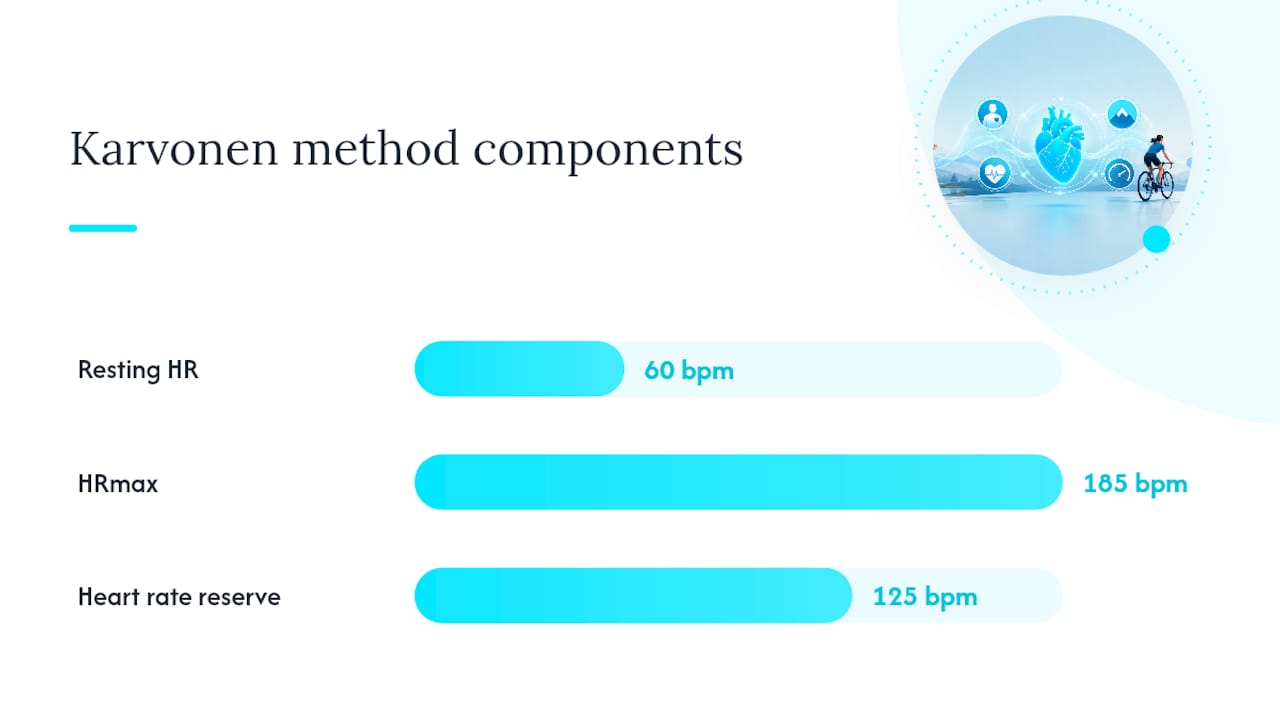
Heart rate reserve, or HRR, is the gap between your resting heart rate and your HRmax, and it’s the basis of the Karvonen method for setting personalised training zones. The formula: target HR = ((HRmax − resting HR) × intensity%) + resting HR.
Say your HRmax is 185 and your resting heart rate is 60. Your HRR is 125.
- HRR-based zones account for individual fitness in a way raw percentage-of-HRmax doesn’t, since two people with the same HRmax can have very different resting rates.
- Resting heart rate drifts with sleep, stress, hydration, and training load, so remeasure it every few weeks rather than relying on one old reading.
- Take your resting figure first thing in the morning, before caffeine or getting out of bed, for consistency.
How do you choose the right HRmax method for you?
Match the method to your goals, your risk profile, and what equipment you already own, rather than picking whichever number is easiest to Google.
- Casual exerciser wanting general zones: use Tanaka or Gulati as a starting estimate, then wear a chest strap or tracker to confirm and adjust over a few weeks.
- Athlete needing precise thresholds for race pacing: a lab graded exercise test is worth the cost, because a few beats per minute of error compounds across a season of structured training.
- Anyone on heart medication, or with cardiovascular risk factors: get clinical clearance and, ideally, a supervised assessment before doing anything maximal.
- Budget or access constrained: combine a formula with repeated field data rather than a one-off number, since the trend across sessions is more informative than any single estimate.
Pro Tip: Think of this as a three-step ladder: estimate with a formula, confirm with wearable peaks over time, and only escalate to a lab test if your training or health genuinely demands that level of precision.
How continuous tracking sharpens your HRmax estimate
A single hard session gives you one data point. Several sessions, across a few weeks, give you a pattern, and that’s where continuous tracking earns its place alongside formulas and lab tests.
- Recording peak heart rate across multiple maximal efforts, in the same activity context each time, narrows your confidence in where your real HRmax sits.
- Comparing those peaks against your formula-based estimate tells you whether you’re running high, low, or roughly on target.
- Because wrist-based optical sensors lose accuracy at high intensity compared with chest straps, pair a device like Voltra with a strap during genuinely maximal efforts if precision matters.
- Update your Karvonen calculation whenever your resting heart rate shifts meaningfully, which daily tracking will show you without needing a fresh lab visit.
Wearables are a practical way to refine an estimate over time. They don’t replace a medically supervised GXT when one is clinically indicated, and no amount of trend data substitutes for a doctor’s assessment if you have known heart risk.
Stop chasing a perfect number
Every formula, test, and gadget here gives you an estimate with some margin of error. What actually improves training is watching the trend across weeks, not obsessing over whether today’s peak was 182 or 186. Pair heart rate data with how hard the effort actually felt and your pace or power output, and you’ll make better decisions than any single number could offer alone.
— Sam
A practical way to track your heart rate without ongoing costs
Most heart rate monitors ask you to keep paying just to see your own data. Voltra doesn’t. Every device gives you real-time heart and recovery metrics, plus lifetime access to the app, with no subscription sitting between you and your numbers.

That matters for exactly the kind of tracking this article describes: capturing peak heart rates across multiple sessions, watching your resting heart rate drift as fitness improves, and updating your Karvonen calculation without a paywall interrupting the process. VOLTRA AIR covers the essentials for continuous heart and activity tracking, while VOLTRA PRO adds deeper recovery and body metrics for anyone refining zones more seriously. Wearable data complements the formulas and field tests already covered here; it doesn’t replace a doctor’s assessment if you have cardiovascular risk factors. If you want to start building your own HRmax trend rather than relying on a single formula, check current pricing and features on the Voltra Air collection page.
This article is general information, not a substitute for advice from a qualified doctor. Consult a qualified healthcare professional about your own circumstances before acting on anything here.
Sources
- Accuracy of Commonly Used Age‑Predicted Maximal Heart Rate Equations - PMC
- Heart Rate calculator - CERG - NTNU
- Heart Rate Reserve: How to Calculate It & What It Means - Cleveland Clinic
- Max heart rate: target heart rate training for runners - Runner’s World
FAQ
Why is the Karvonen method more accurate than a straight percentage of HRmax?
The Karvonen method factors in your resting heart rate, not just your maximum, so it accounts for your individual fitness baseline. Two people with identical HRmax but different resting rates will get different, more appropriate, target zones using heart rate reserve.
What is a good maximum heart rate for my age?
There’s no single “good” number tied to age, since actual HRmax varies widely between individuals of the same age due to genetics, fitness level, and medication. Formulas like Tanaka (208 minus 0.7 times age) give a rough midpoint estimate, but the standard error runs around 10 beats per minute, so your real number could sit meaningfully above or below it.
Is 193 bpm bad when exercising?
Not necessarily. Whether a particular heart rate is a problem depends entirely on your actual measured or estimated HRmax, not a generic threshold, since younger and highly trained individuals routinely reach very high heart rates during maximal effort. If it happened during light or moderate activity rather than a genuinely hard effort, that’s a reason to check in with a doctor.
Is 220 minus your age accurate?
Not particularly. The standard error on Fox’s 220 minus age formula is roughly 7 to 12 beats per minute, and it tends to lose accuracy further in older adults. The Tanaka formula generally performs better across broader adult samples, though it still carries its own margin of error.
How does Voltra help me track my heart rate zones?
Voltra devices provide real-time heart and recovery data with no subscription required, making it practical to log peak heart rates across multiple sessions and refine your zones over time. Pricing for the VOLTRA AIR starts at £99.99, with VOLTRA PRO at £129.99 and VOLTRA CORE at £149.99, each a one-off purchase.
Share:
Why Time in Bed vs Sleep Episode Changes Your Sleep Efficiency Score