

Yes, most people can reduce their resting heart rate through evidence-based lifestyle changes, and the effect is well documented, rather than folklore. Regular aerobic exercise, yoga and paced breathing, better sleep, proper hydration, and cutting back on caffeine and nicotine are the interventions with the strongest backing. Expect measurable change over weeks to months rather than days, and see a doctor if your resting rate stays persistently above 100 bpm or drops with symptoms like dizziness or fainting.
TL;DR:
- Regular aerobic exercise, yoga, and paced breathing can produce meaningful reductions in resting heart rate within three months, especially for those with higher initial rates.
- Quick improvements, often within days, come from improving sleep quality, staying well-hydrated, and cutting stimulants like caffeine and alcohol.
- Consistency is crucial, with measurable changes best seen after six to eight weeks of steady practice, and persistent high or low heart rates warranting medical consultation.
- Wearables help track trends but should be cross-checked with manual pulses, as inaccurate readings can occur during movement or with skin tone differences.
- Lifestyle changes are less effective if underlying health issues or medications like beta-blockers are influencing the heart rate, requiring physician guidance.
Table of Contents
- What resting heart rate actually measures
- How to measure your resting heart rate accurately
- Evidence-based ways to lower resting heart rate
- How long it takes and what to actually expect
- Why tracking your trends matters more than any single reading
- When to seek medical advice
- Dietary factors influencing resting heart rate
- Differences in resting heart rate by age, gender, and fitness level
- Impact of medical conditions on resting heart rate
- Potential risks of excessively low resting heart rate
- My four-week starting plan for lowering resting heart rate
- Tracking the change: where Voltrahealth fits in
- Sources
- FAQ
What resting heart rate actually measures
Resting heart rate (RHR) is the number of times your heart beats per minute while you’re completely at rest, ideally sitting or lying down, not mid-workout or halfway up a flight of stairs. It’s a different measurement from your active or exercise heart rate, which climbs the moment you stand up, let alone move. Think of RHR as your engine’s idle speed. An engine that idles smoothly at low revs is generally in better condition than one that has to work harder just to sit still.
For most adults, a normal resting heart rate falls between 60 and 100 beats per minute, though where you sit within that range says a lot about your cardiovascular conditioning. Highly trained endurance athletes often see resting rates closer to 40 bpm, because a conditioned heart pumps more blood per beat and simply doesn’t need to fire as often.
A handful of factors shape where your number lands:
- Age, with RHR tending to shift slightly as you get older
- Fitness level, since trained hearts pump more efficiently per beat
- Body position, medication use, and even room temperature
- Emotional state, stress hormones, and recent caffeine or nicotine intake
- Underlying health conditions, including thyroid problems and some arrhythmias
A lower resting heart rate within the normal range is generally a sign your heart isn’t working as hard to do its job. That’s why RHR gets used as a rough proxy for cardiovascular fitness at population level, alongside blood pressure and cholesterol, even though no single number tells the whole story on its own.
How to measure your resting heart rate accurately
A single reading tells you almost nothing useful. What matters is a reliable baseline you can track over time, and that starts with getting the measurement right.
To check your pulse manually:
- Sit or lie down for at least five minutes beforehand, ideally right after waking, before you’ve had coffee or moved much.
- Place two fingers (not your thumb, which has its own pulse) on your wrist or the side of your neck.
- Count the beats for 30 seconds and double the number, or count for a full 60 seconds for better accuracy.
- Repeat this on five consecutive mornings and average the results to set your personal baseline, a method Cleveland Clinic recommends for spotting real trends rather than daily noise.
- Log each reading alongside sleep hours, stress levels, and alcohol or caffeine intake from the day before.
Wearables make this easier day to day, but they’re not flawless. Optical sensors can misread during movement, on darker skin tones under certain conditions, or when a strap sits too loosely. Treat wearable data as directionally useful rather than clinically exact, and cross-check against a manual count occasionally.
Pro Tip: Take your baseline readings at the same time each morning and in the same body position. A rate taken lying down will usually read a few beats lower than one taken sitting up, and mixing positions muddies your trend line.
Caffeine, recent exercise, fever, dehydration, and certain medications can all push a single reading up temporarily. If one morning’s number looks unusually high, don’t panic. Check whether anything from the day before explains it before assuming it’s a lasting change.
Evidence-based ways to lower resting heart rate
Not every method delivers the same payoff, and knowing which ones move the needle fastest helps you spend your effort where it counts.
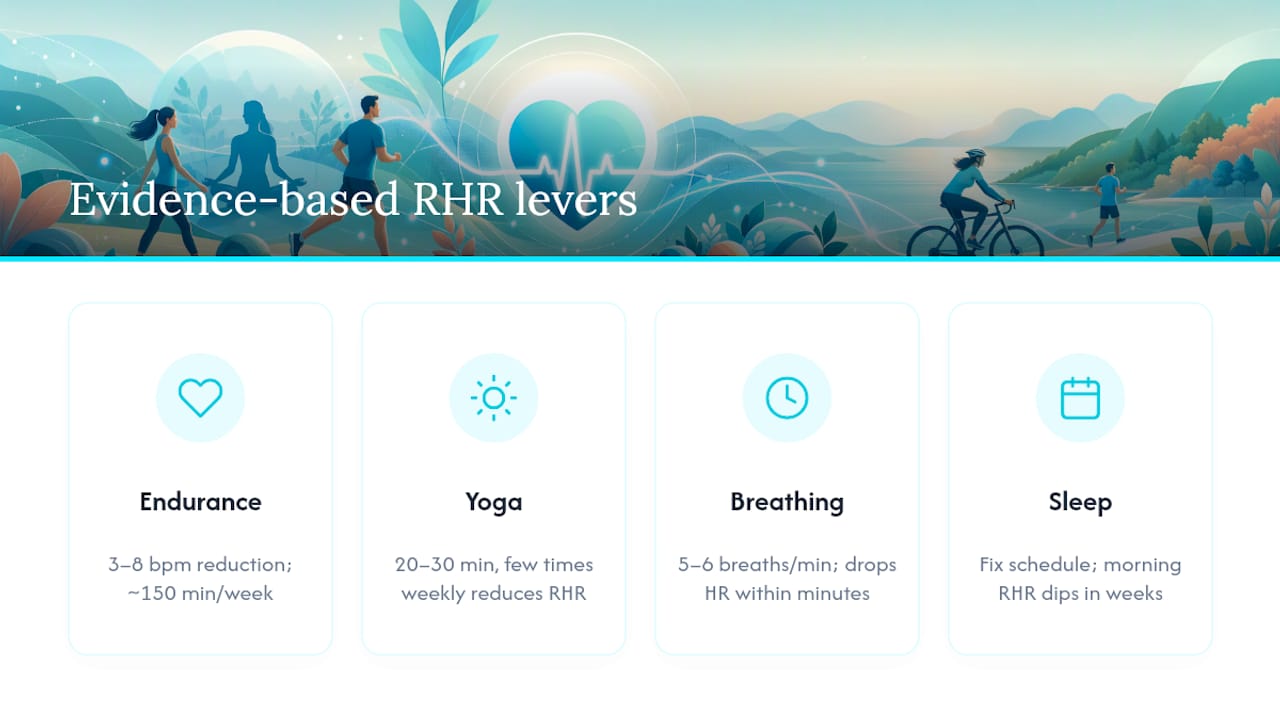
Endurance exercise is the single most effective, best-evidenced lever. A systematic review and meta-analysis of exercise effects on resting heart rate found that regular aerobic training produces consistent reductions, with mean decreases in the region of 3 to 8 bpm depending on the study and a person’s starting point. The American Heart Association’s activity guidance of roughly 150 minutes of moderate aerobic activity a week (brisk walking, cycling, swimming, running) is a sensible target. Three structured sessions a week is enough to start seeing change, and the same meta-analysis notes the effect commonly becomes measurable after about three months of consistent training. Strength training alone shows smaller and more mixed effects on RHR than endurance work, so it’s a useful complement, not a substitute.
Yoga and other parasympathetic-focused practices carry genuinely comparable evidence to aerobic exercise. The same review found yoga produces reliable reductions in resting heart rate, likely through its effect on the parasympathetic nervous system, the branch of your nervous system responsible for calming things down after stress. Twenty to thirty minutes a few times a week, focused on slow movement and breath control rather than a fast-paced flow class, appears to be where the benefit lives.
Consistency beats intensity, and this is worth internalising early. People starting with a higher baseline RHR tend to see the largest reductions, and the gains build cumulatively across weeks of regular practice rather than showing up after one punishing session. Skipping two weeks and then doing an unusually hard workout won’t replicate months of steady training.
Stress management and paced breathing work on two different timescales. Slow, deliberate breathing, typically around five to six breaths a minute, activates the vagus nerve and can drop your heart rate within minutes. That’s an immediate effect, not a lasting one on its own, but practising it daily for five to ten minutes appears to nudge your baseline down over time as your nervous system gets better at shifting into a calmer state. Box breathing, 4-7-8 breathing, and simple diaphragmatic breathing all use the same underlying mechanism.

Sleep quality has a more direct effect on heart rate than most people realise. Poor or insufficient sleep raises both nighttime and resting heart rate, and it’s linked to broader cardiometabolic risk beyond the heart rate number itself, according to Mayo Clinic’s sleep guidance. Fixing a chaotic sleep schedule, even without touching anything else, often produces a visible dip in morning RHR readings within a couple of weeks.
Hydration and cutting stimulants are the fastest wins on this list, if not the biggest. Dehydration thickens the blood slightly and forces the heart to work harder to circulate it, so your rate climbs. Caffeine and nicotine are both stimulants that directly raise heart rate, and even a single alcoholic drink can push your rate up by several beats for a while. None of this requires months of patience: swapping a late-afternoon coffee for water, or trimming evening drinks, can shift next-morning readings almost immediately.
Weight loss and metabolic improvement matter over the longer arc. Carrying excess weight makes the heart pump against more resistance, so gradual fat loss alongside the exercise and sleep changes above tends to compound the RHR benefit over several months rather than weeks.
Medication is a different category entirely, and it belongs with a doctor, not a lifestyle list. Beta-blockers, prescribed for conditions like high blood pressure or certain arrhythmias, work by directly slowing heart rate, sometimes substantially. They’re a clinical tool for a diagnosed issue, not something to self-select because you want a lower number on a wearable. If you’re already on heart-rate-affecting medication and considering lifestyle changes on top, mention it to whoever prescribed it.
How long it takes and what to actually expect
Set your expectations by the calendar, not the week. Meta-analytic data on exercise and yoga shows the reduction in resting heart rate typically becomes apparent after around three months of regular training, though some people notice smaller shifts sooner if their starting point was high. Hydration and stimulant changes work faster, often within days, while sleep improvements tend to show up within one to two weeks of consistent better rest.
| Change made | Typical timeframe | Expected direction and rough magnitude |
|---|---|---|
| Cutting caffeine/alcohol, improving hydration | Days | Small, immediate dip in daily readings |
| Improved sleep consistency | 1 to 2 weeks | Modest reduction, more stable morning readings |
| Paced breathing practice | Minutes (session), weeks (baseline) | Immediate short-term drop; gradual baseline improvement |
| Regular aerobic exercise (3x/week) | 8 weeks | Around 3 to 8 bpm reduction, per meta-analysis data |
| Yoga practice (regular sessions) | 8 weeks | Comparable reduction to aerobic training |
| Weight loss and metabolic changes | Several months | Gradual, compounding reduction |
If your baseline RHR was already high before you started, you’re likely to see a bigger absolute drop than someone starting closer to the middle of the normal range. That’s not unfair, it’s just how the physiology works: there’s more slack to take up. Reassess your approach every four to six weeks by comparing weekly averages rather than single days, and if nothing has budged after three months of genuinely consistent effort, that’s a reasonable point to loop in a doctor.
Why tracking your trends matters more than any single reading
A single low or high reading tells you almost nothing. What matters is the shape of your data over weeks, and that’s where consistent tracking earns its place in any plan to bring your numbers down.
- Check your resting rate each morning, before caffeine, in the same position, and log it.
- Review the weekly average rather than obsessing over daily swings, which fluctuate for reasons that have nothing to do with your fitness.
- Treat a weekly average sitting more than roughly 5 to 8 bpm above your established baseline as a signal to prioritise rest or recovery rather than push harder.
- Use trend data to catch overtraining or brewing illness early, often before you feel unwell.
- Cross-check unusual wearable readings with a manual pulse count if something looks off.
Pro Tip: Don’t chase a number. If your wearable shows a rate a few beats higher than usual after a poor night’s sleep or a stressful day at work, that’s context, not a crisis. The pattern across a month tells you far more than any single morning.
Wearables are genuinely useful for spotting these gradual shifts that you’d otherwise miss entirely between annual check-ups. They are not diagnostic tools, though, and a device flagging an unusual trend is a prompt to pay attention or check in with a professional, not a substitute for one.
When to seek medical advice
Most fluctuations in resting heart rate are ordinary and self-correcting. A handful of patterns are worth raising with a doctor rather than waiting out.
- A resting rate that stays consistently above 100 bpm without an obvious explanation like recent exercise, fever, or a stimulant.
- An unusually low resting rate below 60 bpm accompanied by symptoms such as dizziness, fatigue, or fainting, rather than a low number in someone who’s simply very fit.
- Fainting, chest pain, or severe breathlessness at any heart rate, which needs urgent attention, not a wait-and-see approach.
- A sudden, unexplained shift in your established baseline that persists for more than a week or two.
Clinicians investigating an unusual resting rate typically check for thyroid dysfunction, arrhythmias, infection, anaemia, and medication side effects, since several common drugs affect heart rate as a side effect rather than their main purpose. Bring your tracked trend data, a short symptom log, and a current medication list to the appointment. It turns a vague “my heart rate feels off” into something a doctor can actually work with.
Dietary factors influencing resting heart rate
What you eat and drink shows up in your pulse faster than most people expect. Caffeine is the most obvious lever, stimulating the nervous system and raising heart rate within roughly 15 to 45 minutes of consumption, with effects that can linger for hours depending on how much you’ve had and your own sensitivity. Multiple cups across a day compound this rather than resetting between doses.

Alcohol has a similar but distinct effect. Even one drink can temporarily raise resting heart rate, and the effect tends to be more pronounced overnight, which is part of why many people notice higher morning readings after drinking the evening before. Sodium intake matters too, though less directly. A high-sodium diet contributes to higher blood pressure over time, which in turn makes the heart work harder against greater resistance.
On the other side of the ledger, diets rich in potassium and magnesium, found in leafy greens, nuts, and legumes, support normal electrical signalling in the heart. Omega-3 fatty acids from fish have also been associated with better heart rate variability in nutrition research. None of these dietary levers work in isolation. A single healthy meal won’t offset a stimulant-heavy day, but a generally balanced pattern, low in processed sodium and heavy caffeine, low in excess alcohol, supports the exercise and sleep changes covered earlier rather than competing with them.
Differences in resting heart rate by age, gender, and fitness level
Age shifts the picture gradually. Children and infants have naturally higher resting heart rates than adults, often well above 100 bpm in early childhood, simply because smaller hearts beat faster to move the same volume of blood. By adulthood, most people settle into the standard 60 to 100 bpm band, and RHR tends to drift only modestly with further ageing unless fitness or health status changes substantially.
Women often run a few beats per minute higher than men on average, a difference generally attributed to smaller heart chamber size rather than any difference in cardiovascular health. This gap is a population-level tendency, not a rule for any individual, and plenty of women sit well below the average for their sex.
Fitness level is the biggest lever of the three. A sedentary adult and a competitive cyclist can both be perfectly healthy while sitting 30 or 40 beats per minute apart at rest, purely because a trained heart’s stroke volume, the amount of blood pumped per beat, is so much greater. This is also why comparing your number to a friend’s or a training partner’s rarely tells you anything useful. Your own trend over time matters far more than how you stack up against somebody else’s baseline.
Impact of medical conditions on resting heart rate
Several underlying conditions push resting heart rate outside the range that lifestyle changes alone can fix, which is part of why persistent extremes deserve medical attention rather than more willpower. Hyperthyroidism, an overactive thyroid, commonly speeds the heart up, sometimes alongside weight loss, tremor, and anxiety symptoms that make the connection easier to spot. Hypothyroidism tends to do the opposite, slowing things down.
Arrhythmias, irregular heart rhythms such as atrial fibrillation, can cause a resting rate that’s either abnormally fast or erratic rather than steady, and these need proper diagnosis rather than home tracking alone. Anaemia forces the heart to beat faster to compensate for reduced oxygen-carrying capacity in the blood. Infections and fever raise resting heart rate temporarily and predictably, usually resolving once the illness clears. Anxiety disorders and chronic stress conditions keep the sympathetic nervous system, the body’s fight-or-flight system, more active than it should be at rest, which shows up as a persistently elevated baseline even when someone feels physically fine.
Certain medications beyond beta-blockers also move the number, including some decongestants, asthma inhalers, and antidepressants, which is exactly why a full medication list matters during any clinical assessment of an unusual reading.
Potential risks of excessively low resting heart rate
A low resting heart rate earned through genuine cardiovascular fitness is a good sign, but the number itself doesn’t tell you the reason behind it, and that distinction matters clinically. Bradycardia, generally defined as a resting rate below 60 bpm, is entirely normal and often desirable in trained athletes whose hearts pump more blood per beat.
The concern arises when a low rate comes with symptoms: dizziness, fatigue, confusion, shortness of breath, or fainting. These suggest the heart may not be pumping enough blood to meet the body’s demands, regardless of what the number says on paper. Causes range from an underlying conduction problem in the heart’s electrical system to medication side effects, particularly from beta-blockers or other rate-lowering drugs taken for unrelated conditions. Severely low rates can, in some cases, lead to inadequate blood flow to the brain and other organs, which is why fainting alongside a low pulse is treated as an urgent symptom rather than something to monitor at home.
The practical rule is straightforward: a low number with no symptoms in someone who exercises regularly is rarely worrying. A low number with symptoms, in anyone, is worth a same-week conversation with a doctor rather than a wait-and-see approach.
My four-week starting plan for lowering resting heart rate
Here’s how I’d actually structure the first month, based on where the evidence shows the fastest and most durable returns.
Week one is about establishing your baseline honestly: five mornings of pulse checks before anything else, plus cutting evening caffeine and adding a daily 20 to 30 minute walk. Nothing dramatic yet, just data and one small habit.
Week two introduces three sessions of moderate aerobic activity (brisk walking, cycling, swimming) and five to ten minutes of daily paced breathing, ideally in the evening when stress has usually peaked.
Week three adds one session of yoga or a longer steady-state cardio session, and this is when I’d start actually reviewing weekly averages rather than daily numbers.
Week four is about consolidation: keep what’s working, adjust intensity if sessions feel too easy or too hard, and if nothing has shifted or anything alarming has appeared, that’s your cue to see a doctor rather than push a fifth week of the same plan.
— Sam
Tracking the change: where Voltrahealth fits in
Every method above depends on knowing your numbers, and that’s where a monitoring device earns its place without turning into a gadget for its own sake. Unlike most fitness wearables that lock daily heart health and sleep data behind a monthly fee, some devices give you continuous resting heart rate, sleep, and activity tracking with no subscription fees, so you are not paying twice for data about your own body.

That matters for the four-week plan above, because spotting a genuine downward trend in your resting rate, rather than guessing from memory, is what tells you whether Week 2’s aerobic sessions are actually working or whether you need to adjust. The Voltra tracker monitors heart health, sleep quality, and daily activity continuously, flagging the kind of week-on-week shifts covered in the tracking section above, while Voltra Air offers a more compact option for people who want the same trend data with a smaller device. Neither replaces a clinical assessment. If your data shows a persistent pattern outside the normal range, or you notice symptoms alongside it, that’s still a conversation for a doctor, not an app.
If you’re ready to start tracking your own baseline properly, the Voltra tracker product page is the place to check current bundle options and get set up before your next morning reading.
Sources
The systematic review and meta-analysis on exercise and resting heart rate underpins the timelines and bpm reductions cited throughout this guide. Cleveland Clinic’s guidance on lowering resting heart rate and its reference page on normal heart rate ranges provided the clinical thresholds and tracking protocol. Mayo Clinic’s overview of normal heart rate and its sleep improvement guidance informed the medical thresholds and sleep sections.
- Effects of exercise on the resting heart rate: A systematic review and meta-analysis
- High resting heart rate? Here’s how to slow it down — Cleveland Clinic
- Heart rate: What is a normal heart rate? — Cleveland Clinic
FAQ
What is a good resting heart rate for my age?
For most adults, 60 to 100 bpm is considered normal regardless of age, though children run naturally higher and very fit adults often sit near the lower end, sometimes around 40 bpm in trained athletes.
What is the fastest way to lower my resting heart rate?
Cutting caffeine and alcohol and improving hydration produce the quickest visible change, often within days, while paced breathing lowers heart rate within minutes of practice, though lasting baseline reductions still depend on consistent exercise and sleep habits over weeks.
Why is my resting heart rate so high?
Common causes include recent caffeine or nicotine intake, dehydration, poor sleep, stress, fever or infection, certain medications, and underlying conditions like an overactive thyroid, so a persistently high reading without an obvious cause is worth discussing with a doctor.
Is lowering your resting heart rate a good thing?
Generally yes, since a lower resting heart rate usually means the heart works less hard to do its job, though an unusually low rate accompanied by dizziness or fainting needs medical assessment rather than being assumed to be a fitness marker.
Share:
Shrink Dangerous Belly Fat in 3 Months: Visceral vs Subcutaneous
Increase Deep Sleep in 4–6 Weeks With a Wearable Test Plan