

Visceral fat sits deep in your abdomen, wrapped around the liver, pancreas and intestines, while subcutaneous fat is the layer you can pinch just under your skin. Visceral fat is the more dangerous of the two: it behaves almost like an organ in its own right, pumping out inflammatory chemicals and free fatty acids that drive insulin resistance and cardiovascular risk. The encouraging part is that visceral fat also responds fastest to changes in exercise, sleep and diet.
TL;DR:
- Visceral fat accounts for about 10% of total body fat and drains directly into the liver, increasing metabolic risks more than subcutaneous fat.
- Waist circumference above 94cm for men or 80cm for women signals increased visceral fat risk, with waist-to-height ratio above 0.5 also indicating concern.
- HIIT at roughly 400 MET-minutes weekly shows the strongest evidence for rapid visceral fat reduction compared to other exercise methods.
- Visceral fat tends to decrease faster than subcutaneous fat when starting a new exercise or diet plan, responding within weeks due to its hormonal sensitivity.
- Tracking waist size, resting heart rate, and sleep patterns weekly from non-subscription devices can help monitor visceral fat reduction trends over time.
Table of Contents
- Visceral fat vs subcutaneous fat: the anatomical difference
- Health risks of visceral fat vs subcutaneous fat
- How to measure visceral fat at home and in clinic
- Does visceral fat or subcutaneous fat disappear first?
- A practical plan to reduce visceral fat over three months
- Tracking metrics that actually predict visceral fat loss
- What realistic progress looks like
- Keeping tabs on your numbers without a subscription
- Sources
- FAQ
Visceral fat vs subcutaneous fat: the anatomical difference
The distinction comes down to depth and behaviour, not just appearance. Subcutaneous fat lies between your skin and abdominal wall. It’s the fat you can grab between your fingers, and clinically it’s fairly benign. Visceral fat sits behind the abdominal muscle wall, packed around your internal organs, and it’s firm rather than soft to the touch. That’s why someone with a flat stomach can still carry a dangerous amount of it. As Cleveland Clinic notes, you cannot reliably judge visceral fat levels by sight alone.
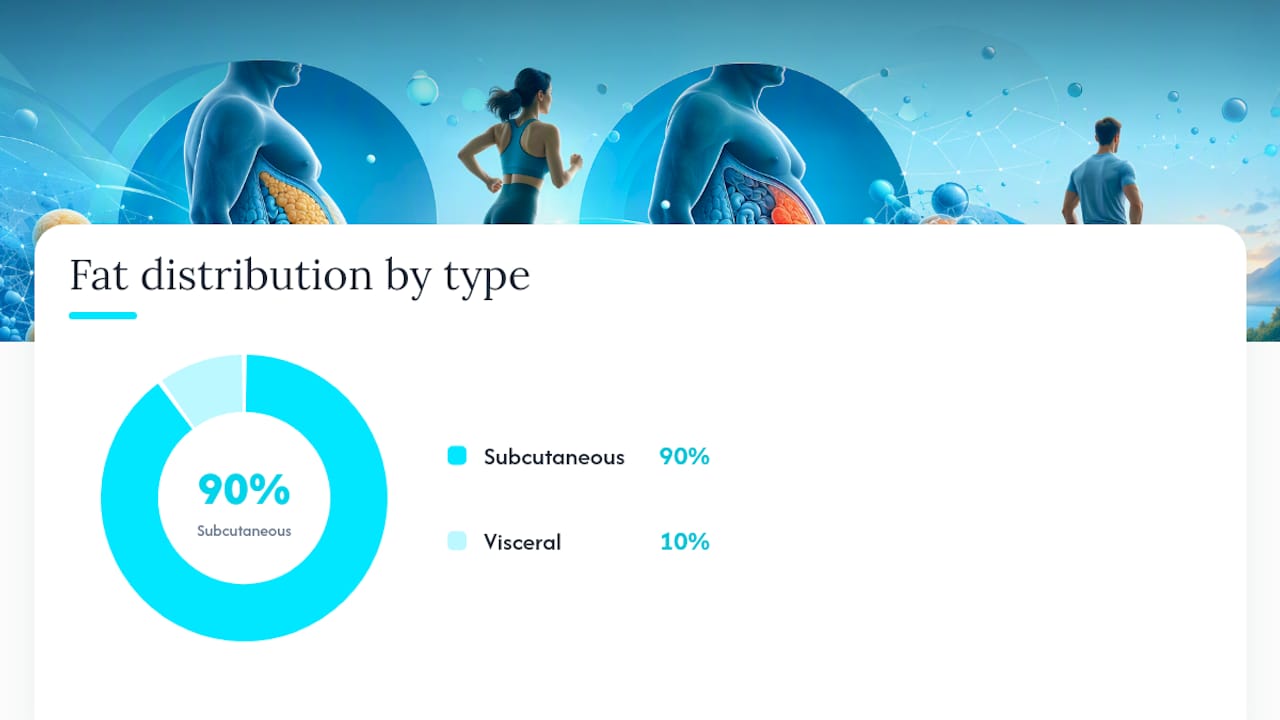
Most people carry roughly 10% of their total body fat as visceral fat, with the remaining 90% distributed subcutaneously, according to Cleveland Clinic. That ratio shifts with age, sex and genetics, but it explains why two people at the same weight can have wildly different metabolic profiles.
The functional gap matters more than the location:
- Subcutaneous fat mostly stores energy and provides insulation, with relatively low hormonal activity.
- Visceral fat behaves as an endocrine organ, secreting hormones and inflammatory signalling molecules.
- Visceral fat drains directly into the portal vein, sending its output straight to the liver.
- Subcutaneous fat’s output enters general circulation, diluting its systemic effect.
A useful shorthand from WebMD: subcutaneous fat is the fat you see, visceral fat is the fat you don’t, and it’s the one your doctor actually worries about.
Health risks of visceral fat vs subcutaneous fat
The mechanism behind visceral fat’s reputation isn’t mysterious once you understand portal circulation. Because visceral fat drains into the vein feeding your liver, the free fatty acids and inflammatory cytokines it releases hit your liver first and hardest, disrupting glucose regulation and lipid metabolism before the rest of your body even gets a look-in. Subcutaneous fat, by contrast, releases far less of this material and routes it through general circulation, where its impact is diluted.
That single anatomical quirk explains why visceral fat correlates strongly with a specific cluster of conditions:
- Type 2 diabetes — chronic exposure to visceral fat’s fatty acid output drives insulin resistance in the liver.
- Cardiovascular disease — inflammatory markers from visceral fat contribute to arterial damage and abnormal lipid profiles.
- Hypertension — visceral fat is linked to higher blood pressure independent of overall body weight.
- Non-alcoholic fatty liver disease (NAFLD) — the liver bears the brunt of portal-vein fatty acid delivery.
- Certain cancers — visceral adiposity is associated with elevated risk in some studies, likely via chronic inflammation.
Visceral fat produces a disproportionate share of the inflammatory cytokines and free fatty acids linked to cardiometabolic disease, even when it makes up a small fraction of total body fat. Subcutaneous fat isn’t harmless in excess, but it doesn’t carry the same direct metabolic signalling pathway to your liver, which is precisely why doctors treat waist size as a more useful risk indicator than weight alone.
How to measure visceral fat at home and in clinic
You cannot see visceral fat directly without imaging, but you can estimate your risk with tools that take seconds. Waist circumference is the simplest: measure around your bare abdomen at the level of your navel, standing relaxed, without pulling the tape tight. Generally, a measurement above 94cm for men or 80cm for women signals rising visceral fat risk, per widely used clinical thresholds referenced by Harvard Health.
Waist-to-hip ratio and waist-to-height ratio add context, particularly for people whose build makes a single waist number misleading. A waist-to-height ratio above 0.5 is a widely cited flag regardless of your height, which makes it more forgiving across different body frames than a fixed waist number alone.
| Method | What it measures | Accuracy | Practical use |
|---|---|---|---|
| Waist circumference | Overall abdominal size | Moderate, quick proxy | Home tracking, repeat monthly |
| Waist-to-height ratio | Risk relative to height | Moderate, more adjusted | Home tracking, useful across heights |
| DEXA scan | Fat distribution, bone and lean mass | High | Clinical, not routine screening |
| CT or MRI | Direct visceral fat volume | Highest | Research and specialist diagnosis only |
DEXA, CT and MRI give the most accurate visceral fat readings available, but cost, radiation exposure (CT), and limited availability mean they’re reserved for clinical or research settings rather than routine checks. If you want a plain-language breakdown of what a DEXA scan can and can’t tell you, this guide to DEXA scan accuracy is a solid starting point before booking one.
Does visceral fat or subcutaneous fat disappear first?
Visceral fat typically drops before subcutaneous fat once you start exercising and eating better, and there’s a biological reason for that. Visceral fat cells are more sensitive to adrenergic signalling, meaning they respond faster to the hormonal cascade triggered by exercise and calorie restriction than the more stubborn subcutaneous layer, according to Harvard Health. That’s genuinely good news: the fat doing the most damage is often the first to shrink.
The exercise evidence backs this up with real numbers. A 2026 network meta-analysis reviewing 61 randomised controlled trials involving 4,136 participants ranked exercise modalities by their effect on visceral adipose tissue, and the results were clear enough to act on:
- HIIT came out on top, achieving significant visceral fat reductions at a minimum effective dose of around 400 MET-minutes per week, roughly three short interval sessions.
- Aerobic exercise alone worked, but often required a higher weekly volume of MET-minutes to match HIIT’s results.
- Combined aerobic and resistance training also required that higher weekly volume, but delivered the added benefit of preserving lean muscle during fat loss.
- The overall minimum effective dose across all modalities was estimated at a moderate range of MET-minutes per week, giving you a rough benchmark regardless of which style you prefer.
Diet plays its part too, though the evidence there is less dose-dependent than exercise. Calorie restriction reduces visceral fat in randomised trials, but pairing a modest deficit with resistance training protects muscle mass far better than dieting alone. Sleep and stress deserve equal billing: poor sleep and chronic stress raise cortisol, which is directly linked to visceral fat accumulation, so a plan that ignores rest and stress management is working with one hand tied behind its back.
A practical plan to reduce visceral fat over three months
Visceral fat responds faster than most people expect, but the timeline still runs in weeks, not days. Here’s a realistic structure.
- Week one: Establish a baseline. Measure waist circumference, note your resting heart rate, and pick two to three HIIT sessions of 15 to 20 minutes, aiming for roughly 130 to 150 MET-minutes each.
- Weeks two to four: Build consistency toward the 400 MET-minute weekly threshold for HIIT, or mix in aerobic sessions if you prefer steadier effort, targeting the higher 1,100 MET-minute range across the week.
- Month two: Add two resistance training sessions weekly to protect muscle as your calorie intake drops. Keep protein intake generous, around 1.2 to 1.6g per kilogram of bodyweight, and prioritise fibre-rich vegetables over refined carbohydrates.
- Month three: Reassess waist circumference and waist-to-height ratio rather than scale weight alone, since muscle gain can mask fat loss on a standard scale.
Alongside training, tighten your nutrition basics: cut added sugar, keep a modest calorie deficit rather than an aggressive one, and treat sleep as non-negotiable training recovery. Seven to nine hours, a consistent bedtime, and even ten minutes of daily breathing or stretching to manage stress all measurably support visceral fat loss.
Pro Tip: Track your waist measurement at the same time of day, ideally first thing in the morning before eating, and log the trend over four-week blocks rather than obsessing over daily fluctuations.
Community-based programmes can help with the accountability side of week one and two. A structured option like this virtual walking challenge gives you a simple way to bank aerobic minutes without needing a gym.
Tracking metrics that actually predict visceral fat loss
Consumer wearables can’t image visceral fat the way a CT scan can, but they’re genuinely useful for spotting trends between clinical check-ins. The metrics worth watching:
- Waist circumference, measured weekly at the same time of day.
- Resting heart rate, which often drops as cardiovascular fitness improves.
- Sleep quality and duration, given the cortisol link to visceral fat.
- Weekly MET-minute accumulation from logged activity.
Body-composition estimates from consumer scales and bands vary in absolute accuracy, so treat any single reading as noise and the four-week trend as signal, a point research on visceral fat as an endocrine organ reinforces when discussing measurement limitations generally. A no-subscription wearable that logs sleep, heart rate and activity consistently removes one common barrier to sticking with this kind of tracking: the nagging sense that you’re paying monthly for data you could just as easily lose interest in.
What realistic progress looks like
Visceral fat loss rewards patience over intensity. Prioritise the metabolic markers, waist trend, resting heart rate, sleep quality, over how your stomach looks in a mirror, because the internal changes happen before the visible ones. Genetics and age shift how quickly any individual responds, so don’t benchmark your month-two waist measurement against someone else’s.
That said, some signs warrant a GP visit rather than another week of self-tracking: a waist circumference climbing rapidly without explanation, a waist-to-height ratio persistently above 0.6, or the combination of high blood pressure, raised blood sugar and abdominal obesity together. Those clusters deserve clinical review, not just a new training plan.
— Sam
Keeping tabs on your numbers without a subscription
Everything in this plan works better when you can see your own trend lines rather than guessing. There are wearables available that track sleep quality, resting heart rate, daily activity and body composition without charging monthly fees to view your data.
Some trackers lock detailed sleep and recovery insights behind subscriptions, but certain devices provide that data without recurring fees, which matters in months two and three of a visceral fat plan, when spotting a plateau early saves you weeks of guessing. The VOLTRA tracker covers the core metrics this article recommends watching: waist trend context alongside heart rate and sleep patterns in one app. Households tackling this together can look at the three-pack bundle for shared tracking without buying separate subscriptions per person. If you’re ready to start logging your baseline this week, the tracker page is the place to begin.
FAQ
Which fat is worse, visceral or subcutaneous?
Visceral fat is worse. It sits around your organs, drains into the liver via the portal vein, and releases far more inflammatory cytokines and free fatty acids than subcutaneous fat.
Which burns first, visceral fat or subcutaneous fat?
Visceral fat typically reduces first because it’s more sensitive to the hormonal signals triggered by exercise and calorie restriction, according to Harvard Health.
Is it easier to lose visceral fat than subcutaneous fat?
Generally yes. Visceral fat responds more readily to exercise and diet changes, while subcutaneous fat tends to shift more slowly and stubbornly over the same period.
What reduces visceral fat quickly?
HIIT produces measurable visceral fat reductions at around 400 MET-minutes per week, the fastest-acting modality identified in recent exercise research, though “quickly” still means weeks, not days.
How can I track visceral fat changes at home?
Track waist circumference weekly and pair it with resting heart rate and sleep data from a device like VOLTRA, watching the four-week trend rather than single-day readings.
Share:
Home Scales Systematically Read Low: Body Fat Percentage Accuracy
Cut 3–8 bpm From Your Resting Heart Rate With Tracking and Training