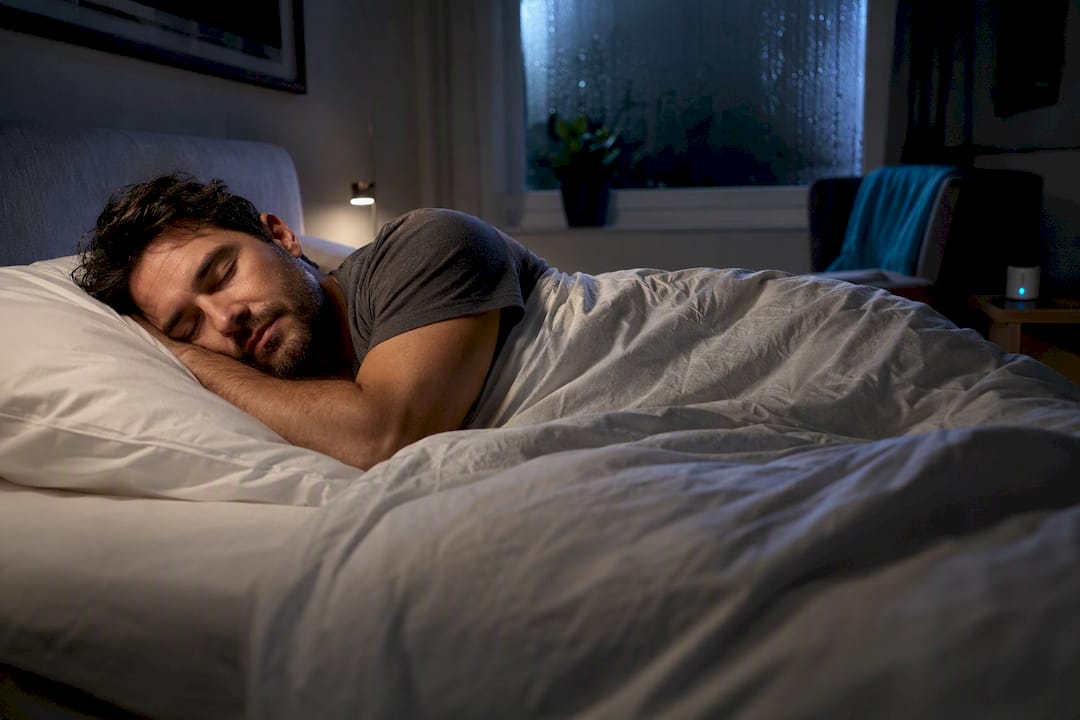
You can meaningfully increase deep sleep, but only indirectly. Deep sleep responds to total sleep time and a handful of behavioural levers, not willpower. The highest-yield move is protecting seven-plus hours with a fixed wake time, since deep sleep is front-loaded into the night and disappears when sleep gets cut short. Layer on a cool bedroom, correctly timed exercise, and an earlier caffeine and alcohol cutoff, and the gains compound. A few extras, like phase-locked pink noise or supervised sleep restriction therapy, show real laboratory evidence but need care or professional guidance to use well.
TL;DR:
- Protecting at least seven hours of sleep with a fixed wake time is the most effective way to increase deep sleep, as it concentrates in the early sleep hours.
- Lowering bedroom temperature to around 18 to 19°C and taking a warm bath before bed can boost deep sleep by facilitating core temperature drops and faster sleep onset.
- Timing exercise earlier in the day and avoiding caffeine six hours before bedtime significantly improve slow-wave sleep duration and quality.
- Wearables are more useful for tracking sleep trends over weeks rather than precise sleep stages, helping you assess the impact of behavioral changes accurately.
- If low deep sleep persists despite adjustments and is accompanied by symptoms like loud snoring or daytime sleepiness, a medical evaluation for sleep disorders such as sleep apnoea is advised.
Table of Contents
- What is deep sleep and why does it matter?
- Signs you’re not getting enough deep sleep
- How to increase deep sleep: a prioritised, practical playbook
- Tracking deep sleep: what wearables can and cannot tell you
- When is low deep sleep a medical problem?
- Why chasing a nightly score misses the point
- Test these changes with a device that doesn’t paywall your own data
- Sources
- FAQ
What is deep sleep and why does it matter?
Deep sleep, technically stage N3 or slow-wave sleep, is the stage where your brainwaves slow to their widest, most synchronised pattern of the night. It’s the stage your body seems to fight hardest to protect, and for good reason.
During N3, your body does its heaviest maintenance work. Growth hormone release peaks, tissue repair accelerates, immune function gets a boost, and your brain consolidates certain types of memory while clearing metabolic waste built up during waking hours. Miss it consistently and you feel it: sluggish mornings, foggier thinking, slower recovery from exercise or illness.
Timing matters as much as duration. Deep sleep clusters overwhelmingly in the first third of the night, with each sleep cycle after that leaning progressively more towards REM sleep. This is why a short night hits deep sleep disproportionately hard, and why going to bed even 45 minutes later can cost you more slow-wave sleep than the clock alone suggests.
A few reference points worth knowing:
- Adults typically spend 13 to 23% of total sleep in deep sleep, with most people landing around 15 to 20%.
- Deep sleep declines steadily with age, with a significant reduction seen between young and middle adulthood.
- Most of your deep sleep happens in the first two sleep cycles, generally occurring in the first several hours of sleep.
Signs you’re not getting enough deep sleep
Waking up tired after what looks like a full night on paper is the most common tell. Deep sleep deficiency shows up as a specific cluster of symptoms rather than generic tiredness.
Watch for:
- Persistent morning grogginess even after seven or eight hours in bed.
- Low energy that doesn’t lift once you’re up and moving.
- Slower thinking, poor concentration, or uncharacteristic clumsiness during the day.
- A wearable consistently flagging low deep sleep percentage or unusually fragmented sleep, night after night.
Single nights don’t mean much on their own, since deep sleep varies naturally with stress, alcohol, or a late meal. What matters is the trend over one to two weeks. If your average stays low despite decent sleep hygiene, something structural is likely going on.
Some signs point beyond lifestyle fixes and towards a clinical issue. Loud, disruptive snoring, witnessed breathing pauses, gasping during sleep, or severe daytime sleepiness despite adequate time in bed all warrant a conversation with a doctor rather than another week of self-experimentation.
How to increase deep sleep: a prioritised, practical playbook
Not every deep sleep tactic is worth the same effort. Some changes move the needle substantially; others are marginal polish. Here’s a sequence built around likely effect size, starting with what actually works.
1. Protect total sleep time and fix your wake time. This is the foundation everything else sits on. Because deep sleep concentrates early in the night, cutting sleep short doesn’t just remove REM at the end. It disproportionately steals slow-wave sleep. A consistent wake time, seven days a week, anchors your circadian rhythm and makes every other intervention on this list more effective. Aim for at least seven hours before touching anything else.
2. Get your bedroom to around 18 to 19°C. Your body needs to drop core temperature by roughly 1 to 1.5°C from its daytime peak to initiate slow-wave sleep. A room that’s too warm blocks this. The Sleep Foundation recommends 18.3°C (65°F) as close to optimal for most adults, though personal tolerance varies by a degree or two.
3. Take a warm bath or shower 60 to 90 minutes before bed. This sounds contradictory, but it works with your physiology rather than against it. Warming the skin causes peripheral vasodilation, blood vessels near the surface widen, which accelerates heat loss once you get out. That rapid cooling afterwards is what nudges the body towards sleep onset faster and appears to support deep sleep measures in trial data.

4. Time exercise for 4 to 6 hours before bed, earlier if possible. Regular moderate-to-vigorous exercise increases slow-wave sleep by roughly 10 to 15 minutes a night according to meta-analytic data, but timing dictates whether you get that benefit or pay for it in delayed sleep onset. Morning or early afternoon sessions are safest. A hard evening workout can raise core temperature and adrenaline right when you need both falling.
5. Cut caffeine at least six hours before bed. This one surprises people because it feels conservative. It shouldn’t. Caffeine consumed even six hours before bedtime can cut total sleep time by more than an hour and disrupt sleep architecture, including the deep stages. Slow caffeine metabolisers, a meaningful chunk of the population, may need an even earlier cutoff.
Statistic Callout: A single afternoon coffee consumed six hours before bed can cost you over an hour of total sleep, according to a systematic review of controlled caffeine studies. That’s a bigger effect than most people assume from “just one cup.”
6. Avoid alcohol close to bedtime. Alcohol’s reputation as a sleep aid is one of the more persistent myths in this space. It does increase early slow-wave sleep, briefly, by raising adenosine levels. But it fragments the second half of the night and suppresses REM sleep, leaving you with a shallower, choppier night overall. A nightcap trades short-term drowsiness for worse sleep quality three or four hours later.
7. Manage light exposure deliberately. Bright light in the morning, ideally natural daylight within the first hour of waking, helps anchor your circadian clock and strengthens the pressure for deep sleep later that night. In the evening, dim household lights and reduce blue light exposure for the 60 minutes before bed. A warm-toned lamp or a screen light filter in the evening makes this easier to maintain without giving up your phone entirely.
8. Consider acoustic stimulation, with realistic expectations. Phase-locked pink noise, sound pulses timed to your brain’s slow-wave rhythm, has produced 8 to 18% increases in slow-wave activity in small lab trials. That’s a genuinely interesting signal, but it comes from small, controlled samples using specialised equipment, not consumer sleep apps playing generic white noise. Treat it as promising rather than proven for home use.
9. Be cautious with supplements. Magnesium glycinate and glycine have some supporting evidence for improving sleep quality, though the research base is thinner than for the behavioural steps above. Melatonin is worth naming explicitly because people misunderstand it: it shifts sleep timing, helping you fall asleep at the right point in your circadian cycle, but it doesn’t directly increase deep sleep. Sedatives and sleeping tablets can actually reduce time spent in slow-wave sleep even as they knock you out faster.
Pro Tip: Change one variable a week, not five at once. If you overhaul your bedroom temperature, exercise timing, and caffeine cutoff simultaneously, you’ll have no idea which change actually worked when your numbers improve.
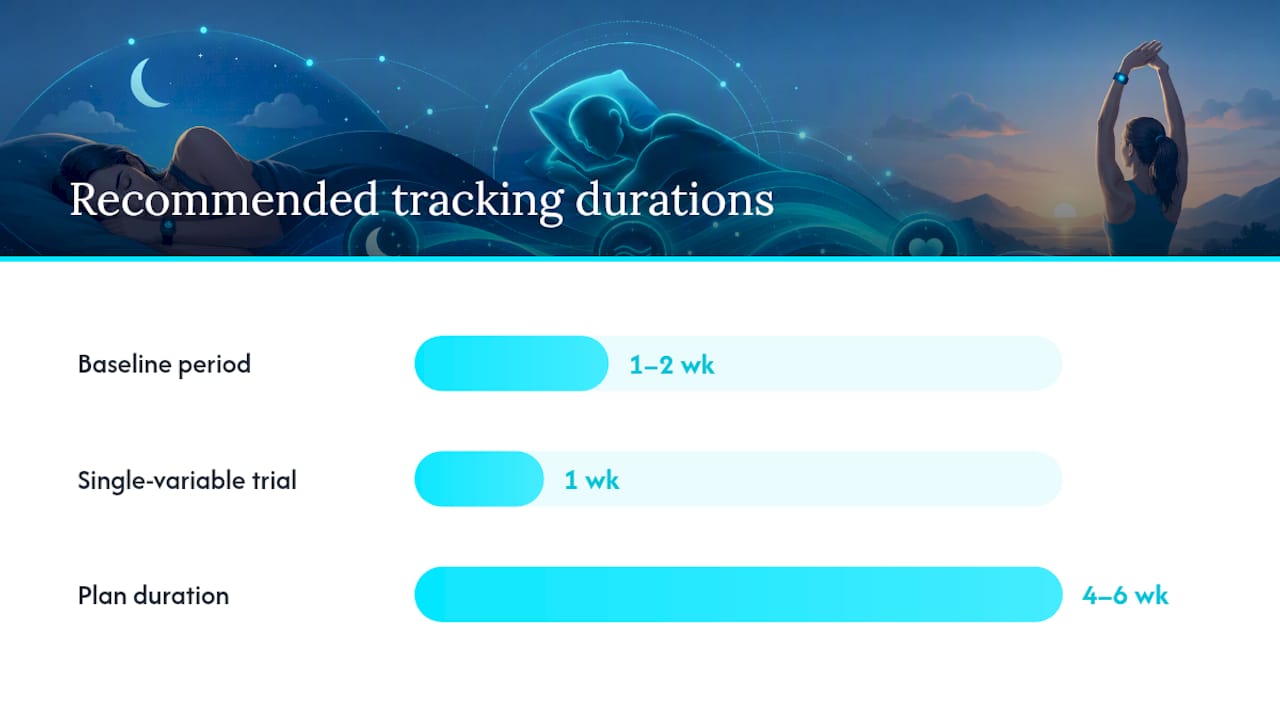
Run this as a genuine 4 to 6 week experiment. Week one, get a baseline with your current habits unchanged. Week two, fix your wake time. Week three, add the temperature and bath routine. Week four, adjust exercise timing. Week five, tackle caffeine and alcohol.
Tracking deep sleep: what wearables can and cannot tell you
Consumer wearables are genuinely good at one thing: distinguishing sleep from wake. They’re considerably less reliable when it comes to precisely classifying which sleep stage you’re in at any given moment. Research comparing consumer devices against EEG find staging accuracy falls well short of clinical polysomnography, the gold-standard test that measures brainwaves directly.
That doesn’t make tracking useless. It changes how you should use it.
- Establish a one to two week baseline before changing anything, so you have something real to compare against.
- Change one variable at a time and give it a full week before judging the result.
- Compare weekly averages for total sleep duration and fragmentation, not the nightly deep sleep percentage your app flashes each morning.
- Watch trends over weeks, not single nights, which is where wearable data earns its keep.
This is exactly the kind of low-friction experiment a device like VOLTRA AIR supports well: no subscription blocking your access to the sleep and recovery data you need to actually run the four to six week plan above.
Pro Tip: If your tracker’s nightly deep sleep score starts dictating your mood before breakfast, that’s a sign to check weekly averages instead and close the app. Fixating on a single night’s number is the fastest route to sleep anxiety, sometimes called orthosomnia, which paradoxically makes sleep worse.
When is low deep sleep a medical problem?
Behavioural fixes solve most cases. But certain patterns point towards a diagnosable sleep disorder rather than a habit problem, and no amount of bedroom temperature tweaking will fix those.
Seek a clinical assessment if you notice:
- Loud snoring combined with witnessed breathing pauses or gasping during sleep.
- Severe daytime sleepiness despite a consistent seven to eight hours in bed.
- Unrefreshing sleep that persists for weeks even after you’ve genuinely tried the behavioural changes above.
- Frequent nighttime waking with no clear cause.
A GP visit typically starts with a screening questionnaire, followed by a home sleep apnoea test or, in more complex cases, lab-based polysomnography if obstructive sleep apnoea is suspected. Treatment pathways diverge from there: CPAP therapy for confirmed sleep apnoea, and CBT-I (cognitive behavioural therapy for insomnia) or supervised sleep restriction therapy for chronic insomnia. Sleep restriction sounds counterintuitive, deliberately limiting time in bed to consolidate sleep, but it’s a legitimate, evidence-based treatment when run under professional guidance rather than attempted alone.
Why chasing a nightly score misses the point
Deep sleep isn’t something you can summon through effort. Your body prioritises it automatically after periods of deprivation, which is why a rough week is often followed by a night of unusually deep, heavy sleep with no extra intervention required. That rebound effect tells you something important: the goal isn’t to “hack” a percentage on an app. It’s to create the conditions, enough total sleep, a cool room, sensible timing, that let your body do what it already knows how to do.
I’d argue the biggest mistake health-conscious readers make is treating a tracker’s overnight score as a verdict on their health rather than as one noisy data point in a longer trend. A single night below your average means very little.
Free, real-time access to that data matters more than people assume, because subscription paywalls discourage exactly the kind of week-over-week comparison this whole approach depends on. If checking your trend costs nothing, you’re far more likely to actually run the experiment properly instead of giving up after four days.
Use monitoring as a diagnostic tool, not a report card. That distinction is the whole game here.
— Sam
Test these changes with a device that doesn’t paywall your own data
There are apps and wearables that lock your sleep stage history behind a monthly fee, which makes running a proper four to six week experiment expensive before you’ve even changed a habit. Voltrahealth’s approach is different: VOLTRA AIR gives you free lifetime access to sleep, recovery, and heart health metrics with no recurring charges, so you can track baseline nights, adjust one variable a week, and compare your averages without watching a subscription clock run alongside your sleep clock.
Setting up the experiment is straightforward: wear the device for a two-week baseline, then work through the temperature, exercise timing, and caffeine adjustments above one at a time, checking your weekly trend rather than any single night. For households running this experiment together, the 5 x VOLTRA bundle covers multiple people without buying devices separately. And if what your data shows points towards something beyond lifestyle, loud snoring, breathing pauses, sleepiness that doesn’t lift, that’s the moment to take it to a doctor rather than another week of tracking. Ready to see your own trend? Get VOLTRA AIR and start your baseline tonight.
This article is general information, not a substitute for advice from a qualified doctor. Consult a qualified healthcare professional about your own circumstances before acting on anything here.
Sources
- The effect of caffeine on subsequent sleep: a systematic review and meta-analysis (Coffee & Health summary)
- Papalambros et al., 2017 — acoustic stimulation and slow waves (PMC5340797)
- Warm bath timing and sleep (PubMed reference)
- Kredlow et al. — exercise and sleep (meta-analysis)
- Are sleep trackers accurate? (Neuroscience commentary)
FAQ
Why is my deep sleep so low?
Low deep sleep usually traces back to short total sleep time, an irregular wake schedule, late caffeine or alcohol, high stress, or age-related decline. Persistent low readings despite good habits can point to an underlying sleep disorder worth checking with a doctor.
Is 47 minutes of deep sleep good?
Forty-seven minutes is reasonable for someone sleeping around four to five hours of deep-sleep-relevant cycles, but it’s below average if your total sleep time is seven-plus hours.
What prevents deep sleep?
The biggest disruptors are insufficient total sleep, a warm bedroom, late caffeine, alcohol close to bedtime, irregular sleep schedules, and untreated sleep disorders like obstructive sleep apnoea. Chronic stress and elevated cortisol also interfere with slow-wave sleep onset.
I have high REM sleep but low deep sleep. Is this normal?
This pattern often reflects a shortened or delayed sleep window, since deep sleep concentrates early in the night while REM builds towards the morning. It can also happen with alcohol use, which suppresses deep sleep more than REM in the second half of the night, or simply with age, as older adults naturally lose more slow-wave sleep than REM.
Can a wearable like Voltra actually help me increase deep sleep?
A wearable can’t add deep sleep directly, but it can show whether your changes, like an earlier caffeine cutoff or a cooler bedroom, are moving your weekly averages in the right direction. Voltra’s free, subscription-free access to that trend data makes it practical to run a real multi-week test.
Share:
Cut 3–8 bpm From Your Resting Heart Rate With Tracking and Training
Track Muscle Mass Percentage Right: See Real Gains in 4–6 Weeks