

Heart rate variability responds to lifestyle changes faster than most people expect. Cut alcohol, practise resonance breathing at six breaths per minute, and maintain a consistent sleep schedule. Changes in rolling average HRV may be observable within a few weeks, with further improvements from structured exercise and stress management building over several months. Track multi-day rolling averages, such as weekly or monthly, rather than daily readings, because single-night dips often reflect random variation rather than meaningful change.
TL;DR:
- Reducing alcohol intake can significantly improve HRV within days to weeks, with ongoing benefits from consistent sleep, exercise, and stress management.
- Tracking seven to thirty-day rolling averages of HRV provides a clearer picture of health improvements than daily readings, which are often affected by random variation.
- High-intensity interval training and resistance workouts boost HRV in the short term, but overtraining can cause levels to drop, so balance and recovery are essential.
- Consistent sleep habits, especially keeping a cool, dark, and screen-free environment before bed, greatly enhance overnight HRV improvement.
- Cutting alcohol has the greatest immediate impact, while addressing sleep and hydration supports long-term baseline increases in HRV.
Table of Contents
- What higher HRV actually tells you about your body
- Common reasons your HRV is low, and when it’s a red flag
- Where to start: the priority order that saves you time
- Sleep habits that move the needle on HRV
- Training smart: which workouts raise HRV and which ones tank it
- Breathing and mindfulness practices that shift HRV within minutes
- Alcohol, hydration and food: the dietary changes with the biggest payoff
- Cold exposure and biofeedback: what’s proven and what’s still experimental
- Getting an accurate reading: devices, metrics and timing
- What to expect and when: a realistic timeline
- How consistent tracking turns HRV changes into evidence
- Why most HRV advice misses the obvious lever
- Track your own HRV data without paying for the privilege
- Where to read more on HRV and exercise research
- Sources
What higher HRV actually tells you about your body
HRV measures the variation in time between your heartbeats, and that variation reflects the tug-of-war between your sympathetic nervous system (fight-or-flight) and your parasympathetic system (rest-and-digest). A higher number generally means your nervous system shifts flexibly between the two. A flat, low number often means it’s stuck in overdrive.
This matters because HRV isn’t just a curiosity metric. It correlates with how well you recover from a hard training session, how your body handles a stressful week at work, and how resilient your immune system is when illness strikes. Higher HRV tends to track with better sleep architecture, faster recovery between workouts, and a nervous system that copes with life’s curveballs without staying wound up for hours afterwards.
The comparison that actually matters is the one against yourself. HRV is shaped by age, sex, genetics, and baseline fitness, so a reading of 40ms means something completely different for a 25-year-old marathon runner than for a 55-year-old office worker. Chasing someone else’s number is a waste of energy.
What to watch instead:
- Your own 7 to 30 day rolling average, not any single night’s figure.
- Whether that average trends upward over weeks, not days.
- How your HRV responds after specific changes, like a poor night’s sleep or a heavy training block.
- Context markers such as resting heart rate and sleep duration alongside HRV, since they tell a fuller story together.
Common reasons your HRV is low, and when it’s a red flag
Most low HRV readings have a boring, fixable explanation. A handful point to something that needs medical attention.
Short-term (acute) causes are usually the easiest to spot once you look for them:
- A poor night’s sleep, even one, can suppress next-morning HRV noticeably.
- Alcohol, which blunts nocturnal parasympathetic activity for more than a single night.
- Dehydration, which forces the heart to work harder to maintain blood pressure.
- A heavy training session in the past 24 to 48 hours that hasn’t been fully absorbed.
- Illness, including the early, symptomless stage of a cold or flu, when HRV often drops before you feel unwell.
Chronic, longer-running causes are worth taking seriously because they don’t resolve with one good night’s sleep. Sleep apnoea is a major one. Interrupted breathing during sleep repeatedly triggers stress responses that suppress HRV, often without the person realising they have a problem beyond feeling tired. Chronic low-grade inflammation, certain medications (particularly beta-blockers, though the effect there is expected rather than a fault), and unmanaged chronic stress all keep HRV pinned low over months rather than days.
The red flag to know: if your HRV stays persistently and unusually low despite good sleep, no alcohol, and manageable stress, and it comes with symptoms like unexplained fatigue, palpitations, or breathlessness, that’s worth a conversation with your GP rather than another lifestyle tweak.
Where to start: the priority order that saves you time
Don’t try to fix everything at once. Cut alcohol first, as it strongly suppresses HRV, and reducing intake tends to produce a noticeable improvement within days to weeks. Then fix sleep regularity, adjust training load, add breathing practice, and finally dial in hydration and nutrition. Track each change for at least a week before judging it.
Sleep habits that move the needle on HRV
Sleep is the single biggest lever most people underuse, and it responds faster to changes in HRV during sleep tracking than almost anything else on this list.
The foundation is consistency, not duration alone. Establishing a consistent bedtime and wake-up time daily, including weekends, supports circadian rhythm regularity to hand your body over to deep, parasympathetic-dominant sleep stages more efficiently. Aim for sufficient sleep, generally around seven to nine hours. Waking naturally without an alarm most mornings is a decent sign you’re in that range.
Three environmental factors do most of the heavy lifting:
- Temperature. A cool bedroom temperature within a moderate range supports the natural body temperature drop that triggers deeper sleep stages, where HRV tends to peak overnight.
- Light control. Total darkness, or as close as you can get, keeps melatonin production uninterrupted. Blackout curtains or an eye mask are cheap fixes with outsized effects.
- Screen timing. Stopping screens 60 minutes before bed reduces blue light exposure that can delay melatonin release and fragment early sleep. The research on blue light and sleep backs up what most people already suspect: the glow from a phone at midnight isn’t neutral.
Avoid large meals and alcohol close to bedtime. Both force your digestive and cardiovascular systems to keep working when they should be winding down, which shows up directly as suppressed overnight HRV.
Pro Tip: If your sleep habits are solid, seven to nine hours, consistent schedule, cool dark room, and your HRV still won’t budge, ask your GP about screening for sleep apnoea. It’s a common, under-diagnosed cause of stubbornly low HRV even in people who feel like they’re doing everything right.
Training smart: which workouts raise HRV and which ones tank it
Exercise is one of the best-evidenced ways to raise HRV, but the type of exercise matters more than most training plans admit. A 2024 meta-analysis of 16 randomised controlled trials found structured exercise training improved SDNN, RMSSD, and HF power across healthy adults, with the biggest gains showing up in RMSSD and HF, the metrics most tied to parasympathetic (vagal) activity.
Not all training modalities work the same way. A network meta-analysis of 29 trials covering over 1,300 participants ranked high-intensity interval training top for improving SDNN and RMSSD, while resistance training came out ahead specifically for HF power. Steady aerobic work, the zone 2 pace where you can hold a conversation but not sing, builds vagal tone over time even though its short-term SDNN gains are less dramatic than HIIT’s.
A weekly structure that balances these without overreaching:
- Two HIIT sessions (20 to 25 minutes, intervals like 4x4 minutes hard with equal recovery).
- One resistance session focused on compound lifts.
- Two zone 2 aerobic sessions (30 to 45 minutes, easy pace).
- At least one full rest day, more if your rolling HRV average is trending down.
The catch with HIIT is that it’s a double-edged sword. It produces some of the fastest short-term SDNN and RMSSD gains, but stacked too frequently without adequate recovery, it becomes a net HRV suppressor rather than a booster. If your morning HRV drops over multiple consecutive days after intense sessions, it may indicate a need to reduce training intensity or volume for recovery.
Pro Tip: Use your HRV trend as a coaching signal, not a scoreboard. A dip after one tough session is expected. A sustained slide over five to seven days means it’s time to swap a HIIT session for a walk.
Breathing and mindfulness practices that shift HRV within minutes
Resonance breathing is the fastest acute lever you have, and it costs nothing but attention.
- Breathe at roughly six breaths per minute: a five-second inhale, five-second exhale, no pause between.
- Practise for 5 to 20 minutes, ideally at the same time daily so it becomes a habit rather than an emergency tool.
- Notice the immediate effect. Most people see a visible uptick in real-time HRV readings within the first few minutes of steady resonance breathing, as the paced rhythm synchronises with your natural respiratory sinus arrhythmia.
- Layer in daily mindfulness beyond the breathing itself: even ten minutes of seated meditation lowers baseline sympathetic drive over weeks.
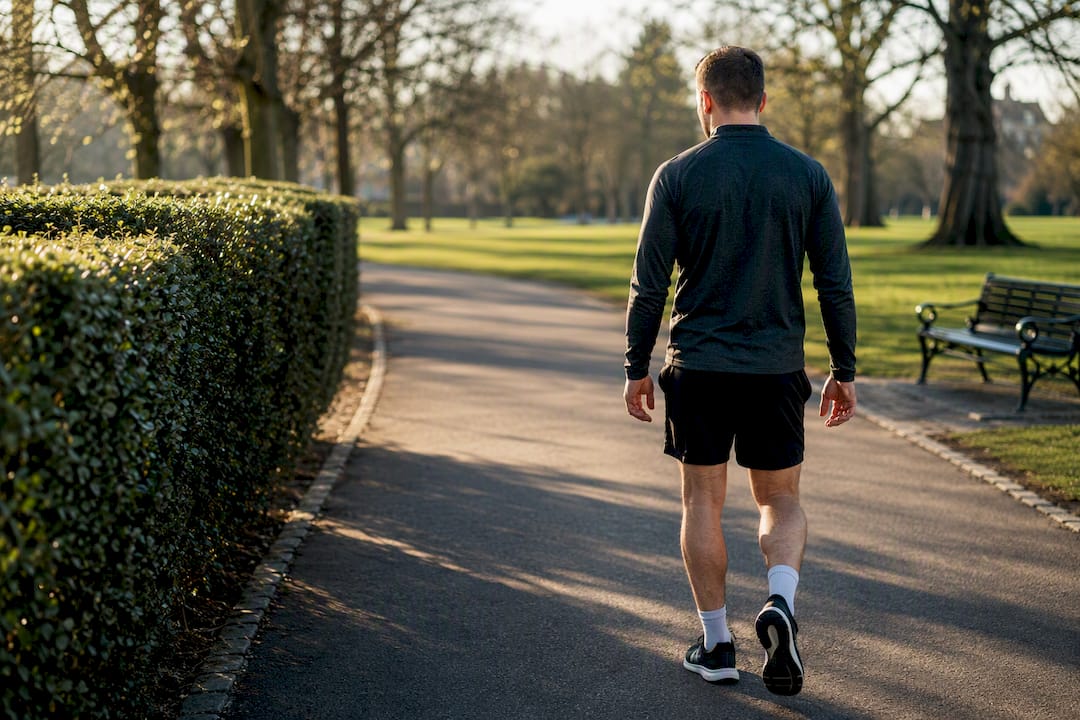
- Take short nature walks when you can. The combination of light physical movement, daylight exposure, and being away from screens has a cumulative calming effect that shows up in weekly HRV averages, even though no single walk will move the needle dramatically.
The trick for busy schedules is stacking these into moments you already have. Five minutes of resonance breathing before a meeting, or during a commute, adds up over a month more than a single 20-minute session you skip half the time.
Alcohol, hydration and food: the dietary changes with the biggest payoff
Alcohol is the single strongest dietary suppressor of HRV on this list, and it’s the one most people underestimate. It disrupts nocturnal parasympathetic activity for more than just the night you drink, and cutting it out, even briefly, tends to produce a noticeable rebound within days rather than weeks. If you’re only going to change one habit this month, this is the one with the fastest, most visible payoff.
Hydration has a smaller but real effect. Mild dehydration forces your cardiovascular system to compensate, which shows up as a modest but measurable dip in HRV. The fix is unglamorous: drink water consistently through the day rather than catching up late.
On supplementation, omega-3 fatty acids have the most consistent evidence behind them. Reviews of omega-3 and autonomic function show modest but repeatable HRV improvements with 1 to 2 grams of combined EPA and DHA daily, typically visible after four to eight weeks. A food-first approach, oily fish like salmon, mackerel or sardines two to three times weekly, gets you most of the way there without a supplement aisle.
- Cut or reduce alcohol first; expect a rebound in days, not weeks.
- Drink water consistently rather than in large catch-up doses.
- Eat oily fish two to three times weekly, or supplement with 1 to 2g EPA+DHA daily.
- Favour anti-inflammatory whole foods over ultra-processed options, since chronic inflammation is one of the quieter, chronic suppressors of HRV.
Cold exposure and biofeedback: what’s proven and what’s still experimental
HRV biofeedback, using real-time HRV data to train yourself into resonance breathing patterns, has a genuine evidence base. Typical protocols run 10 to 20 minutes per session, several times weekly, with measurable improvements in baseline HRV showing up over four to ten weeks of consistent practice.
Cold exposure works through a different mechanism: brief cold showers or face immersion trigger the diving reflex, a parasympathetic surge that evolved to conserve oxygen underwater. Short, controlled exposure (30 to 60 seconds of cold water on the face or a brief cold shower) can produce an acute HRV bump, and repeated practice may build longer-term adaptation, though the evidence here is less robust than for exercise or breathing.
- Start biofeedback sessions at 10 minutes, building to 20, three to four times weekly.
- Try 30 to 60 second cold exposures rather than jumping straight to ice baths.
- Track your response for at least two weeks before deciding if cold exposure suits you.
- Treat auricular vagus nerve stimulation as an emerging, adjunctive option rather than a substitute for sleep, exercise or breathing basics.
One thing worth flagging plainly: roughly a third of people find cold exposure genuinely uncomfortable enough to abandon it within the first fortnight, which is why starting with brief, tolerable doses matters more than intensity.
Getting an accurate reading: devices, metrics and timing
Bad measurement habits cause more false alarms than bad HRV itself. The single biggest mistake is judging your trend from one night’s number.
- Take readings overnight or first thing in the morning, before caffeine, food or a stressful email.
- Compare 7 to 30 day rolling averages against each other, not one day against the last.
- Watch RMSSD (short-term, parasympathetic-linked variability) and SDNN (overall variability across a longer window) as your two core metrics.
- Expect device-to-device differences; consistency in when and how you measure matters more than which brand you use.
- Don’t panic over one low reading. Clinical guidance from Mayo Clinic Press is consistent on this: single-day HRV numbers are noisy, and only sustained multi-week trends carry real meaning.
A tracker worn consistently overnight, rather than one you forget to charge twice a week, will give you a cleaner rolling average than a more “accurate” device used inconsistently.
What to expect and when: a realistic timeline
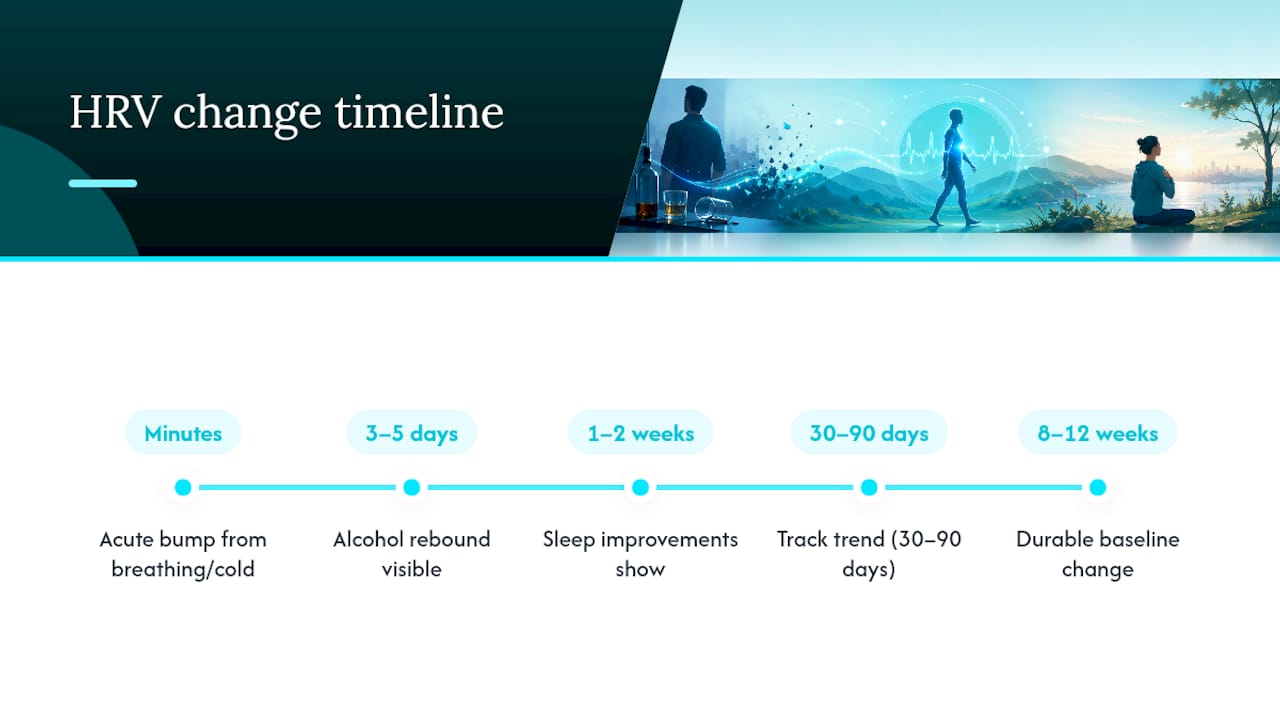
Some changes show up almost immediately. Resonance breathing and cold exposure can shift your HRV reading within minutes, though that’s an acute bump, not a baseline change. Cutting alcohol tends to produce a visible rebound within three to five days. Sleep improvements often show within one to two weeks.
Real baseline change, the kind that holds up in your 30-day rolling average, typically takes eight to twelve weeks of consistent sleep, training and stress habits. Run it as a proper experiment: pick one change, track for 30 to 90 days, and judge only the trend line, not any single week.
How consistent tracking turns HRV changes into evidence
Running a 30 to 90 day HRV experiment only works if the data behind it is actually there every single day. That’s the practical argument for a device you’ll wear consistently rather than one you keep unplugged in a drawer because the subscription lapsed.
This system was built around that exact gap: continuous tracking of HRV, sleep, and recovery metrics without a recurring fee getting in the way of long-term data. When you’re testing whether cutting alcohol for a month actually moved your RMSSD, or whether switching two HIIT sessions for zone 2 walks changed your recovery trend, you need unbroken data across the full window, not a partial month because access got cut off.
A few reasons this matters in practice:
- Many users have tracked their metrics through this app-based system.
- Early data shows a large majority reporting improved sleep quality within the first 14 days, a metric directly tied to overnight HRV.
- No subscription means a 90-day experiment costs nothing beyond the initial device.
- Menstrual cycle tracking is built in, relevant since hormonal shifts across the cycle measurably affect HRV baselines for many women.
Why most HRV advice misses the obvious lever
The pragmatic mistake people make with HRV is chasing the interesting stuff, cold plunges, breathing apps, expensive supplements, before fixing the boring stuff. Alcohol and sleep regularity do more for your baseline in a month than any biofeedback gadget will do in a year.
Start with one measurable change. Not five. Pick the one costing you the most, usually alcohol or sleep timing, and track it alone for 30 days before adding anything else. Use your device to inform decisions, not to judge your worth on a bad night. A single low reading after a rough sleep means nothing; a three-week downward trend means something.
If your numbers stay stubbornly low despite doing the basics well, that’s not a training problem anymore. See a GP, particularly if it comes with fatigue, breathlessness or palpitations.
— Sam
Track your own HRV data without paying for the privilege
Most HRV apps lock your own trend data behind a monthly fee, which makes a genuine 90-day experiment expensive before you’ve even started. Voltrahealth takes a different approach: buy the device once, and every metric it tracks, HRV, sleep stages, recovery, stays fully accessible for as long as you own it.

That matters for exactly the kind of experiment this article has walked through. Cutting alcohol for a month, shifting your training split, tightening your sleep window, none of it is worth testing if you lose access to the data halfway through. The Voltra tracker gives you continuous overnight HRV readings and rolling averages without a subscription wall, and the Voltra Air is worth a look if you want something lighter for consistent overnight wear, since comfort is often the difference between a tracker you actually sleep in and one that ends up in a drawer.
If persistent low readings come with fatigue or breathlessness, see a GP rather than relying on a device alone. For everyone else running a genuine 30 to 90 day HRV improvement plan, check the current bundle options and get tracking from tonight.
Where to read more on HRV and exercise research
The 2024 meta-analysis on exercise and HRV and the network meta-analysis on exercise modality are the strongest evidence base for training recommendations here. For breathing and cold exposure protocols, HRV Zone’s practical guide covers session structures in more depth than most fitness sites bother with.
This article is general information, not a substitute for advice from a qualified doctor. Consult a qualified healthcare professional about your own circumstances before acting on anything here.
Sources
- Effects of Exercise Training on Heart Rate Variability in Healthy Adults: A systematic review and meta-analysis (2024)
- Effect of exercise modality on heart rate variability in adults: systematic review and network meta-analysis
- Can tracking heart rate variability improve your health? — Mayo Clinic Press
Share:
Research Backed 7 Step Protocol for Bioimpedance Scale Accuracy
Home Scales Systematically Read Low: Body Fat Percentage Accuracy