Fat loss means losing body fat specifically, while weight loss means losing total mass, which can include fat, muscle and water. For both health and appearance, fat loss is usually the better goal, because it protects the muscle that keeps your metabolism and strength intact. The most reliable route combines resistance training, adequate protein and a moderate, sustained calorie deficit rather than a crash diet.
TL;DR:
- Losing fat while preserving muscle requires resistance training two to four times weekly and consuming roughly 1.2 to 2.0 grams of protein per kilogram of body weight daily.
- A moderate calorie deficit of about 500 kcal daily supports fat loss without excessive muscle breakdown, with a goal of losing 0.5 to 1 kg per week.
- Tracking progress through body measurements, photos, and strength levels offers a more accurate picture than relying solely on scale weight, which fluctuates from water and food.
- Combining resistance training with sufficient protein intake and a gradual pace minimizes muscle loss and metabolic slowdown during fat loss efforts.
- Body recomposition works best for beginners, those returning to training, or already lean individuals, while higher body fat levels generally benefit from dedicated weight loss phases.
Table of Contents
- What fat loss and weight loss actually mean
- How your body burns fat, and the myths that get it wrong
- Why weight loss often costs you muscle and water, not just fat
- How to lose fat without losing muscle: training, protein and pace
- How to measure progress without being misled by the scales
- Choosing between a weight-loss phase and body recomposition
- What wearables and smart scales can tell you about fat loss
- What most people get wrong about fat loss
- Tracking your own fat-loss trend day to day
- FAQ
- Sources
What fat loss and weight loss actually mean
The number on your scales reflects total body mass: fat, muscle, water, glycogen, bone and even the contents of your digestive system at that moment. Fat loss refers only to the reduction of fat mass, the tissue that stores excess energy. These two figures often move together, but not always, and conflating them is where most confusion about dieting starts.
Energy balance governs both. Eating fewer calories than you burn creates a deficit, and your body makes up the shortfall by breaking down stored fuel, mostly fat, but also some protein from muscle tissue if the deficit runs too deep or too long. The size of that deficit matters enormously for what gets lost. A moderate deficit tends to spare more muscle, while an aggressive one pushes your body to pull more heavily on lean tissue because fat stores alone cannot always meet the energy demand fast enough.
Several things can shift your scale weight within a day or two without any real change in fat:
- Carbohydrate intake, because each gram of stored glycogen holds roughly 3 grams of water alongside it.
- Sodium intake, which affects how much water your body retains.
- Hormonal fluctuations, particularly across the menstrual cycle.
- Recent meals or bowel movements, which add or remove physical mass temporarily.
- Intense training sessions, which can cause short-term water retention as muscles repair.
This is why a single weigh-in tells you very little. Someone eating a high-carbohydrate meal the night before stepping on the scales might see a jump of a kilogram or more that has nothing to do with fat gained. The same applies in reverse: a low-carbohydrate day or a sweat-heavy workout can make the scales dip without any genuine loss of body fat.
Understanding this distinction changes how you should interpret progress. If your only metric is total body weight, you are measuring a number influenced by dozens of short-term variables alongside the one you actually care about. Tracking body composition, even loosely through tape measurements, photos and how clothes fit, gives a much more honest picture of whether you are losing fat or simply losing water and food mass that will return within days.
How your body burns fat, and the myths that get it wrong
Fat loss happens through a process called lipolysis, where fat cells break down stored triglycerides into fatty acids and glycerol, releasing them into the bloodstream. Those fatty acids travel to tissues such as muscle, where they are oxidised, meaning broken down for energy inside the mitochondria. The end products of that process are carbon dioxide, which you exhale, and water, which leaves the body through urine, sweat and breath. In practical terms, you breathe out the vast majority of the fat you lose, a detail that surprises most people the first time they hear it.
This mechanism explains why two long-standing myths about fat loss do not hold up. The first is spot reduction, the idea that doing targeted exercises such as sit-ups or side bends will burn fat specifically from that area. Fatty acids released anywhere in the body enter a shared bloodstream and get used wherever the body’s tissues need the energy, not preferentially near the muscle you just worked. Where you lose fat first or last is determined largely by genetics and hormonal patterns, not by which exercises you choose.
The second myth is the claim that fat “turns into” muscle, or the reverse, that muscle turns into fat when you stop training. Fat and muscle are different types of tissue with entirely different cellular structures, and one cannot convert into the other. What actually happens when someone stops training and continues eating the same amount is that muscle may shrink from disuse while fat stores grow from the unchanged calorie surplus, giving the appearance of a swap that never truly occurred.
A further complication is metabolic adaptation, sometimes called adaptive thermogenesis. As you lose weight, your body requires fewer calories to function, partly because a smaller body burns less energy at rest, and partly because hormonal and neural signals shift to defend against further loss, nudging hunger up and spontaneous movement down. This is a normal physiological response, not a sign that something has gone wrong, but it does explain why progress that felt steady in the first few weeks of a diet often slows even when you have not changed anything about your approach. Recalculating your calorie needs periodically, rather than assuming the original numbers still apply months later, helps you work with this adaptation instead of being caught out by it.
Why weight loss often costs you muscle and water, not just fat
When you restrict calories without doing any resistance exercise, a meaningful share of the weight you lose is not fat. A 2026 PubMed systematic review and meta-analysis of 34 randomised controlled trials found that pairing calorie restriction with exercise prevented nearly 45.7% of the fat-free mass loss typically seen with dieting alone, with mixed and strength training producing the greatest benefit.

A 2026 meta-analysis of 34 RCTs found that exercise alongside calorie restriction prevented around 45.7% of the fat-free mass loss usually seen with diet alone. That figure captures why two people who lose the same amount of total weight can end up with very different results: one retains strength and muscle tone, the other looks and feels noticeably softer despite reaching the same number on the scales.
Several factors moderate how much lean tissue you risk losing during a diet. Deficit size is the most significant: a 2021 meta-analysis found that an energy deficit of roughly 500 kcal per day can prevent lean-mass gains from resistance training altogether, and that larger deficits impair lean-mass retention further still. Training status matters too, since people newer to resistance exercise tend to preserve or even build muscle in a deficit more easily than those who are already well trained. Age plays a role, as muscle-protein synthesis becomes less responsive with age, meaning older adults typically need to pay closer attention to training and protein intake to offset losses. Protein intake itself is one of the strongest levers available, and insufficient protein during a deficit accelerates muscle breakdown regardless of how much you train.
The practical consequence is straightforward: the faster you try to lose weight, the higher the proportion of that loss is likely to come from muscle rather than fat. Someone cutting calories aggressively to hit a short-term target, a wedding, a holiday, a competition, is trading long-term metabolic health for short-term speed. Muscle is metabolically active tissue, meaning it burns calories simply by existing, so losing it lowers your resting energy expenditure and makes the next attempt at fat loss harder, not easier. This is part of why so many people find that each successive diet feels less effective than the last, a pattern often described as metabolic damage but which is, more accurately, the cumulative effect of repeated muscle loss from overly aggressive deficits.
Gradual, moderate-paced weight loss combined with resistance training and sufficient protein is the approach Harvard Health recommends specifically to minimise this muscle loss, noting that rapid weight loss is the scenario most likely to sacrifice lean tissue. The lesson is not that fast weight loss is impossible, but that it reliably costs more muscle than a measured approach would, and that cost compounds the longer you repeat the cycle.
How to lose fat without losing muscle: training, protein and pace
Preserving muscle while losing fat is less about finding a secret method and more about getting three fundamentals right at the same time: resistance training, protein intake, and a sensible pace of loss. Each one reinforces the others, and skipping any single one undermines the whole strategy.
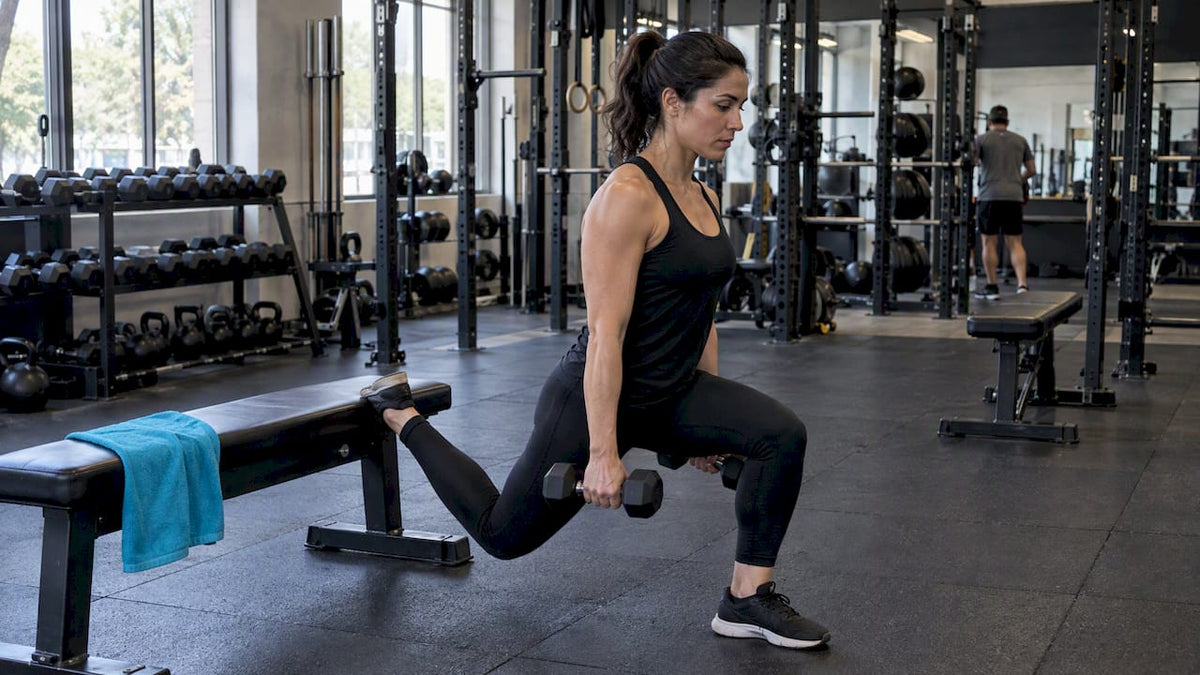
- Train with resistance two to four times per week, prioritising compound movements such as squats, deadlifts, presses and rows, and aim to progressively add weight, reps or sets over time rather than repeating the same session indefinitely; learn more about best practices for conditioning and movement to optimise your training.
- Hit a protein target that supports muscle retention. NHS guidance suggests roughly 80 to 100 grams of protein per day for the general population, rising to about 1.2 to 2.0 grams per kilogram of body weight for people doing regular resistance exercise, which for a 70 kg adult training several times a week works out to roughly 84 to 140 grams daily.
- Spread protein across three to four meals rather than loading it all into one, since this gives your muscles a steadier supply of amino acids throughout the day.
- Keep your deficit moderate. A deficit of around 500 kcal per day, rather than 1,000 or more, gives you a realistic shot at keeping resistance training effective, since the same 2021 meta-analysis found that deficits around this size were already enough to blunt lean-mass gains, with steeper cuts doing more damage still.
- Aim for a loss of about 0.5 to 1 kg per week. Harvard Health points to this range as a pace that allows fat loss to dominate over muscle loss, compared with the faster rates common on crash diets.
- Favour strength or mixed training over cardio alone. The evidence consistently shows resistance and mixed modalities protect lean mass better than steady-state cardio by itself, which, while useful for cardiovascular health and extra calorie burn, does little to signal your body to retain muscle.
Pro Tip: Weigh your protein-rich foods for a week to see what your actual intake looks like: most people underestimate it by a wide margin until they measure.
None of these steps work in isolation. Training without enough protein gives your muscles a reason to grow but not the raw material to do it. Enough protein without training removes the reason your body would bother keeping extra muscle at all. And an overly aggressive deficit can undermine both, since recovery and performance suffer when there is not enough fuel to support hard training sessions. Getting all three roughly right, rather than perfecting one and ignoring the others, is what separates people who finish a diet leaner and stronger from those who finish it simply smaller.
How to measure progress without being misled by the scales
Choosing the right way to track progress matters as much as choosing the right diet and training plan, because the wrong metric can make you quit a strategy that is actually working, or stick with one that is not. No single method is perfect, so combining a few gives a far more reliable picture than relying on any one of them alone.
- Scale weight is easy to track daily but fluctuates with water, food and hormones, so it should be read as a weekly or monthly average, never a single reading.
- Waist circumference, measured at the navel with a soft tape, tends to track fat loss around the midsection fairly closely and is cheap and simple to repeat consistently.
- Body-fat percentage via bioimpedance (BIA) scales offers a convenient trend indicator at home, though accuracy varies with hydration, recent food intake and even room temperature, so consistency in how and when you measure matters more than any single figure. Our guide to body fat percentage accuracy covers how to get more reliable readings from a home scale.
- DEXA scans give a far more precise breakdown of fat, muscle and bone, but they involve a cost and are usually done only every few months rather than as a routine tool.
- Progress photos, taken in consistent lighting, clothing and poses every few weeks, often reveal changes in shape and muscle definition before the scales or tape show much movement.
- Strength metrics, such as the weight you can lift for a given number of reps, are a strong indirect signal: maintaining or improving strength during a deficit suggests you are holding onto muscle even as the scale number falls.
The common thread across all of these is that trend lines beat single readings. A body-fat scale reading taken once after a weekend of restaurant meals and little sleep will not match a reading taken first thing in the morning after a normal week, and treating either as the definitive truth leads to false alarm or false confidence. Tracking the same measurement under the same conditions, then looking at the direction of travel over three or four weeks, filters out the daily noise and shows you what is actually happening to your body composition. Pairing an objective number, whether that is waist measurement or a body-fat trend, with a subjective check such as how your clothes fit or how a specific lift feels, tends to give the most trustworthy read on progress.
Choosing between a weight-loss phase and body recomposition
The right approach depends on where you are starting from, not on which method sounds more appealing. A focused weight-loss phase, built around a clear calorie deficit, tends to suit people carrying a higher level of body fat, where the immediate health gains from losing weight, better blood pressure, improved blood sugar control, reduced joint strain, outweigh the slower, more precise work of simultaneous muscle building. In this scenario, a moderate deficit paired with resistance training to protect lean mass is the sensible default, rather than chasing recomposition from a starting point where there is still substantial fat to lose.
Body recomposition, where you aim to lose fat and build or maintain muscle at roughly the same time, suits a different set of circumstances. It tends to work best for people new to resistance training, since their muscles respond readily to a new stimulus even while eating at a slight deficit or even maintenance. It also suits people returning to training after a break, who can often regain lost muscle relatively quickly even without a calorie surplus, and people who are already fairly lean and want to refine their shape rather than lose a large amount of weight. For these groups, chasing an aggressive weight-loss number is often counterproductive, since there is little spare fat to lose and an unnecessary deficit risks the muscle they are actually trying to build.
A practical hybrid exists between these two extremes. Cycling calories, eating slightly above maintenance on heavy training days and below it on rest days, can support both training performance and a weekly average deficit. Adjusting intake day to day based on activity level, rather than eating an identical amount every day regardless of what you did, tends to suit people with variable training schedules. Either way, recomposition is typically a slower process than a dedicated weight-loss phase, often taking several months to show clearly on the scales or a DEXA scan, so it suits readers who value a lasting change in body composition over readers chasing a number by a specific date.
What wearables and smart scales can tell you about fat loss
Tracking body composition trends alongside sleep, heart rate and activity gives useful context for a fat-loss effort, since recovery and stress both influence how your body responds to a deficit. Devices that track resting heart rate, heart rate variability and sleep quality, alongside body composition estimates from a smart scale, let you spot patterns, such as a stalled fat-loss trend that coincides with poor sleep or a rising stress signal.

The accuracy limits matter here. Consumer BIA scales and wearable calorie estimates are better suited to spotting trends over weeks than to pinpointing an exact body-fat percentage on any given day, and following a research-backed protocol for bioimpedance accuracy (measuring at the same time, in similar hydration states) improves consistency considerably. A sensible routine is a daily morning reading on the same device, a weekly average rather than daily obsessing, and cross-checking against a tape measurement and progress photos once a month.
What most people get wrong about fat loss
The biggest mistake is treating the scale number as the scoreboard rather than one noisy input among several. Readers who shift their attention to body composition and muscle preservation, rather than chasing the fastest possible drop in total weight, tend to end up leaner, stronger and better positioned to keep the result.
The second mistake is reaching for an extreme deficit out of impatience. It accelerates muscle loss, slows recovery and usually backfires within weeks through fatigue or a binge that undoes the progress. Resistance training and adequate protein throughout the process are not optional extras, they are what determines whether weight lost is fat or muscle.
Finally, expect months rather than weeks, and measure progress the same way each time. Switching methods or interpreting a single bad reading as failure is how good strategies get abandoned too early.
— Sam
Tracking your own fat-loss trend day to day
A device that shows body composition, recovery and sleep in one place takes some of the guesswork out of a fat-loss phase, particularly when you are trying to judge whether a stalled week is genuine or just noise. Our VOLTRA AIR, VOLTRA PRO and VOLTRA CORE collections track these metrics without any subscription fee, so the data stays available for as long as you own the device.

What these devices measure in practice:
- Body composition trends, including estimated fat mass and muscle mass over time, not just total weight.
- Heart rate variability, which can flag when poor recovery is affecting how your body is responding to a deficit.
- Sleep quality and duration, a factor that interacts closely with hunger, recovery and training performance.
None of this replaces a conversation with a doctor or dietitian if you have an underlying health condition, but used consistently, as a morning routine alongside a tape measure, the trend data gives a clearer read on fat loss than the scales alone. Browse the full VOLTRA range to find the option that suits your budget and goals.
This article is general information, not a substitute for advice from a qualified doctor. Consult a qualified healthcare professional about your own circumstances before acting on anything here.
FAQ
Which one is better, fat loss or weight loss?
Fat loss is generally the better goal, since it improves body composition and protects the muscle that keeps your metabolism and strength intact. Weight loss alone can include muscle and water, which may leave you lighter but not necessarily healthier or leaner looking.
What is the 30/30/30 rule for fat loss?
The 30/30/30 rule is a popular social-media framework suggesting adequate protein intake soon after waking, followed by morning low-intensity exercise. It is not an established clinical guideline, and the core principles it leans on, adequate protein and regular activity, matter far more than the specific numbers or timing.
How do I know I am losing fat?
Reliable signs include a shrinking waist measurement, clothes fitting looser around the midsection, maintained or improved strength in the gym, and a downward trend in body-fat percentage over several weeks rather than a single reading. Progress photos taken under consistent conditions often reveal these changes before the scales do.
Why do I look slimmer but weigh the same?
This usually means you have gained muscle while losing fat, a result known as body recomposition, since muscle is denser than fat and takes up less space for the same weight. It can also reflect reduced water retention or bloating, which changes how you look without changing your actual tissue composition.
Sources
- Effect of diet and exercise on preservation of fat-free mass during weight loss (PubMed)
- Resistance training in energy deficit impairs lean mass gains (PubMed)
- Dietary advice for people taking weight loss medicines – Food and nutrition | Guy’s and St Thomas’ NHS Foundation Trust
- Trying to lose weight? Be careful not to lose muscle | Harvard Health
Share:
One Minute 18 bpm Test for Heart Rate Recovery and UK Tracking
UK: Measure and Improve Metabolic Age in 2–3 Months With NHS Guidance