
Fitness tracker accuracy depends entirely on what you’re measuring. Step counts and resting heart rate tend to hold up well against research-grade equipment, often within 10% in free-living conditions. Energy expenditure and sleep-stage breakdowns are far less reliable, sometimes off by well over 100%. Treat single readings as noisy and trends over weeks as meaningful, and confirm anything clinically significant with a proper medical device.
TL;DR:
- Step counts are generally accurate within 10% during normal walking but can be significantly off when movement is slow or mobility aids are used.
- Resting heart rate readings are reliable, with an average error of around 2 bpm, but accuracy decreases during rapid transitions or intense activity.
- Energy expenditure estimates are frequently overestimated by over 25%, with no consumer device reliably maintaining errors below 20%.
- Sleep duration tracking is reasonably accurate, but sleep stage detection has only 50% to 65% agreement with polysomnography.
- Long-term trend data is most trustworthy when using a single device with consistent firmware, and subscriptions are unnecessary for reliable data access.
Table of Contents
- Fitness tracker accuracy by metric: steps, heart rate, calories and sleep
- What actually changes fitness tracker precision in daily life
- How to read your tracker’s numbers without getting misled
- Choosing a tracker that matches what you actually want to measure
- Where Voltrahealth fits into evidence-based tracking
- How do leading fitness tracker brands compare on accuracy?
- Does age or fitness level change how accurate your tracker is?
- Do app updates and syncing affect fitness tracker reliability?
- Simple ways to improve your fitness tracker’s accuracy
- Why wearables are worth trusting, and where they aren’t
- Get continuous trend data without the ongoing subscription cost
- Sources
- FAQ
Fitness tracker accuracy by metric: steps, heart rate, calories and sleep
Not all numbers on your wrist deserve the same trust. Some are genuinely close to lab-grade measurement. Others are closer to an educated guess dressed up in a clean graph.
Step counting: the strongest performer, with a catch
Steps are usually the most dependable output a wearable gives you, but only under normal walking conditions. A free-living comparison against a research-grade ActiGraph monitor found the Apple Watch and Oura Ring landed within 10% of the reference device on average, while Fitbit overestimated step counts by 18% in that sample.
That average hides a much bigger problem. Pushing a shopping trolley, using a walking frame, or shuffling around a kitchen barely moves your wrist, and wrist-based accelerometers rely on wrist motion to register a step. If you or someone you’re monitoring moves slowly or uses a mobility aid, treat the daily step count as a rough guide rather than a precise figure.
Heart rate: accurate at rest, shakier in transition
Wrist-based optical heart rate sensing, known as photoplethysmography or PPG, works by shining light into the skin and measuring how blood flow changes the light that bounces back. It’s a clever trick, and it performs well when your body is calm and your wrist is still.
A meta-analysis of Apple Watch studies found a pooled mean heart-rate bias of just −0.27 beats per minute, with resting MAPE (mean absolute percentage error) around 2 bpm in many studies. That sounds close to perfect. But the same review found limits of agreement stretching from roughly −7.2 to 6.6 bpm, meaning any individual reading could still be off by several beats even when the average across a population looks tight. Averages flatter the technology; individuals experience the spread.
Accuracy drops further during rapid changes, such as sprinting from a jog or standing up suddenly. A validation study of wearables under transient heart-rate states found per-second agreement worsens noticeably during fast transitions, and that wider averaging windows reduce the noise. This is why most trackers show a smoothed heart rate rather than a true beat-to-beat value during exercise.
Energy expenditure: the weakest link by a wide margin
Calorie counts are where consumer wearables consistently struggle most. Algorithms have to estimate energy expenditure from movement and heart rate data, a task that involves guessing at stride length, muscle efficiency, and metabolic rate, none of which the device can actually measure. Research summarised by Stanford Medicine found fitness trackers measured heart rate reasonably well but were far less reliable on calories burned, with the Apple Watch often overestimated energy expenditure significantly and Fitbit showed much larger overestimations in that work.
Statistic callout: Some validation work has found no consumer device consistently holding energy-expenditure error below 20%. If you’re using a tracker’s calorie burn to plan intake against a specific deficit, you’re building a diet plan on a number the device itself can’t pin down reliably.
Sleep: duration is fine, stages are not
Sleep tracking splits neatly into two tiers of trustworthiness. Total sleep time and basic sleep/wake detection are reasonably solid. A polysomnography validation meta-analysis found two-state sleep/wake agreement of roughly 86% to 89% across consumer devices, which is a genuinely useful figure for tracking how long you’re actually asleep each night.
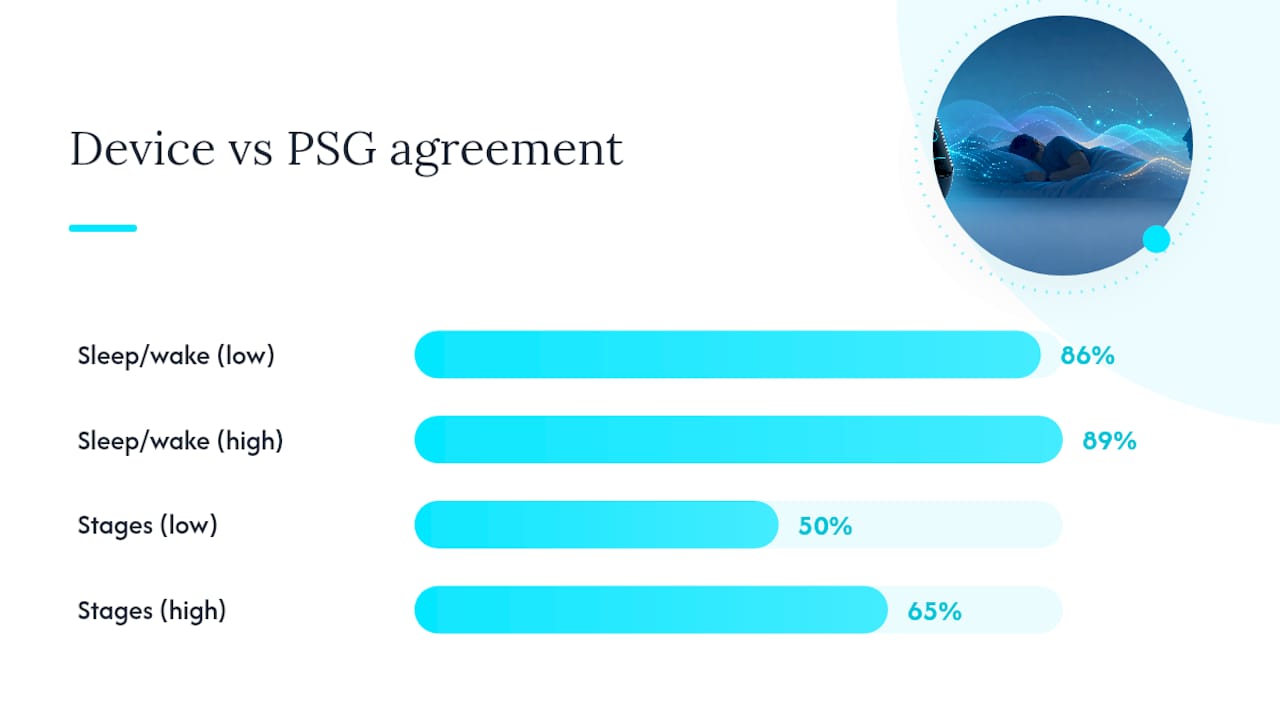
Sleep stages are a different story. The same research found multi-state sleep stage agreement dropped to roughly half to two-thirds accuracy compared with polysomnography, the gold-standard lab test using brainwave monitoring. That’s largely because consumer devices infer sleep stages from movement and heart rate patterns rather than the electrical brain activity that defines them clinically. A tracker can tell you slept for seven hours with reasonable confidence. It’s guessing, more than measuring, when it tells you exactly how many minutes you spent in deep sleep.
SpO2, VO2 max, and arrhythmia detection
Blood oxygen (SpO2) readings from wrist devices tend to show small average bias against clinical pulse oximeters but wide limits of agreement, meaning the group average looks fine while any single reading carries real uncertainty. VO2 max estimates vary considerably depending on the exercise protocol a brand uses, so numbers aren’t comparable across devices.
Arrhythmia detection, such as irregular rhythm notifications for atrial fibrillation, is more clinically interesting. Research on wearable arrhythmia detection in clinical pathways found reasonable positive predictive value for these alerts, alongside a meaningful rate of inconclusive readings. A notification is a prompt to get checked, never a diagnosis on its own.
- Steps: typically within 10% of research-grade monitors in normal walking; errors climb sharply at slow speeds
- Resting heart rate: MAPE around 2%, small population-level bias
- Heart rate during exercise transitions: noticeably less reliable, improved by averaging
- Energy expenditure: frequently overestimated by 25% to over 100%
- Sleep duration: roughly 86% to 89% agreement with polysomnography
- Sleep stages: only 50% to 65% agreement with polysomnography
- Arrhythmia alerts: useful screening signal, not a diagnosis
What actually changes fitness tracker precision in daily life
The number on your screen isn’t just a function of the sensor inside your device. It’s a function of how that sensor interacts with your skin, your movement, and the situation you’re in.
- Sensor and algorithm design. PPG sensors read blood flow through skin; chest straps read electrical signals directly from the heart, which is why chest straps generally outperform wrist-based optical sensors during intense or erratic movement. Sampling rate and the proprietary algorithm processing that raw signal both shape the final number, and firmware updates can shift results between one week and the next.
- Fit and wear. A loose strap lets light leak in and out unpredictably; a tight one restricts blood flow the sensor is trying to read. Sweat, cold skin, and tattoos over the sensor site can all degrade signal quality.
- Individual physiology. Validation research has repeatedly found higher error rates associated with darker skin tone, higher BMI, and larger wrist circumference, likely because these factors change how light penetrates and reflects through tissue. If a device’s validation study used mostly lean, lighter-skinned participants, its published accuracy figures may not transfer cleanly to you.
- Activity type. Cycling, weightlifting, and swimming create movement patterns the algorithm may not have been trained on, unlike running or walking, which most consumer devices handle well.
- Validation context. A lab test on a treadmill under controlled conditions is not the same as free-living use on a commute, at work, or during a football match. Always check whether a device’s published accuracy came from a lab protocol or from everyday conditions, because the gap between the two is often large.
Pro Tip: When a brand quotes an accuracy percentage, check whether it comes from a controlled lab test or a free-living study. Free-living numbers are the ones that predict how the device behaves in your actual life.
How to read your tracker’s numbers without getting misled
Sticking with one wearable device over time improves the usefulness of trend data. Comparing your Tuesday reading on one tracker with your Thursday reading on a different brand tells you nothing, because each uses a different algorithm and baseline. Consistency with one device turns noisy daily numbers into a meaningful trend line.
A few practical adjustments make that trend line more trustworthy:
- Use rolling averages for heart rate rather than fixating on any single spot reading, especially during exercise.
- Treat calorie burn estimates as directional at best, never as a precise figure to subtract from your food intake.
- Focus on total sleep time and consistency of bedtime, not the exact minutes your app assigns to deep or REM sleep.
- Note context when something looks off, a heavy gym session, a new medication, an illness, so unusual readings don’t get misread as device error or, worse, ignored entirely.
- Keep firmware updated and the app synced, since outdated software is a common source of readings that suddenly look wrong.
If your device flags an irregular heart rhythm, or you notice symptoms like unexplained breathlessness, chest discomfort, or a resting heart rate that has drifted well outside your normal range, don’t wait for the tracker to “confirm” it over more nights. Book an appointment and get a validated ECG. Wearables are a prompt to check, not a substitute for the check itself.
Statistic callout: Limits of agreement for wrist heart-rate sensors can span roughly 14 beats per minute even when average bias looks small, which is exactly why a single alarming reading deserves a second look with proper equipment rather than immediate worry.
Choosing a tracker that matches what you actually want to measure
Start by deciding your priority, because no device optimises equally well for everything. Someone chasing step-based activity goals has different needs from someone tracking resting heart-rate trends for stress management, or someone monitoring sleep timing around shift work.
- Identify your primary metric. If steps and daily movement matter most, prioritise a device validated in free-living conditions rather than lab-only testing. If heart-rate trends matter more, look for validation against a chest strap or ECG reference.
- Check the validation population. A study run on young, fit, lightly built adults may not reflect accuracy for someone older, heavier, or with darker skin tone. Look for validation work that resembles your own profile where possible.
- Favour transparent, exportable data. Devices that let you export raw data and see how a metric is calculated give you more room to sanity-check unusual readings against context.
- Match sensor type to your activity. Chest straps generally outperform wrist optical sensors for high-intensity interval work; rings and wrist devices are usually fine for daily trends and sleep.
- Prioritise long battery life and consistent firmware support. A device that dies overnight can’t track sleep, and inconsistent updates can quietly shift accuracy over time without you noticing.
A short checklist at the point of purchase saves a lot of frustration later: does the brand publish free-living validation data, does it disclose what reference standard it used, and does it let you export your own numbers rather than locking them inside the app?
Where Voltrahealth fits into evidence-based tracking
Some companies offer health metrics, sleep, heart health, and daily activity tracking without recurring subscription fees, in contrast to wearables that charge monthly just to unlock full data access. That structure matters for the trend-first approach this article recommends: because trend tracking depends on consistent long-term use, a lifetime-free app removes the temptation to stop paying and lose access to your own history.
Real-time data on stress response, workout recovery, and menstrual cycle impact is designed to support exactly the kind of pattern-spotting this article argues matters more than any single reading.
, and would strengthen this further, but the underlying principle holds regardless: unrestricted, long-term access to your own data is what makes trend monitoring possible in the first place.
How do leading fitness tracker brands compare on accuracy?
No consumer brand nails every metric. Devices that perform well on step counting in free-living conditions don’t necessarily lead on heart-rate precision, and strong heart-rate performance doesn’t guarantee reliable sleep-stage detection. The PLOS One free-living comparison found meaningful differences between devices on step counting alone, with some brands running consistently closer to research-grade equipment than others in the same sample.
The more useful comparison isn’t brand versus brand on a single headline number. It’s which metric each device was actually validated for, and against what reference standard. A living umbrella review of wearable validation studies found roughly 11% of commercially available wearables have been validated for at least one biometric outcome, and only about 3.5% of the total validation work needed across the industry has been completed. Most accuracy claims you’ll see in marketing material simply haven’t been through independent testing at all.
That’s a strong argument for checking a specific brand’s published validation studies for the specific metric you care about, rather than trusting a general reputation for “accuracy.” A device can be excellent at step counting and mediocre at sleep staging, or vice versa, and broad brand loyalty doesn’t tell you which is true for the feature you’ll actually use daily.
Does age or fitness level change how accurate your tracker is?
Your age, body composition, and fitness level all influence how well a wearable reads you, often more than which brand you’ve chosen. Older adults tend to see larger step-count errors, particularly during slower walking speeds, shuffling gaits, or use of walking aids, because wrist accelerometers rely on a swing pattern that changes with age and mobility.
Fitness level affects heart-rate accuracy in a less obvious way. Highly trained individuals often have lower resting heart rates and faster recovery after exertion, both of which can behave differently against algorithms trained largely on general population data. Someone with a resting heart rate in the high 30s or low 40s, common among endurance athletes, may see a tracker’s “normal range” flags trigger inappropriately.
Body composition matters too. Higher BMI and larger wrist circumference have both been linked to reduced optical heart-rate accuracy, since more tissue between the sensor and blood vessels changes how light scatters and returns to the sensor. None of this means the technology is broken for these groups, but it does mean the published accuracy percentage for a device was measured on a specific population, and your results may reasonably differ from that headline figure.
Do app updates and syncing affect fitness tracker reliability?
Firmware and app updates can alter how trackers calculate results, sometimes noticeably and without clear user notification to the user. A brand might retune its heart-rate algorithm, adjust its step-detection sensitivity, or change how it classifies sleep stages in a routine software update, which means a device that performed one way last month could behave differently this month without any change in the underlying sensor.
Syncing issues create a subtler problem: data gaps. If your tracker fails to sync overnight, you might see a truncated sleep record or a missing block of heart-rate data the next morning, which can look like a device fault when it’s really a connectivity hiccup. This matters most for trend analysis, because a data gap misread as a genuine health change can trigger unnecessary worry.
The practical fix is straightforward. Keep your app and device firmware current, sync regularly rather than letting data queue for days, and check your tracker’s changelog on the rare occasion a metric looks unusual right after an update. Most reputable brands document what a firmware update changed, and that note is often the quickest explanation for a sudden shift in your numbers.
Simple ways to improve your fitness tracker’s accuracy
A few habits meaningfully improve how much you can trust your daily readings, and none of them require buying new hardware.
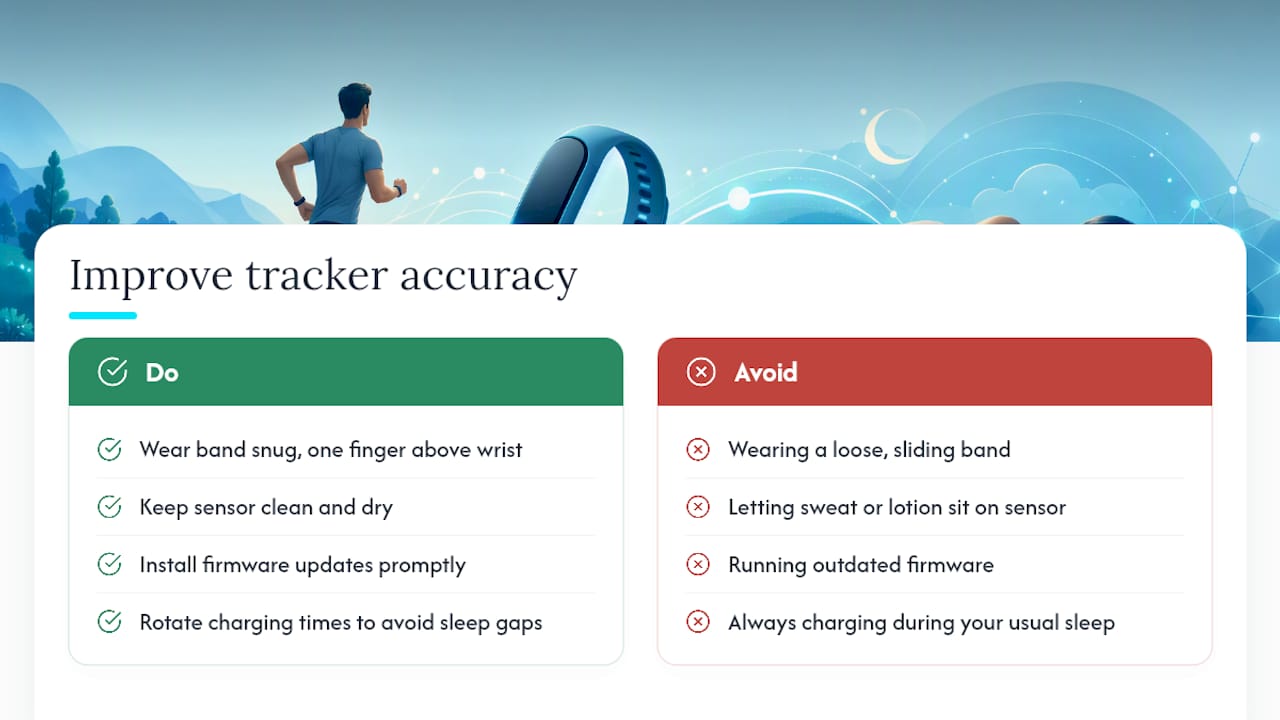
Wear the device correctly. Position a wrist tracker roughly a finger’s width above the wrist bone, snug enough that it doesn’t slide but not so tight it restricts circulation. A loose fit is the single most common cause of poor optical heart-rate readings during exercise.
Keep the sensor area clean and dry. Sweat, lotion, and skin oils can all interfere with the optical sensor’s ability to read blood flow accurately, particularly during longer workouts.
Update firmware promptly. As covered above, algorithm tweaks ship through software updates, and running outdated firmware means missing accuracy improvements the brand has already released.
Charge overnight on a rotation, if your device requires removal for charging, rather than always at the same time you’d normally be asleep, so you don’t create systematic gaps in your sleep data. Cross-check unusual readings against context. If your heart rate spikes unexpectedly, log what you were doing in that moment before assuming the device is faulty. For anyone specifically working on lowering their resting heart rate over time, tracking consistently alongside training is more informative than any single day’s number, as this guide on reducing resting heart rate explains in more detail.
Why wearables are worth trusting, and where they aren’t
The honest trade-off with consumer wearables is accessibility versus clinical precision. You get continuous, low-friction data that no clinic could ever generate through periodic visits, and that accessibility is genuinely valuable for spotting patterns in stress, sleep, and recovery over time. What you don’t get is diagnostic-grade certainty on any single reading.
Manufacturers should be pushed harder on transparent, population-matched validation data rather than marketing percentages pulled from a single lab test. Until that becomes standard, the smartest use of any tracker is behaviour change and trend spotting, not clinical decision-making. If a reading concerns you, get it checked properly rather than trusting the device to resolve the question on its own.
— Sam
Get continuous trend data without the ongoing subscription cost
Voltrahealth exists because most wearables ask you to keep paying just to keep seeing your own health data. That’s backwards for anyone following the trend-first approach this article recommends: monitoring stress, sleep, and heart health over weeks and months only works if you’re not tempted to cancel a subscription and lose access to your own history halfway through.
The VOLTRA AIR is priced at £99.99 as a one-off purchase, with lifetime app access included at no extra cost. For readers who want deeper metrics alongside heart and sleep tracking, the VOLTRA PRO sits at £129.99, and the VOLTRA CORE at £149.99 for those wanting the fullest feature set. All three run on the same principle covered throughout this guide: consistent, long-term data beats any single reading, and consistent use only happens when access doesn’t depend on a recurring bill.
If you’re ready to see the difference in your own numbers, compare specifications across the Voltra Air, Pro, and Core ranges and pick the one that matches the metrics you care about most. And if you’re weighing up whether to retire an older device first, BuyBackBear lets you sell or trade in your current smartwatch before making the switch.
Sources
- Comparison of consumer‑grade wearable devices with a research‑grade instrument for measuring physical activity in a free‑living setting
- Systematic review and meta‑analysis evaluating Apple Watch measurement accuracy
- Accuracy and acceptability of wrist‑wearable activity‑tracking devices: systematic review
- Accuracy of heart rate measurement under transient states: a validation study of wearables for real‑life monitoring
FAQ
Are fitness trackers actually accurate?
It depends entirely on the metric. Step counts and resting heart rate are often accurate within about 10%, based on free-living validation research, while calorie burn and sleep-stage detection show much larger, less reliable errors.
What fitness tracker is the most accurate?
No single brand leads on every metric, since accuracy varies by feature, activity type, and the person wearing it. The most useful approach is checking whether a specific device has been independently validated for the exact metric you care about, rather than relying on general brand reputation.
Can you trust a heart rate on a smart watch?
Resting heart rate readings are generally trustworthy, with pooled bias as low as −0.27 bpm in meta-analysis data. Accuracy drops during rapid heart-rate transitions and intense exercise, so treat any single spike or dip with some caution rather than alarm.
Is Apple or Fitbit more accurate?
Free-living testing has found differences between brands on specific metrics rather than one being universally superior. In one comparison against a research-grade monitor, Apple Watch stayed closer to the reference device on step counts, while Fitbit overestimated steps by 18% in that same sample.
Do no-subscription trackers like Voltrahealth sacrifice accuracy for lower cost?
Not based on how the product is structured. Voltrahealth’s devices run on the same sensor technologies as subscription-based competitors, with the difference being lifetime app access included in the one-off price rather than an ongoing fee for full data access.
Share:
4 Maximum Heart Rate Methods and When a Lab Test Is Worth It
90 Minute Sleep Cycles Explain HRV During Sleep: What to Watch