
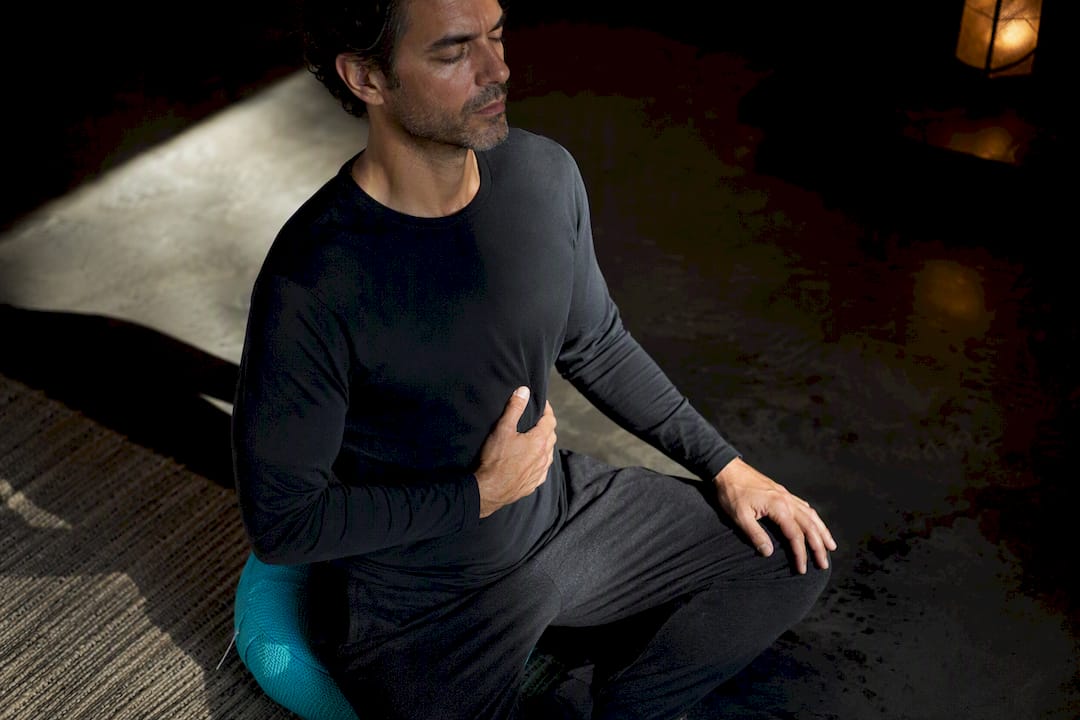
Yes, breathwork raises HRV, both during a session and, with consistent training, at rest over time. Resonance breathing (also called coherent breathing), paced at around six breaths a minute, produces the largest acute gains of any technique tested. Try it now: inhale for five seconds, exhale for five seconds, for ten minutes, and check how you feel afterwards.
TL;DR:
- Resonance breathing at six breaths per minute produces the largest immediate and long-term increases in HRV, especially when practiced consistently over weeks.
- Techniques like cyclic sighing or humming breathing are effective for quick stress resets, but resonance breathing provides the greatest HRV gains for training purposes.
- Finding your personal resonance frequency typically involves testing breaths per minute between 4.5 and 7 to maximize heart rate oscillation amplitude.
- Slow, deep, belly-focused breathing with proper posture and moderate depth is essential to avoid dizziness or lightheadedness during practice.
- Using wearable devices with lifetime tracking options helps measure progress reliably without recurring subscription fees.
Table of Contents
- What is breathwork for HRV, and why does breathing rate matter?
- Which breathing technique raises HRV the most?
- How do you find your personal resonance frequency?
- Is breathwork safe, and what causes dizziness during a session?
- Which HRV numbers should you actually track?
- A practical 4-week breathwork plan to increase HRV
- How wearable tracking supports a breathwork habit
- When breathwork alone isn’t enough
- Track your breathwork progress without a subscription
- Sources
- FAQ
What is breathwork for HRV, and why does breathing rate matter?
Heart rate variability measures the variation in time between consecutive heartbeats. A higher HRV generally signals a nervous system that shifts smoothly between stress and recovery; a lower one suggests the body is stuck in a more defensive, sympathetic state. It is not a fitness score in the way step counts are. It is closer to a readout of how adaptable your autonomic nervous system is on any given day.
Breathing changes HRV because of a mechanism called respiratory sinus arrhythmia, or RSA. Every time you inhale, your heart rate speeds up slightly; every time you exhale, it slows down. This happens because breathing directly modulates vagal nerve output to the heart. Fast, shallow breathing compresses that swing and flattens HRV. Slow, deep breathing widens it and lets the vagus nerve exert more influence, which is one reason breathing patterns and HRV are so tightly linked.
The baroreflex adds a second layer. This reflex loop constantly adjusts heart rate in response to blood pressure changes, and it oscillates naturally at close to 0.1 Hz, roughly six cycles a minute. When you breathe at that same frequency, your respiratory rhythm and your baroreflex rhythm fall into phase with each other. The two waves amplify instead of cancel, and that resonance is exactly why coherent breathing at six breaths a minute outperforms both faster and slower rates for boosting HRV amplitude.
The experimental evidence backs this up cleanly. A study using phase-rectified signal averaging and entropy analysis tested breathing at 6, 10 and 15 breaths per minute and found that slower breathing significantly increased time-domain HRV metrics while faster rates reduced them. The same research flagged something worth knowing before you start experimenting with your own pacing: changes in end-tidal CO2 during paced breathing are a genuine driver of these autonomic shifts, which is part of why breathing too slowly or too deeply too soon can backfire into lightheadedness rather than calm.
A separate trial on brief resonance-frequency sessions found that a single short round of paced breathing near 6 breaths a minute raised LF-HRV during the exercise itself, even though its effect on cognitive inhibition tasks in that single-session design was less conclusive. The acute cardiovascular response, in other words, shows up faster and more reliably than any downstream cognitive benefit.
What actually happens inside a session, in order:
- Your breathing rate slows towards 5–6 cycles per minute.
- The amplitude of your heart rate’s rise and fall (RSA) widens.
- Your baroreflex and respiratory rhythms begin to synchronise.
- LF-HRV and related time-domain metrics increase, often within minutes.
A key figure to hold onto: a randomised controlled trial had participants practise resonance breathing for 20 minutes daily over four weeks, and found significant increases in SDNN, pNN50 and total power alongside a measurable drop in perceived stress, compared with a control group. That is the clearest evidence yet that breathwork’s benefits do not stop at the end of the session.
Which breathing technique raises HRV the most?
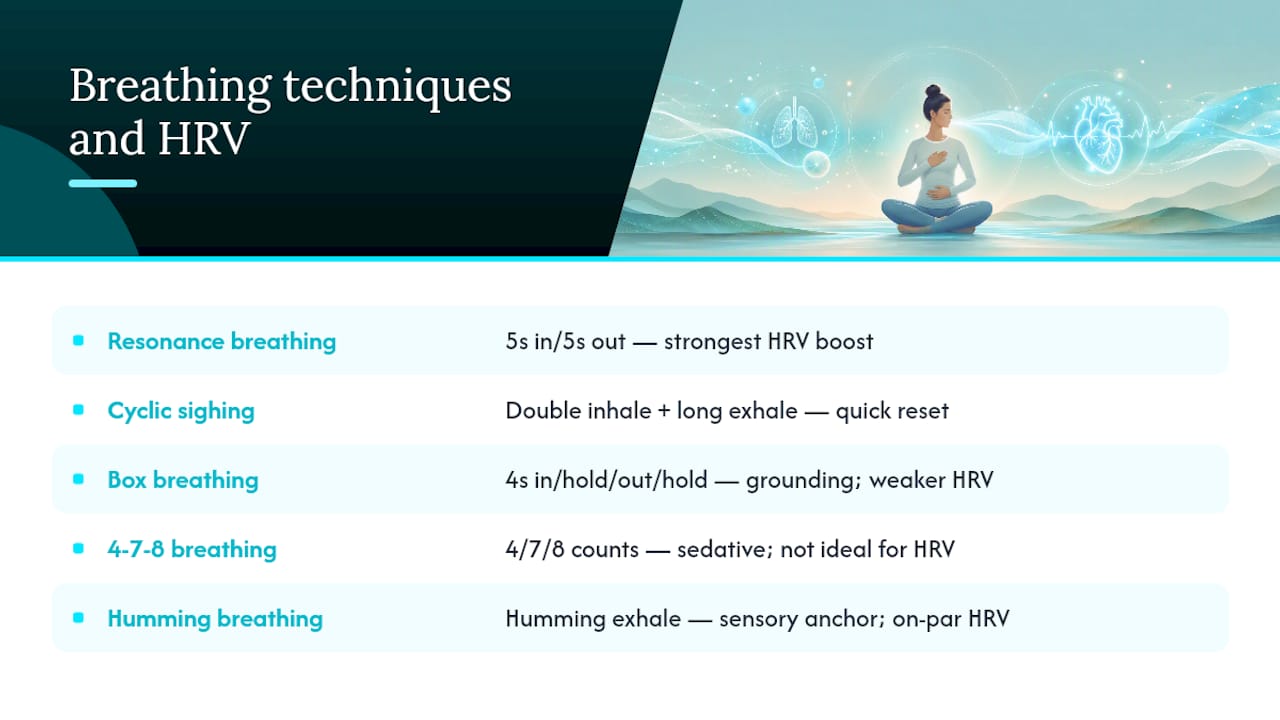
Resonance breathing wins for raw HRV amplitude, but it is not the only technique worth learning, and it is not always the right one for the moment. Cyclic sighing, box breathing, 4-7-8 and humming breathing each do something slightly different, and picking the right one depends on whether you are chasing a quick nervous system reset, better sleep, or a dedicated HRV training effect.
Resonance or coherent breathing. Breathe in for five seconds, out for five seconds, through the nose if comfortable, seated or lying down with a relaxed belly. This is the technique behind both the four week RCT and the brief resonance-frequency study cited above, and it consistently produces the biggest jump in SDNN and LF-HRV of anything tested. Use it as your main HRV training tool, in daily 10 to 20 minute sessions.
Cyclic sighing. A double inhale through the nose (a normal breath followed by a short top-up breath), then a long, slow exhale through the mouth. A pilot investigation comparing slow-paced breathing against humming breathing found that both techniques increased SDNN, total power and LF power compared with simple rest, with no significant difference between the two, which suggests the extended exhale itself is doing much of the work regardless of exact technique. Cyclic sighing is quick, needs no counting discipline, and suits acute stress spikes, before a difficult meeting, mid argument, or after a jolt of adrenaline.
Box breathing. Four seconds in, four seconds hold, four seconds out, four seconds hold, repeated. It is popular with military and first-responder training because the equal-count structure gives an anxious mind something concrete to focus on. It is not the strongest HRV amplifier on this list. The breath-holds interrupt the smooth oscillation that RSA and the baroreflex rely on, but as a grounding tool under acute pressure it earns its keep.
4-7-8 breathing. Four seconds in, hold for seven, exhale slowly for eight. This is closer to a sedative technique than an HRV-training one. The long breath-hold and extended exhale strongly stimulate vagal tone, which makes it a genuinely good pre-sleep ritual, but the awkward asymmetry of the count makes it harder to sustain for a full ten-minute training block, and it has not been tested with anything like the rigour applied to resonance breathing.
Humming breathing. A normal inhale followed by a humming exhale, which adds gentle vibration and slightly increases exhale resistance. The same pilot study found humming performed statistically on par with slow-paced breathing for SDNN and relaxation, so if nasal breathing feels uncomfortable or you want a technique with an immediate sensory anchor, humming is a legitimate substitute rather than a novelty.
Pro Tip: *If you only have five minutes and your goal is calming down fast rather than training HRV long-term, cyclic sighing beats resonance breathing.
For dedicated HRV training, resonance breathing is the technique to build a habit around. For situational stress, cyclic sighing or humming. For falling asleep, 4-7-8. Box breathing sits best as a focus tool during acute pressure rather than a metric-moving daily practice.
How do you find your personal resonance frequency?
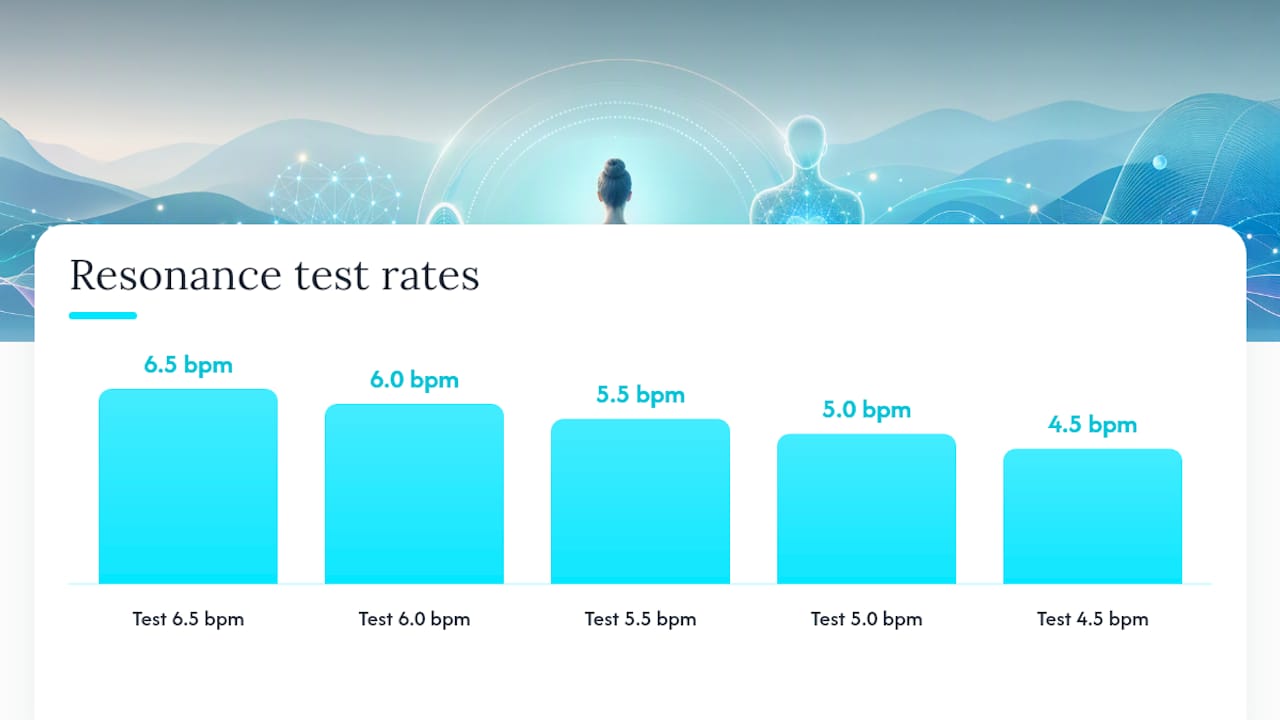
Six breaths a minute is a useful starting point, not a universal constant. Resonance frequency varies between individuals, generally somewhere in the 4.5 to 7 breaths per minute range, and pinpointing your own number gets you a noticeably larger HRV effect than guessing.
- Pick a quiet 20 to 30 minute window where you will not be interrupted, and sit upright with your feet flat on the floor.
- Test 6.5 breaths per minute for two minutes, keeping your breath depth (tidal volume) roughly constant. If you have an HRV app or chest-strap monitor, watch the amplitude of the RSA waveform, how much your heart rate swings up on the inhale and down on the exhale.
- Drop to 6.0 breaths per minute for two minutes, same constant depth, same observation.
- Continue down in 0.5 bpm steps through 5.5, 5.0 and 4.5, noting which rate produced the widest, most rhythmic swing in heart rate.
- Repeat once above your estimated resonance rate, testing 7.0 bpm, to confirm you have not missed a higher resonance point.
- Settle on the rate that gave the largest, smoothest oscillation. That is your personal resonance frequency.
Keeping tidal volume steady across each test matters more than people expect. If you breathe more deeply at one rate than another, you confound the comparison. A deeper breath alone can widen HRV amplitude regardless of pacing, which would give you a misleading resonance estimate.
If you have no device and no patience for a formal test, skip straight to a simplified beginner protocol: start at 6 breaths a minute (5 seconds in, 5 seconds out) for your first week, and simply notice whether it feels comfortable or strained. Nudge the pace slightly slower if you feel breathless keeping up, or slightly faster if you feel you are overfilling your lungs. Most adults land somewhere close to 6 bpm anyway, which is why it is such a common default recommendation.
A pacer app or a wearable with real-time HRV-guided pacing removes most of the guesswork. Reviews of breathwork adherence note that guided pacing tools measurably improve how consistently people maintain a slow breathing rate, which matters because drifting back to a normal 12 to 16 breaths a minute halfway through a session quietly erases most of the benefit. Aim for 10 to 20 minute sessions once your rate is dialled in, long enough for the baroreflex and respiratory rhythms to lock into phase, short enough to fit into an actual daily routine.
Pro Tip: Breathe through your belly, not your chest. Place a hand just below your ribs and try to feel it rise on the inhale. Chest-led breathing tends to be shallower and faster, which works against the slow, steady pattern resonance training depends on.
Posture matters more than people assume. Slumping compresses the diaphragm and makes slow, full breaths harder to sustain, so sit tall or lie flat with knees slightly bent. And resist the urge to breathe unusually deeply just because the pace has slowed. Depth and rate are separate variables. A slow, moderate breath beats a slow, maximal one, which brings us to why some people feel dizzy the first time they try this.
Is breathwork safe, and what causes dizziness during a session?
Mild lightheadedness during slow breathing is common and almost always down to one of two things: over-breathing (moving more air than your body needs, which drops CO2 too far) or holding your breath too long at the top or bottom of a cycle. Neither is dangerous in a healthy adult, but both are easy to fix.
- Dizziness or tingling in the hands: usually a sign you are breathing too deeply, not too slowly. Shallow the inhale slightly.
- Breathlessness or a racing feeling: a sign the pace is too slow for your current lung capacity. Move up half a breath per minute.
- Lightheadedness during breath-holds (box breathing, 4-7-8): often means the hold is too long relative to your comfort. Shorten it.
- Anxiety or panic during the exercise: stop, return to normal breathing, and try a shorter session next time.
CO2 dynamics sit behind most of this. The same controlled-breathing research that measured entropy and phase-rectified signal averaging metrics also tracked end-tidal CO2 and confirmed that CO2 shifts during paced breathing meaningfully influence the autonomic response, for better and for worse. Push CO2 down too fast with over-deep breathing, and you get the classic light-headed, tingly sensation rather than calm.
Certain groups should check with a clinician before starting a structured breathwork practice: anyone with a diagnosed cardiac condition, uncontrolled hypertension, severe respiratory disease such as advanced COPD, or anyone pregnant. None of this is a reason to avoid breathwork outright, but slow-paced breathing changes blood pressure and cardiac rhythm in real time, and that is worth a conversation with a doctor first if you fall into one of those categories.
Three practical rules cover almost every situation. Start with short sessions, five minutes rather than twenty, until you know how your body responds. Practise seated or lying down rather than standing, particularly in the first few attempts. And if you feel faint at any point, stop immediately and return to your normal breathing rhythm rather than pushing through.
If you are someone who reacts quickly to breath-holds or slow pacing, adapt rather than abandon the practice: shorten each inhale slightly, keep breaths gentler, and insert a few cycles of normal breathing between paced rounds rather than doing twenty minutes unbroken.
Which HRV numbers should you actually track?
Two metrics matter for most people using breathwork to manage stress: RMSSD and SDNN. RMSSD reflects short-term, beat-to-beat variation and responds quickly to vagal tone changes, which makes it the best number for judging day-to-day recovery and the immediate effect of a breathwork session. SDNN captures variability across a longer window and reflects overall autonomic flexibility, which is the metric that moved most clearly in the four-week resonance breathing trial mentioned earlier.
Device choice affects how much you can trust either number. Chest straps read the electrical signal directly from the heart and are generally the more accurate option for HRV specifically. Wrist-worn devices infer heart rate from blood flow using optical sensors, which works well for daily trends but is more sensitive to movement artefacts and looser fit. For a resonance-frequency test where you are hunting for small differences between 5.5 and 6.5 breaths a minute, sampling quality genuinely matters, since noisy data can hide the exact peak you are trying to find.
Consistency in how you measure matters as much as the device itself:
- Take your baseline reading at the same time each morning, ideally within a few minutes of waking.
- Measure before caffeine, food or a shower, all of which shift heart rate and HRV independently of your nervous system’s baseline state.
- Stay still and seated or lying down for the reading rather than measuring mid-movement.
- Track two to three times a week at minimum if daily measurement feels excessive; a wearable that logs automatically overnight removes this burden entirely.
Expectations should be set at two different timescales. Within a single session, HRV metrics can shift within minutes as your breathing slows and RSA amplitude widens, which is the effect the brief resonance-frequency study captured. Resting HRV, the number you would see on an ordinary Tuesday morning with no breathwork happening at all, takes longer to move. The four-week RCT saw its clearest gains in SDNN and pNN50 after sustained daily practice, not after a single good session. If your morning resting HRV has not budged after a week of practice, that is normal. Give it the full four to eight weeks before judging whether the habit is working.
A practical 4-week breathwork plan to increase HRV
This plan assumes 10 to 20 minutes a day and builds from simple pacing towards a dedicated resonance-training block.
- Week one: find your baseline and your rate. Practise 5s in / 5s out for 10 minutes daily, once in the morning if possible. Take a resting HRV reading before you start the week and again at the end, using the same conditions each time.
- Week two: run the resonance-frequency test. Use the stepwise 4.5 to 7 bpm protocol described earlier, once this week, then settle into your personal rate for daily 10 to 15-minute sessions for the rest of the week.
- Week three: extend and diversify. Push daily resonance sessions to 15 to 20 minutes. Add cyclic sighing as a two-minute reset whenever acute stress spikes during the day, separate from your main session.
- Week four: consolidate and check progress. Keep the 15 to 20 minute daily resonance session. Compare your resting HRV reading against week one’s baseline, taken the same way, same time, same conditions.
If your numbers have not moved by the end of week four, the likely culprits are inconsistent timing (measuring under different conditions each time), sessions that drifted back towards a faster natural breathing rate without you noticing, or simply not yet being far enough into the eight-week window some people need. Adjust the pace slightly rather than the technique before concluding it is not working.
Pro Tip: Adherence beats intensity here. A Frontiers review on breathwork practice found that guided pacing and simple logging were the biggest predictors of people sticking with a practice long enough to see results. A five-minute session you actually do every day outranks a twenty-minute session you skip three times a week, especially when supported by a smart alternative to MoodWallet combining mindfulness and intervention.
The most common adherence failure is skipping the morning session and trying to cram it in at night instead, right before sleep interferes with your motivation to concentrate on pacing. Anchor the habit to something you already do daily, coffee, brushing your teeth, the commute, rather than leaving it to whenever you remember.
How wearable tracking supports a breathwork habit
Breathwork’s biggest practical obstacle is not the technique. It is knowing whether it is working, and remembering to do it consistently. Continuous tracking removes both problems by giving you a morning HRV baseline, a recovery trend line, and a record of whether yesterday’s session actually happened, without relying on memory or guesswork.
A device that logs sleep quality, resting heart rate and HRV trends overnight lets you separate genuine progress from noise, one bad night’s sleep can distort a single reading, but a four-week trend line will not lie to you the way a single number can. Some wearable device makers build products around ongoing, no-subscription tracking, with lifetime access to companion apps so the data stays useful for as long as you keep wearing it, not just for the first billing cycle.
When breathwork alone isn’t enough
Breathwork is one of the fastest, cheapest tools available for shifting your autonomic state in real time. It is not a stand-alone treatment for chronic anxiety, depression or long-standing insomnia. Ten minutes of resonance breathing will calm you down today. It will not resolve a sleep debt built over months or replace psychotherapy for a genuine clinical condition.
Pair it with the basics that actually move HRV over the long run: consistent sleep, regular exercise and, where symptoms persist, a psychotherapist or GP. Treat breathwork as one lever among several, not the whole strategy.
Certain symptoms deserve a doctor’s attention rather than a breathing app: chest pain, fainting, or new heart palpitations during or after a session are not signs to breathe through. They are signs to stop and get checked.
— Sam
Track your breathwork progress without a subscription
Most HRV apps ask you to pay monthly just to see your own trend line. Voltrahealth’s devices give you that data for the life of the product, no recurring fees, so a four-week resonance-breathing habit is actually easy to measure from start to finish.

The VOLTRA AIR tracks resting heart rate and sleep patterns overnight, giving you the consistent morning baseline that breathwork tracking depends on. Step up to VOLTRA PRO for longer battery life and more detailed biometrics if you want to log every session across a full four-week plan without charging daily, or the VOLTRA CORE for a balanced set of recovery and HRV features. All three come with lifetime access to the app, so the trend data you build during your resonance-frequency testing stays visible for as long as you’re tracking, not just the first fortnight. Have a look at the VOLTRA AIR range and pick the one that matches how closely you want to follow your numbers.
This article is general information, not a substitute for advice from a qualified doctor. Consult a qualified healthcare professional about your own circumstances before acting on anything here.
Sources
- Effect of Resonance Breathing on Heart Rate Variability and Cognitive Functions in Young Adults: A Randomised Controlled Study
- The impact of controlled breathing on autonomic nervous system modulation: analysis using phase-rectified signal averaging, entropy and heart rate variability
FAQ
Does breathwork improve HRV?
Yes. A randomised controlled trial found that 20 minutes of daily resonance breathing for four weeks significantly increased SDNN, pNN50 and total power compared with a control group, alongside reduced perceived stress.
How can I instantly improve my HRV?
Slow your breathing to around six breaths a minute (five seconds in, five seconds out) for a few minutes. Studies show this synchronises your breathing with the baroreflex and produces a measurable rise in LF-HRV within the session itself, though lasting resting-HRV change takes weeks of consistent practice.
Does 4-7-8 breathing increase HRV?
4-7-8 breathing likely raises HRV acutely through its extended exhale and breath-hold, similar to the mechanism behind other slow-breathing techniques, but it has not been tested with the same rigour as resonance breathing. It suits pre-sleep relaxation better than dedicated HRV training.
Does shallow breathing cause low HRV?
Yes. Fast, shallow breathing compresses respiratory sinus arrhythmia and reduces the heart rate swing between inhale and exhale, and experimental data confirms that faster breathing rates decrease time-domain HRV metrics compared with slow, paced breathing.
Share:
Lower Metabolic Age in 2–3 Months: UK Plan, Lift, Eat Protein, Track Free
Why Time in Bed vs Sleep Episode Changes Your Sleep Efficiency Score