
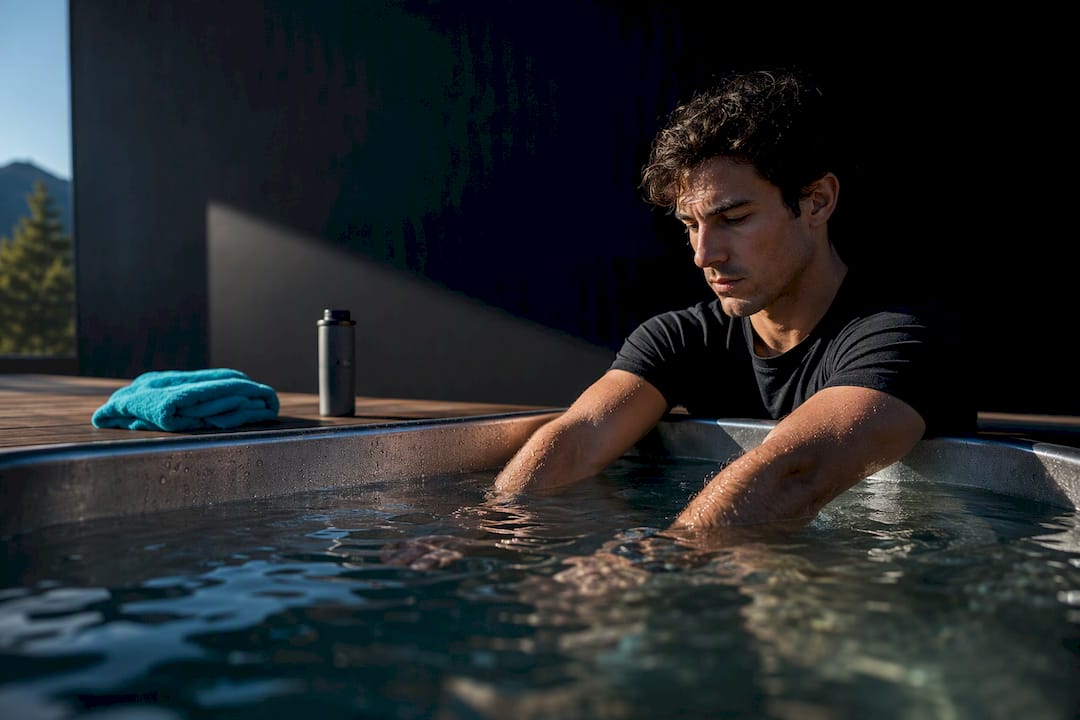
Cold exposure reliably produces an acute rise in parasympathetic HRV markers like RMSSD, but that spike often reflects a sympathetic cold shock followed by a baroreflex-driven heart-rate drop, not necessarily better recovery. Treat any single reading as a data point, not a verdict, and if you have a heart condition or take medication affecting blood pressure, check with a doctor before plunging.
TL;DR:
- Cold exposure causes a moderate, short-lived increase in parasympathetic HRV markers like RMSSD and HF power, typically lasting 15 minutes post-exposure.
- Protocols generally use water temperatures between 7 and 15°C for durations of 30 seconds to 15 minutes, with gradual progression recommended for beginners.
- Acute HRV spikes reflect baroreflex activity and vagal engagement, but long-term changes in baseline autonomic balance remain uncertain and vary across individuals.
- People with heart conditions, uncontrolled hypertension, or circulatory issues should seek medical clearance before attempting cold immersion due to the high-risk initial cold shock phase.
- Consistent self-tracking of HRV and resting heart rate over several weeks improves understanding of individual responses and safety when integrating cold exposure routines.
Table of Contents
- What the best research says about cold exposure hrv
- How cold exposure alters autonomic control and timing
- What temperature and duration do studies actually use?
- When does cold exposure actually help recovery or stress?
- Who should avoid cold exposure or get medical clearance first?
- How should you measure and interpret your own HRV response?
- Tracking your own cold exposure hrv response with a wearable
- Does regular cold exposure change your baseline autonomic balance?
- Why does your response to cold exposure differ from someone else’s?
- Ice baths, cold showers, or cryotherapy: which affects HRV most?
- Can cold exposure improve your mood through HRV changes?
- How do you build cold exposure into a routine safely?
- An evidence-first take on the cold exposure hype
- Track your own cold exposure hrv response without a subscription
- Sources
- FAQ
What the best research says about cold exposure hrv
The strongest evidence comes from a 2024 meta-analysis on cold exposure and HRV, which pooled trial data and found a standardised mean difference of 0.61 for RMSSD and 0.46 for HF power, both statistically significant at p<0.001. In plain terms, that’s a moderate, consistent effect, not a fluke of one or two well-designed studies. The rise in these parasympathetic indices commonly persisted for around 15 minutes after exposure ended, which tells you the effect is real but short-lived unless something else sustains it.
Most trials measured HRV within that immediate post-exposure window rather than tracking hours or days out, so the evidence base speaks confidently to acute change and far less confidently to durable adaptation. Participant profiles varied too: some studies recruited trained athletes doing structured cold-water immersion after exercise, others used general-population volunteers in resting conditions. That matters because a fit 28-year-old’s autonomic response to 10°C water looks nothing like a sedentary 55-year-old’s.
The evidence base has real limits worth naming plainly:
- Many trials are small, often fewer than 30 participants, which limits how confidently findings generalise.
- Protocols vary wildly in temperature, duration and immersion depth, making direct comparison difficult.
- A PLOS One systematic review covering 3,177 participants across 11 studies found genuinely heterogeneous long-term outcomes, even where short-term patterns agreed.
- Few studies follow the same people over weeks or months, so long-term autonomic adaptation is inferred more than proven.
None of this undermines the core finding. It does mean you should read any single cold-plunge testimonial, including your own, with a healthy amount of scepticism.
How cold exposure alters autonomic control and timing
The physiological sequence is fairly well mapped, and understanding it explains why your HRV app might show a “great” score minutes after you’ve been gasping in freezing water.
- Cold shock hits first. Sudden cold skin contact triggers an involuntary gasp reflex, a spike in heart rate, and a jump in blood pressure as the sympathetic nervous system fires.
- The baroreflex intervenes. As blood pressure rises, the baroreflex responds by slowing heart rate back down, which is a protective mechanism, not a sign your body has “relaxed.”
- Parasympathetic indices rebound. RMSSD and HF power climb as heart rate falls, partly reflecting real vagal engagement and partly reflecting the mechanical effect of a slower, more variable heart rate. Small studies on localised cold stimulation to the neck and face suggest a genuine vagal pathway, similar to the diving reflex, contributes here rather than the change being pure artefact.
- The effect fades over the following hour. Most elevated readings normalise somewhere between 15 and 60 minutes post-exposure, though some studies report delayed shifts in stress markers appearing many hours later.
That final point is the one people miss. A PLOS One review found stress-reduction signals emerging around 12 hours after cold-water immersion, well after the immediate HRV bump has settled. The instant spike and the later wellbeing effect may not be the same phenomenon at all.
What temperature and duration do studies actually use?
Protocols cluster into three rough bands, and knowing which one a study used helps you judge whether its findings apply to your bathtub-and-ice-bag setup or a purpose-built plunge tank.
- 7 to 10°C: used in many controlled recovery trials, often for shorter durations of 5 to 15 minutes.
- 10 to 15°C: the band AUSactive’s position statement identifies as where most studied physiological reactions peak, and a common starting point for supervised programmes.
- 1 to 5°C: rarer in research, more common in commercial plunge tanks, and associated with a sharper cold-shock response according to Public Health Ontario’s guidance.
Duration in trials ranges from as little as 30 seconds to around 15 minutes, with casual users typically doing 30 seconds to 2 minutes and structured athlete protocols running longer.
For a first attempt, 10 to 15°C for 30 to 60 seconds is a sensible entry point. Progress gradually over several weeks, adding 30 seconds or dropping the temperature by a degree or two only once the previous step feels manageable, not exhilarating in a panicked way.
- Start seated or standing in water you can exit instantly if needed.
- Breathe out slowly and deliberately rather than holding your breath through the gasp reflex.
- Do your first few sessions with someone nearby, not alone.
- Build up over 3 to 6 weeks rather than jumping straight to sub 5°C immersion.
Pro Tip: Exhale for longer than you inhale during the first 30 seconds of immersion. Slowing the outbreath helps blunt the gasp reflex and gives you more control over the initial sympathetic surge.
When does cold exposure actually help recovery or stress?
Cold exposure isn’t a single intervention with one effect. It behaves differently depending on whether you’re using it to unwind or to bounce back from training, and conflating the two leads to disappointment.
- Resting or stress-focused use: the calming effect seems to build over hours, not minutes. The 12-hour stress-reduction window reported in the PLOS One review suggests patience matters more than chasing an instant mood lift.
- Post-exercise recovery: here the evidence is more specific. A randomised controlled trial found that cold-water immersion, often around 15 minutes at 14°C, accelerated the return of several HRV indices to baseline compared with passive recovery, with many measures normalising within 10 to 60 minutes.
- Weaker evidence zones: claims about cold exposure improving mood or immunity long-term rest on thinner, more heterogeneous data than the acute HRV findings.
If your goal is faster recovery after a hard session, the athlete-focused trials give you a reasonable template. If your goal is a calmer evening, don’t expect the plunge itself to deliver it. The hours afterwards seem to matter more.
Who should avoid cold exposure or get medical clearance first?
The first 30 to 60 seconds of cold immersion are the highest-risk window, full stop. This is when the cold shock response peaks: heart rate and blood pressure spike sharply, and in susceptible people this can trigger arrhythmias or a hypertensive episode. Harvard Health’s review is blunt about this, noting that cold plunges can carry real cardiac risk for people with underlying heart problems even though the same stimulus produces a beneficial-looking HRV pattern in healthy people.
Several groups need medical clearance before trying it:
- People with diagnosed arrhythmias or a history of unexplained fainting.
- Anyone with uncontrolled hypertension.
- People with Raynaud’s phenomenon or other significant circulatory conditions.
- Anyone taking beta blockers, diuretics, or certain antidepressants, since these can blunt or exaggerate the cardiovascular response to sudden cold.
The 2024 meta-analysis pooling cold-exposure trials reported an RMSSD effect size (SMD) of 0.61 and an HF power effect size of 0.46, both statistically significant. Encouraging numbers, but they describe averages across generally healthy trial participants, not a guarantee for every individual.
Practical safety steps matter as much as the temperature you choose. Never plunge alone, agree a rewarming plan before you get in, and start gradually rather than diving straight into sub 5°C water on day one. AUSactive’s position statement recommends screening and supervised practice for exactly this reason, and facility operators are advised to keep rewarming areas and trained staff on hand.
How should you measure and interpret your own HRV response?
RMSSD and HF power are the two metrics worth watching, since they’re what the research actually measured. Record paired heart rate and RR interval data where your device allows it, and always establish a baseline from several consecutive morning readings before you start experimenting with cold exposure at all.
A useful measurement rhythm looks like this:
- Take a baseline reading across 5 to 7 mornings before your first session, in similar conditions each time.
- Capture a reading during exposure if your device supports it, then again at 0 to 15 minutes and 30 to 60 minutes post-exposure.
- Track the trend over several weeks rather than judging any single session in isolation.
- When your heart rate drops sharply during recovery, expect HRV to rise partly because of that baroreflex mechanism, not purely because you’re “more relaxed.”
- Treat sudden erratic readings as possible device noise before treating them as physiological signal, particularly with wrist-based sensors during movement.
Sport scientists solve this by pairing HRV with heart rate, perceived exertion and sometimes core temperature, then looking at within-person trends over time rather than one-off comparisons. That’s the more reliable read, and it’s realistic for anyone with a decent wearable.
Tracking your own cold exposure hrv response with a wearable
A simple four-step workflow makes this practical rather than theoretical:
- Log 5 to 7 mornings of baseline HRV and resting heart rate before your first cold session.
- Standardise your test: same time of day, similar water temperature, same duration each time you compare.
- Capture immediate (0 to 15 minute) and delayed (30 to 60 minute) readings straight after exposure.
- Review trends over several weeks in the companion app rather than reacting to any single number.
Some wearables track heart rate, HRV and sleep continuously with free lifetime app access, which suits this kind of repeated self-testing without adding a subscription cost to an already experimental habit.
Pro Tip: Label each session in your app notes with the water temperature and duration. Without that context, a HRV trend graph six weeks from now is just numbers with no story attached.
Does regular cold exposure change your baseline autonomic balance?
The honest answer is that the long-term picture is far less settled than the acute one. Most of the strongest data, including the 2024 meta-analysis, measured what happens in the minutes following a single session. Whether repeated exposure over months shifts your resting autonomic balance, meaning a higher baseline HRV even when you’re not in cold water, is a much thinner evidence base.
The PLOS One review found genuinely mixed long-term outcomes across the 11 studies it examined, which is a fair reflection of where the science currently sits. Some regular cold-water swimmers and plungers report improved baseline calm and resilience to stress, and there’s a plausible mechanism: repeated controlled sympathetic activation followed by parasympathetic rebound could, in theory, train the autonomic nervous system in a way similar to how structured exercise builds cardiovascular resilience.
But plausible isn’t proven. The heterogeneity in temperature, duration, and frequency across existing trials makes it difficult to say “do X for Y weeks and expect Z improvement” with any confidence. What’s more defensible is a cautious framing: consistent, gradual cold exposure appears to be a workable autonomic stimulus, and tracking your own trend over 8 to 12 weeks will tell you more about your individual response than any population-level average can. If your morning baseline HRV climbs steadily over that period alongside your cold sessions, that’s a meaningful personal signal, even if it can’t be generalised to everyone else doing the same routine.

Why does your response to cold exposure differ from someone else’s?
Age, fitness level and baseline HRV all shape how strongly cold exposure moves your autonomic markers, and this is one of the most underdiscussed variables in the whole conversation. A fit 25-year-old with a naturally high baseline HRV often shows a sharper, faster parasympathetic rebound after cold exposure than an unconditioned 60 year old, partly because cardiovascular and autonomic flexibility both decline somewhat with age.
Fitness level matters independently of age too. Trained endurance athletes, the population many recovery-focused CWI trials recruited, tend to have more efficient baroreflex function to begin with, so their heart rate drops faster and their HRV numbers swing more dramatically during the post-exposure window. That’s part of why athlete-specific trial results, like the 14°C, 15 minute protocol referenced earlier, may not translate directly to a sedentary beginner trying the same thing.
Baseline HRV itself is a factor too. Someone starting from a low baseline, often linked to poor sleep, chronic stress or deconditioning, may see a proportionally larger jump after cold exposure simply because there’s more room to move. That doesn’t necessarily mean more benefit; it may just mean more autonomic instability being nudged in one direction temporarily.
The practical takeaway is straightforward: compare your own readings to your own history, not to a friend’s numbers or a study’s average. Individual variation here is large enough that population data tells you what’s plausible, not what you personally should expect.
Ice baths, cold showers, or cryotherapy: which affects HRV most?
Full-body cold-water immersion has by far the strongest evidence behind it, largely because that’s what most of the cited trials, including the 14°C RCT protocol, actually tested. Ice baths and plunge tanks trigger the complete cold shock and baroreflex sequence described earlier, and the resulting RMSSD and HF power changes are what the meta-analytic data reflects.
Cold showers produce a similar physiological pattern but generally a milder one, since water contact isn’t as total or sustained and the temperature is rarely as extreme as a dedicated plunge tank. Anecdotally, people report the same gasp-then-calm sequence, but there’s less controlled trial data specifically isolating showers from full immersion, so the acute HRV effect size for showers specifically is not well quantified in the research.
Whole-body cryotherapy chambers use extremely cold dry air rather than water, for a much shorter duration, usually 2 to 4 minutes at temperatures well below anything used in water-immersion studies. The mechanism differs because there’s no water conduction, and the evidence base for cryotherapy’s HRV effects specifically is thinner and less consistent than the water-immersion literature.
There’s also a gentler option worth knowing about: localised cold stimulation to the neck or face appears to engage similar vagal pathways to full immersion, including something resembling the diving reflex, while placing far less systemic stress on the body. That makes it a reasonable option for people who want an autonomic nudge without the cardiovascular strain of a full plunge.
Can cold exposure improve your mood through HRV changes?
The proposed link runs through the autonomic nervous system: if cold exposure genuinely shifts you toward greater parasympathetic activity, and parasympathetic tone is associated with feelings of calm and reduced physiological stress, then a mental health benefit is biologically plausible. The timing evidence lends some support here. The PLOS One review found stress-reduction signals appearing around 12 hours after cold-water immersion, well past the point where the immediate HRV spike has settled, which suggests something durable may be happening beyond the initial autonomic co-activation.
That said, this is a coherent but limited signal, not settled science. The same review noted an immediate inflammatory increase alongside the delayed stress reduction, and outcomes varied considerably depending on protocol and population. Reported mood improvements after cold exposure are also inconsistent across studies, with some showing a lift and others showing little change, and Harvard Health’s synthesis notes benefits often emerge with repeated sessions rather than after a single plunge.
The most defensible position is this: cold exposure looks like a plausible tool for stress modulation via autonomic pathways, particularly with regular practice, but it shouldn’t be framed as a proven mood treatment. Anyone using it specifically to manage anxiety or depression symptoms should treat it as a complementary habit alongside proper clinical support, not a replacement for it.
How do you build cold exposure into a routine safely?
Integrating cold exposure sustainably comes down to sequencing and monitoring, not willpower. Start by establishing your baseline HRV and resting heart rate over several mornings before your first session, so you actually have something to compare against later. Choose a consistent time of day, most people find mornings practical, and keep your protocol identical for the first few weeks: same temperature band, same duration, same measurement windows afterwards.
Progress gradually rather than chasing the coldest water or longest duration you can tolerate. Increase duration or decrease temperature in small increments only once a session feels routine rather than shocking. Pair each session with a measurement check at 0 to 15 minutes and again at 30 to 60 minutes post-exposure, and review your trend every few weeks rather than reacting to any single day’s numbers.
Build in the safety basics as non-negotiable habits, not optional extras: never plunge alone, have a rewarming plan ready before you get in the water, and stop immediately if you experience chest pain, dizziness, or an irregular heartbeat. If you’re on medication that affects blood pressure or heart rhythm, or you have a diagnosed cardiovascular condition, get medical clearance before starting, regardless of how gradually you plan to progress. Combining this routine with a wearable that tracks HRV and resting heart rate over time turns cold exposure from a guessing game into something you can genuinely evaluate for your own body.
An evidence-first take on the cold exposure hype
Cold exposure is a genuinely reliable way to stimulate your autonomic nervous system. That part of the story checks out. What doesn’t check out is treating a single post-plunge HRV spike as proof of anything, recovery, resilience, readiness. It’s a snapshot of baroreflex activity as much as vagal tone. Test it on yourself, screen for real risk factors first, and let weeks of paired data tell you what one cold morning can’t.
*— Sam
Track your own cold exposure hrv response without a subscription
Most HRV apps ask you to pay monthly just to see your own trend data clearly, which makes little sense when the whole point of testing cold exposure is watching your own numbers change over weeks. Some wearables track heart rate, HRV and sleep continuously with free lifetime app access, no recurring charge, so every baseline morning reading and every post-plunge check-in stays visible without a subscription eating into the value of your own data.
The VOLTRA AIR is a straightforward entry point at £99.99 one-off, built for exactly the kind of baseline-then-test protocol this article describes. If you want more detail in your recovery data, the VOLTRA PRO at £129.99 one-off adds deeper metrics for tracking longer-term autonomic trends, while the VOLTRA CORE at £149.99 one-off rounds out the range for anyone wanting the fullest picture of sleep, recovery and heart health alongside cold exposure experiments. Pair either device with a structured breathwork routine to work on baseline vagal tone between sessions. If you have any cardiovascular risk factors, get medical clearance before your first cold session, then pick your device and start logging your baseline this week.
This article is general information, not a substitute for advice from a qualified doctor. Consult a qualified healthcare professional about your own circumstances before acting on anything here.
Sources
- PubMed: meta-analysis (2024) on cold exposure and HRV
- PLOS One systematic review and meta-analysis (2025)
- AUSactive position statement on cold-water immersion safety (2024)
- Randomized controlled trial on CWI and HRV (Journal of Science and Medicine in Sport, 2015/2022)
- Harvard Health: Cold plunges — healthy or harmful for your heart? (2025)
FAQ
Can a cold or illness affect your HRV status?
Yes. Illness typically triggers systemic inflammation and sympathetic activation, which usually lowers HRV rather than raising it, the opposite pattern to a cold plunge. If your HRV drops unexpectedly and you feel unwell, treat it as a signal to rest rather than a reason to test cold exposure that day.
How does cold exposure affect the vagus nerve?
Cold exposure appears to engage vagal pathways partly through a mechanism similar to the diving reflex, where facial and neck cold contact triggers parasympathetic activity. Small experimental studies found localised cold stimulation to the neck increased RMSSD and slowed heart rate compared with control conditions.
Does cold exposure increase heart rate?
Initially, yes. The first moments of cold contact trigger a sympathetic cold shock response that raises heart rate and blood pressure sharply, which is the highest-risk window for susceptible people. Heart rate then typically falls as the baroreflex responds, which is what drives the HRV rise researchers measure afterwards.
Is resting heart rate higher when it’s cold?
Ambient cold weather alone can modestly raise resting heart rate as your body works to maintain core temperature, but this is different from the acute cold-shock spike seen during immersion. Tracking your resting heart rate over time with a wearable like Voltra helps you distinguish normal seasonal variation from a genuine physiological change worth investigating.
Share:
Athletes: Use Wearables, 7 Day HRV and a 10% Rule to Spot Overtraining
7 Step Weight Tracking for Smart Scale Safety in Pregnancy