Caffeine can shift your heart rate variability, but the change is usually small, short-lived, and heavily dependent on dose, timing, and how used your body is to caffeine in the first place. A single coffee is unlikely to wreck your recovery data. If you want a stable morning baseline, skip caffeine for at least two hours before you measure. The rest of this piece breaks down the evidence and gives you a proper self-test to check your own response.
TL;DR:
- Caffeine’s effect on HRV depends heavily on dose, timing, and individual habituation, with larger doses and recent intake more likely to delay recovery markers.
- Drinking caffeine two hours before HRV measurement helps reduce acute effects, especially since caffeine peaks in blood within 30 to 90 minutes after ingestion.
- Habitual coffee drinkers often show blunted responses due to adaptation, and heavy drinkers may experience temporary vagal withdrawal when skipping their usual caffeine.
- Small, inconsistent trial sizes and measurement methods create variability, making personal self-testing essential to understand your own response.
- Most people, especially young and healthy ones, will not see significant long-term HRV impact from moderate caffeine intake, but irregular or high consumption can cause temporary disruptions.
Table of Contents
- Caffeine and HRV: what the trials and reviews actually show
- Dose, timing, and habituation: the three variables that predict your response
- What caffeine means for your post-exercise recovery numbers
- How your wearable actually captures HRV, and how to stop it lying to you
- Run your own caffeine and HRV self-test in under two weeks
- The bottom line for your recovery decisions
- How Voltra helps you separate a coffee blip from a real trend
- A fair note on how confident you should be in any of this
- Track the real trend, not the caffeine blip
- Sources
- FAQ
Caffeine and HRV: what the trials and reviews actually show
The strongest evidence available comes from a systematic review and meta-analysis of caffeine intake strategies and post-exercise HRV, which pooled results across randomised controlled trials testing different forms, doses, and timings of caffeine. The conclusion was blunt: no significant pooled difference emerged for RMSSD (root-mean-square of successive differences, the main time-domain marker of parasympathetic activity) or HF (high-frequency power, its frequency-domain counterpart). The effect sizes sat close to zero across the trials reviewed.
That headline finding matters, but it hides real variation underneath. Individual trials tell a messier story than the pooled average suggests.
- A double-blind, placebo-controlled trial using a low dose of roughly 170mg of caffeine gum found no delay in HRV recovery after exercise. Several indices, including SDNN (standard deviation of NN intervals), LF (low-frequency power), HF, and SD1 (a Poincaré-plot measure of short-term variability), were actually higher post-exercise with caffeine than with placebo, according to the trial published on low-dose caffeine and post-exercise HRV.
- A crossover study using a higher dose of 300mg taken before moderate aerobic exercise found the opposite: delayed recovery of RMSSD and SD1, plus a slower return of blood pressure to baseline, in young male participants tested in the caffeine and autonomic recovery crossover study.
- A randomised crossover trial comparing caffeinated espresso, decaffeinated espresso, and water found that habitual coffee drinkers responded differently from occasional drinkers. Decaffeinated espresso actually triggered a relative vagal withdrawal in habitual users, a counterintuitive result the espresso and HRV crossover study links to compensatory autonomic adaptation.
Why do these trials disagree so much? Three things drive the noise. Sample sizes are small, often under 40 participants, which makes it easy for a handful of outlier responses to swing the average. Studies use different HRV metrics, some leaning on RMSSD and HF, others reporting SDNN or LF/HF ratios, and these do not always move together. And measurement technology differs: some trials use chest-strap ECG, others use PPG (photoplethysmography, the light-based sensor most consumer wearables rely on), and PPG is more prone to motion artefact and beat-detection errors during and after exercise.
Large observational data adds a further layer. The ELSA-Brasil cohort study on coffee consumption and HRV, which looked at over 15,000 adults, found that the crude association between habitual coffee drinking and lower HRV mostly disappeared once researchers adjusted for confounders like age, smoking, and physical activity. A trend towards lower RMSSD only showed up at very high intake, three or more cups a day. One coffee is not the same signal as a lifetime of heavy consumption.
Put together, the evidence points to a genuinely individual response rather than a universal caffeine penalty. Experts synthesising this trial heterogeneity note that caffeine’s autonomic effect depends heavily on context: your dose, your timing relative to exercise, and your baseline tolerance all shape the direction of the change, according to the same meta-analysis on caffeine and post-exercise HRV.
Dose, timing, and habituation: the three variables that predict your response
Three variables explain most of the disagreement between studies: how much caffeine you take, how long ago you took it, and how often you normally drink it.
Research generally splits caffeine intake into three rough brackets:
- Low dose (roughly 100 to 200mg), about the amount in a standard cup of filter coffee. Effects on HRV in this range tend to be neutral or even mildly facilitative, as seen in the 170mg trial above.
- Moderate dose roughly 200 to 300mg, closer to two strong coffees or an energy drink. Responses here vary more by individual and by whether exercise is involved.
- High dose 300mg or above, the range where trials start reporting delayed vagal recovery, such as the 300mg pre-exercise result that slowed RMSSD and blood pressure normalisation.
Statistic worth remembering: in the low-dose trial, several post-exercise HRV indices came back higher with caffeine than with placebo, not lower, which is the opposite of what most people assume caffeine does to recovery markers.
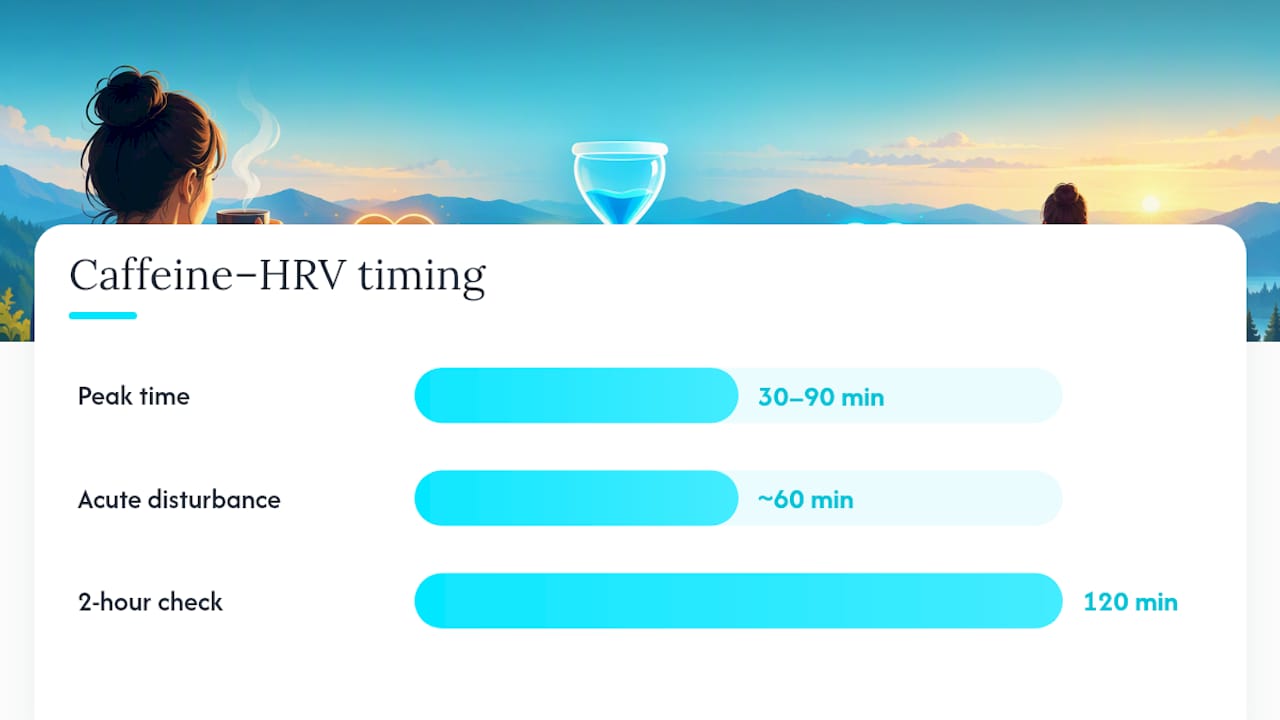
Timing matters almost as much as dose. Caffeine reaches peak blood concentration roughly 30 to 90 minutes after ingestion, and in several studies, any HRV disturbance it caused had largely settled within about an hour. That is a narrow window. If you drink coffee and then wait two hours before checking your HRV, you have likely missed the acute effect entirely, which is exactly why timing your measurement matters more than avoiding caffeine altogether.
Habituation is the wildcard. Regular coffee drinkers tend to show a blunted acute response, their autonomic nervous system has adapted to the daily dose, so the same 200mg that jolts an occasional drinker barely registers for someone who has three cups a day, every day. The flip side is stranger: habitual users sometimes show a withdrawal effect, a vagal withdrawal when they switch to decaf or skip their usual dose, as the espresso crossover trial demonstrated. If you are a heavy coffee drinker who suddenly quits for a “detox” week, do not be surprised if your HRV moves in an unexpected direction for a few days.
What caffeine means for your post-exercise recovery numbers
Post-exercise HRV is where caffeine’s reputation gets shakiest, because the two trials most often cited point in opposite directions. Context, not just dose, decides which way you go.
The case for delayed recovery comes from the 300mg crossover trial, where a relatively high dose taken before aerobic exercise slowed the return of RMSSD, SD1, and blood pressure to resting values in young male subjects. The mechanism plausibly involves sympathetic activation from caffeine stacking on top of the sympathetic surge from exercise itself, so the parasympathetic “brake” takes longer to re-engage.
The case against a delay is just as solid. The low-dose trial found no slowdown at all, and some indices actually improved relative to placebo. The pooled meta-analysis backs this up at scale: across varied caffeine strategies, moderate-certainty evidence found no significant overall difference in RMSSD or HF during post-exercise recovery.
So which result should guide your own training decisions? A few practical rules help:
- If you took a high dose (300mg or more) shortly before a hard session, expect your HRV recovery window to look slightly delayed, and don’t panic if RMSSD takes a bit longer to climb back.
- If your usual dose is modest, one to two coffees, don’t expect caffeine to explain a bad recovery reading; look elsewhere first, at sleep, hydration, or training load.
- Ignore single-session dips entirely. A one-off lower RMSSD after a caffeinated pre-workout is noise, not a signal, unless it repeats across several sessions under the same conditions.
- Young, healthy, fit individuals in these trials generally showed smaller or no delay effects, so if you fall outside that profile, your personal response could differ from the published averages.
How your wearable actually captures HRV, and how to stop it lying to you
RMSSD is the metric most wearables lean on for daily HRV scores, and for good reason: it responds most sensitively to parasympathetic (vagal) activity, which is exactly the branch of your nervous system caffeine and stress both influence. HF power measures similar territory from the frequency domain, while SDNN captures overall variability across a longer window, including both sympathetic and parasympathetic contributions.
Device type changes what you actually get. Chest-strap ECG monitors detect the electrical signal directly and are considered the reference standard in research. Wrist-based PPG sensors estimate heart rate from blood volume changes under the skin, which works well at rest but degrades during movement or in cold hands, exactly the situations where you might want to test a caffeine effect during light activity. This is one reason the caffeine and HRV meta-analysis flags measurement window and device choice as key sources of disagreement between trials.
Getting a reading you can trust comes down to controlling four things:
- Fix the clock time. Measure at the same time each day, ideally within minutes of waking, before you’ve moved much or checked your phone.
- Fix your posture. Lying down produces different values from sitting up, and switching between the two from day to day introduces variability that has nothing to do with caffeine.
- Control your breathing where possible. A slow, steady breath rate reduces artificial swings; some apps guide you through this during the reading.
- Avoid same-morning confounders. Caffeine, exercise, alcohol, and smoking in the hours before a baseline reading can each move HRV independently, so stacking them together makes it impossible to isolate caffeine’s contribution.
Pro Tip: Take your baseline reading before you even get out of bed. The moment you stand up, your body activates a sympathetic response just from the postural change, which can mask or exaggerate whatever caffeine is doing underneath.
Choosing a stable measurement window also matters for the same reason circadian timing affects other physiological markers. If you’re building a testing routine, it helps to understand how circadian rhythms affect heart-rate measurements more broadly, since your body’s natural rhythm and your caffeine timing can easily get tangled together if you’re not careful.
Run your own caffeine and HRV self-test in under two weeks
You don’t need a lab to find out how caffeine actually affects your own HRV. A short, controlled protocol beats guessing.
- Establish a caffeine-free baseline. Spend three to four consecutive mornings with no caffeine before your reading, measuring at the same clock time, same posture, same conditions each day. Average these to get your personal baseline RMSSD.
- Pick a standard dose and stick to it. Choose a realistic amount, say 100mg (roughly one cup of filter coffee) or 200mg, and use the same drink, same volume, every test day.
- Measure at fixed intervals. Take readings pre-dose, then at 30, 60, and 120 minutes after. This captures the absorption peak and lets you see whether any HRV shift resolves within the hour, as several trials found.
- Repeat at least three times. A single test day tells you almost nothing, day-to-day variability alone can produce a swing that looks like a caffeine effect but isn’t. Three to five repeats under identical conditions give you a pattern you can actually trust.
- Compare against your baseline, not against “normal.” There is no universal healthy RMSSD number; you’re looking for a consistent deviation from your caffeine-free average.
| What you observe | Likely meaning |
|---|---|
| RMSSD drops at 30 to 60 minutes, recovers by 120 minutes | Typical transient response, consistent with several trial findings, not a recovery concern |
| No meaningful change across any timepoint | You may be habituated, or your personal dose is low relative to your tolerance |
| RMSSD stays suppressed well past 120 minutes, repeated across tests | Worth lowering your dose, moving your intake earlier, or testing a lower amount |
| Wildly inconsistent results between repeat days | Confounders (sleep, stress, alcohol) are likely swamping the caffeine signal, tighten your protocol |
Control for sleep quality, stress, and alcohol on your test days. If any of those vary wildly, your caffeine data will be worthless.
The bottom line for your recovery decisions
- Treat single-morning HRV dips as noise, not a verdict, unless the pattern repeats across several days.
- If you want a clean baseline reading, avoid caffeine for at least two hours beforehand.
- Judge training and recovery decisions on multi-day trends, not one caffeinated morning.
- See a clinician if you notice a large, sustained HRV drop alongside symptoms like unusual fatigue, palpitations, or breathlessness. That pattern is not explained by a coffee.
- Run the structured self-test above before you decide caffeine is “ruining” your recovery data. Most people find it isn’t.
How Voltra helps you separate a coffee blip from a real trend
Spotting the difference between an acute caffeine wobble and a genuine recovery problem requires days of comparable data, not one reading. Voltrahealth’s subscription-free app keeps every morning’s RMSSD trend in one place indefinitely, and guided breathwork programmes for HRV help steady your breathing during measurement, cutting the noise that makes single readings misleading.
A fair note on how confident you should be in any of this
The honest answer is: moderately confident, not fully. Trial samples are small, methods vary, and your own physiology, dose tolerance, habitual intake, fitness level, will shift where you land on the spectrum between the low-dose and high-dose findings above. Treat HRV as one input alongside sleep quality and how you actually feel, not a standalone verdict. If enough readers run the self-test protocol and want to compare notes, that’s a conversation worth having properly.
— Sam
Track the real trend, not the caffeine blip
Some health tracking services offer no subscription fees, allowing users to run the self-test protocol above for extended periods without recurring bills nudging them to stop early, which supports long-term HRV pattern-spotting. 
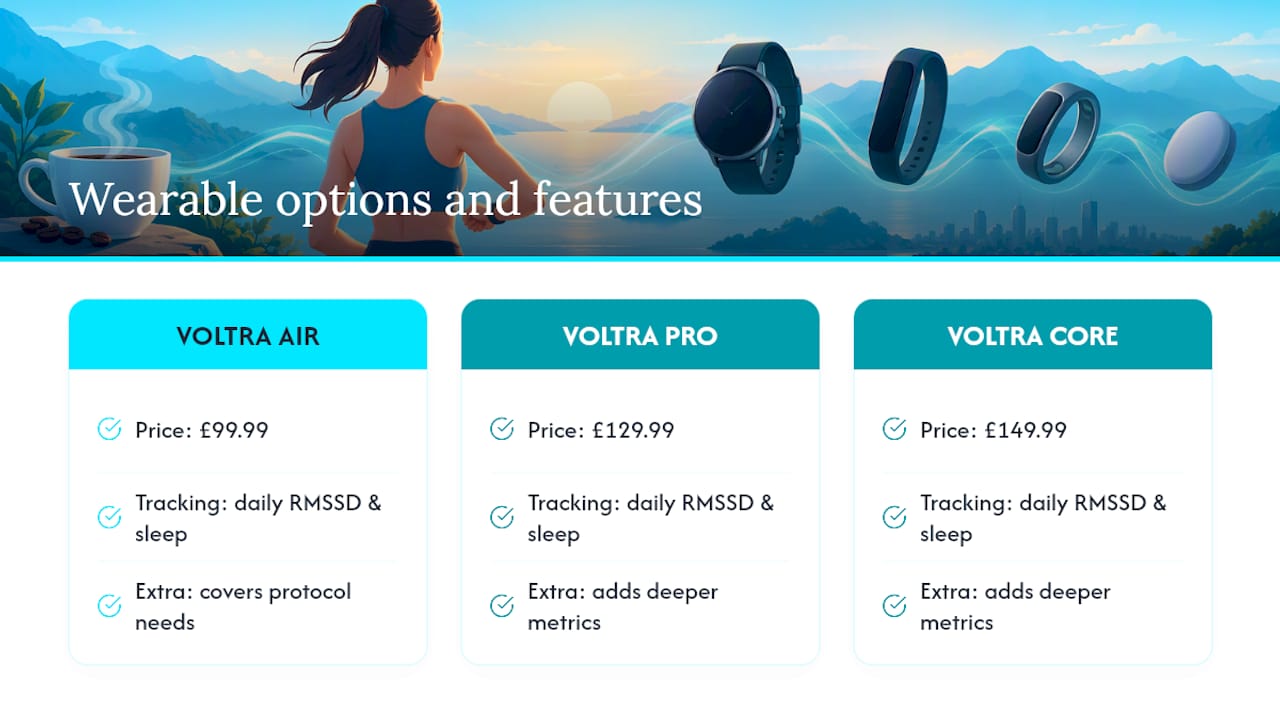
A one-off wearable purchase may provide long-term access to companion apps where caffeine self-tests, breathwork sessions, and morning RMSSD baselines can be tracked in one dashboard. The entry-level VOLTRA AIR at £99.99 covers the daily tracking this protocol needs, while VOLTRA PRO at £129.99 and VOLTRA CORE at £149.99 add deeper metrics if you want more than RMSSD and sleep data. Pick a device, run your baseline days this week, and see what your own numbers actually say about your coffee.
This article is general information, not a substitute for advice from a qualified doctor. Consult a qualified healthcare professional about your own circumstances before acting on anything here.
Sources
- Impact of caffeine intake strategies on heart rate variability during post-exercise recovery: a systematic review and meta-analysis
- Short-term effects of espresso coffee on heart rate variability and blood pressure in habitual and non-habitual coffee consumers–a randomized crossover study
FAQ
Why is my HRV so low despite being healthy?
Low HRV in an otherwise healthy person is usually explained by poor sleep, high training load, stress, alcohol, or measurement timing rather than an underlying health problem. Caffeine taken close to your reading, especially at higher doses, can also produce a transient dip that resolves within an hour or so, based on the trial evidence above.
What is the two hour coffee rule?
It refers to waiting roughly two hours after drinking caffeine before taking a baseline HRV reading, since caffeine peaks in the blood between 30 and 90 minutes and many of its HRV effects settle within about an hour. Following this rule gives you a cleaner comparison point when tracking trends over time with a device like Voltrahealth’s app.
What are the first signs of too much caffeine?
Early signs of excessive caffeine typically include jitteriness, a racing or pounding heartbeat, restlessness, and difficulty sleeping. On HRV data specifically, very high habitual intake, three or more cups daily, has been linked to a small downward trend in RMSSD in large observational data, though the effect is modest compared with the crude, unadjusted association.
What is considered an unhealthy HRV?
There’s no single universal number that marks “unhealthy” HRV, because normal ranges vary hugely by age, fitness, and measurement method. What matters more is a sustained, unexplained downward trend in your own baseline over days or weeks, particularly alongside symptoms, rather than any single low reading against a generic benchmark.
Share:
Alcohol and Sleep Data: Wearables Show 2–3 BPM Rise per Drink
Athletes: Use Wearables, 7 Day HRV and a 10% Rule to Spot Overtraining