
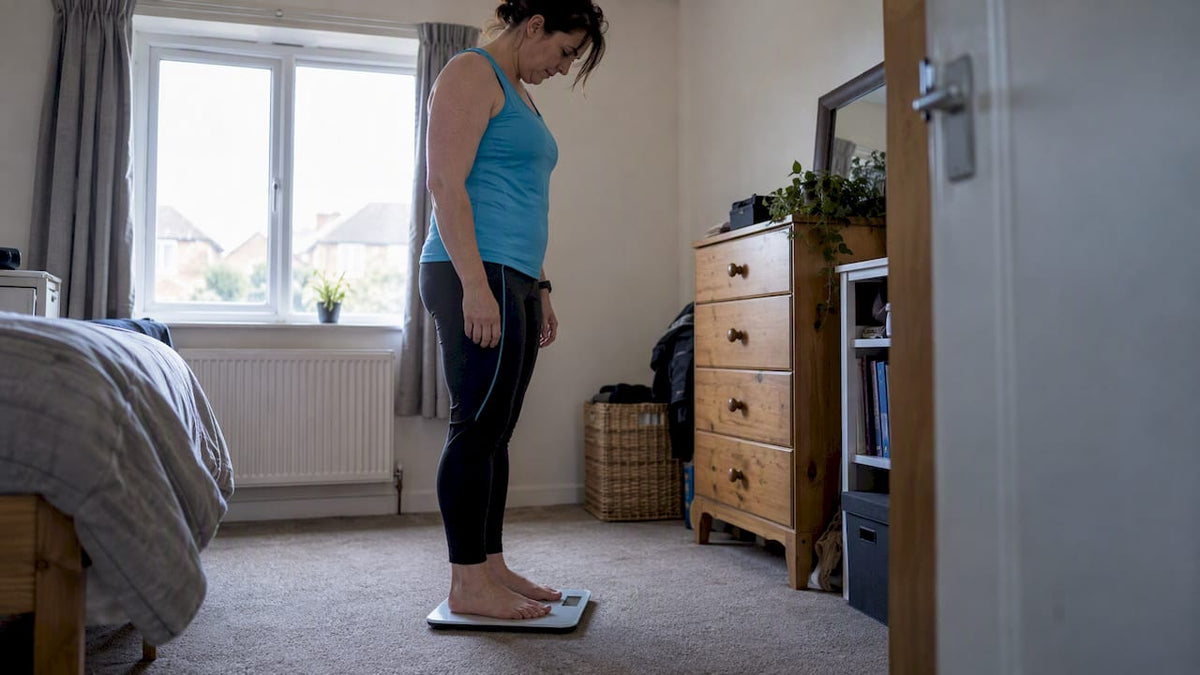
The visceral fat number on your bathroom scale is a proprietary, unitless index generated by electrical resistance readings and your personal details, not a clinical measurement of fat around your organs. Treat it as a trend marker to watch over weeks and months, never as a diagnosis. If your reading sits in the higher bands, the sensible next step is to check your waist circumference and raise it with a GP rather than panic over a single reading.
TL;DR:
- Consumer scales commonly label scores from 1 to 12 healthy and 13 or higher excess, but thresholds and maximums vary by manufacturer.
- BIA readings have limited agreement with CT, so compare results only on the same device and use clinical assessment when an exact measurement matters.
- Waist cutoffs are below 94 cm for men, 90 cm for some ethnic groups, and 80 cm for women; discuss rising scores with your GP.
- Hydration, food, and recent exercise can shift readings, so weigh under consistent morning conditions and judge monthly averages rather than reacting to a single result.
- Sustained changes can reduce visceral fat: favor Mediterranean style meals, combine aerobic activity with resistance training, improve sleep, and limit alcohol.
Table of Contents
- What visceral fat is and why it matters
- How consumer scales estimate visceral fat using BIA
- Typical scale ranges and what the numbers usually mean
- Accuracy and limitations: what the evidence says about BIA versus CT and MRI
- How to interpret your score: waist measurements and other markers
- How to reduce visceral fat with diet, exercise and sleep
- Getting consistent readings with a Voltra device
- Putting your visceral fat number into perspective
- Track your visceral fat trend with a Voltra device
- FAQ
- Sources
What visceral fat is and why it matters
Visceral fat sits deep in the abdominal cavity, wrapped around the liver, pancreas and intestines, which is different from the subcutaneous fat you can pinch under the skin. This deep fat is metabolically active: it releases inflammatory compounds and fatty acids directly into the bloodstream, which can worsen insulin resistance over time.
That is why clinicians care about it specifically, rather than treating all body fat the same way. The practical difficulty is that visceral fat cannot be seen or felt from the outside, so medicine has leaned on an accessible proxy instead.
- Visceral fat surrounds internal organs, while subcutaneous fat sits just beneath the skin.
- Excess visceral fat is linked to inflammation, insulin resistance and higher cardiovascular risk.
- Waist circumference is used clinically because it correlates with visceral fat without needing a scan.
How consumer scales estimate visceral fat using BIA
Most home scales use single-frequency bioelectrical impedance analysis (BIA): a mild, imperceptible electrical current passes through your body, and the device measures how much resistance it meets. Fat resists the current more than muscle or water does, so the resistance reading becomes the raw input for an estimate.
- The scale sends a small current through your feet (or hands, on some devices) and records the resistance.
- That resistance figure is combined with your age, sex, height and weight in a formula built by the manufacturer.
- The formula outputs a visceral fat rating on a proprietary scale that has no fixed clinical unit.
Because each brand builds its own formula from its own population data, a reading from one manufacturer is not directly comparable to a reading from another. The number is best understood as that device’s opinion of your trend, generated consistently enough to be useful for watching change over time but not standardised enough to be universal.
Typical scale ranges and what the numbers usually mean
Many consumer scales display visceral fat on a scale running roughly from 1 to 59. Manufacturer guidance built into that format commonly treats 1 to 12 as the healthy range and 13 and above as excess, though the exact cut-offs and the scale’s ceiling vary by brand.
- Check your own device’s manual or app, since the healthy cut-off and maximum value differ between manufacturers.
- A single high reading is not an emergency: look for a pattern across several weeks before drawing conclusions.
- A persistently high reading, especially alongside a wider waist, is a reasonable trigger to check with a GP or practice nurse.
The difference between visceral and subcutaneous fat matters here too, since a rising visceral score with a stable waist measurement can still be worth tracking; our explainer on visceral versus subcutaneous fat covers that distinction in more depth.
Accuracy and limitations: what the evidence says about BIA versus CT and MRI

CT and MRI scans remain the gold standard for measuring visceral fat area, because they can directly image the fat surrounding organs rather than inferring it from resistance. These scans are expensive, involve radiation or long scan times, and are never used for routine home tracking.
A cross-sectional study comparing single-frequency BIA with CT found limited agreement between the two methods for assessing visceral fat, with accuracy varying by sex and by the threshold used (PMC, 2021). BIA measures body water and electrical resistance, then infers fat levels through population-based formulas, which explains why it can diverge from direct imaging.
- BIA is low-cost, instant and repeatable at home, which CT and MRI are not.
- Agreement between BIA-derived indexes and imaging is inconsistent enough that a single BIA reading should not be treated as a diagnosis.
- The practical rule: use a home scale to track your own trend over time, and rely on clinical imaging or a doctor’s assessment when a precise figure actually matters.
How to interpret your score: waist measurements and other markers
A visceral fat rating means more when you pair it with a waist measurement and, where relevant, basic blood tests. Waist circumference remains a better predictor of cardiometabolic risk than BMI alone, and it costs nothing but a tape measure.
- Find the midpoint between the top of your hip bone and the bottom of your lowest rib, and wrap the tape there.
- Breathe out normally before taking the reading, and measure at the same time of day each time for consistency (ELHT NHS Trust).
- Compare your result against NHS low-risk thresholds: below 94 cm for men generally, below 90 cm for men in certain higher-risk ethnic groups, and below 80 cm for women.
- If your waist measurement exceeds these cut-offs alongside a rising visceral fat score, ask your GP about checking blood pressure, cholesterol and blood glucose.
Pro Tip: Keep your waist below half your height as a quick daily sanity check, since this waist-to-height ratio is a simple complement to any scale reading.
How to reduce visceral fat with diet, exercise and sleep
Visceral fat responds well to lifestyle changes, often more readily than subcutaneous fat, which is encouraging news for anyone looking at a high reading. Clinical reviews link consistent lifestyle interventions to measurable reductions in visceral adipose tissue alongside improvements in insulin and lipid markers.
- Favour a Mediterranean-style eating pattern, with vegetables, whole grains, fish and olive oil replacing refined carbohydrates and sugary drinks.
- Build in regular aerobic activity, such as brisk walking or cycling, combined with resistance training two or three times a week.
- Prioritise sleep and reduce alcohol intake, since both affect how your body stores and mobilises fat.
- Measure consistently rather than daily, since hydration, recent exercise and food intake all shift impedance readings temporarily.
Pro Tip: Expect weeks rather than days for a visceral fat trend to shift meaningfully, so judge progress on a monthly average instead of your last single reading.
Getting consistent readings with a Voltra device
We provide a companion app that tracks sleep, activity and body composition trends without any subscription fees, allowing you to observe your visceral fat index over time without ongoing costs. Consistency in how you measure matters as much as the device itself.
- Weigh in at the same time of day, ideally first thing and barefoot, to reduce hydration-related noise in the reading.
- Follow a steady routine before stepping on the scale, our seven-step protocol for bioimpedance accuracy walks through the details.
- Watch for sustained shifts across several weeks rather than reacting to any single day’s number.
- The app can flag meaningful trend changes, helping you separate normal fluctuation from a pattern worth acting on.
Putting your visceral fat number into perspective
A visceral fat score is a nudge, not a verdict. The most useful habit is pairing it with a waist measurement and, when numbers look persistently high, a conversation with your GP about blood pressure, lipids and glucose.
What reassures me most about this metric is how responsive visceral fat tends to be: modest, sustained changes to diet, movement and sleep move it in the right direction for most people. Use your device to stay informed, not to self-diagnose.
— Sam
Track your visceral fat trend with a Voltra device
Watching a visceral fat score change over months is far easier when your device and app cost nothing beyond the initial purchase. Our VOLTRA AIR is priced at £99.99 one-off, our VOLTRA PRO at £129.99 one-off, and our VOLTRA CORE at £149.99 one-off, each with lifetime free app access and no recurring charges.

For a reliable trend, weigh in at the same time each morning, barefoot and before eating, and let the app’s weekly averages do the interpreting for you. Browse the full Voltra range to find the device that fits how closely you want to track your numbers.
FAQ
What is a good visceral fat score?
On the common consumer scale format running from 1 to 59, manufacturer guidance typically treats a reading of 1 to 12 as healthy, with 13 and above flagged as excess. These cut-offs are brand-specific, so check your own device’s guidance alongside your waist measurement.
Is 7.5 visceral fat good?
A reading sits comfortably within the healthy range most manufacturers define as 1 to 12. It is still worth tracking over time rather than treating as a one-off result, since normal day-to-day fluctuation is expected.
How do I lower my visceral fat level?
Visceral fat responds to sustained lifestyle changes: a Mediterranean-style diet, regular aerobic exercise plus resistance training, better sleep and reduced alcohol intake. Most people see meaningful shifts over weeks to months rather than days.
How do I calculate my visceral fat area?
Precise visceral fat area is only measured accurately through CT or MRI scanning in a clinical setting, since these scans directly image fat around your organs. A home BIA scale gives an estimated index instead, useful for tracking your own trend but not a substitute for imaging when an exact area measurement is needed.
How accurate are smart scale visceral fat readings?
Home BIA scales are convenient and repeatable, but validation research shows limited agreement with CT imaging for precise visceral fat assessment. They work best for monitoring your personal trend on the same device rather than producing a clinically exact figure.
Sources
- Measurement of visceral fat and abdominal obesity by single-frequency bioelectrical impedance and CT: a cross-sectional study
- Health Survey for England: ethnicity and health (NHS digital)
- Should you worry about your waistline? (Harvard Health)
Share:
Battery Life: UK Fitness Tracker Tests vs. Box Claims