
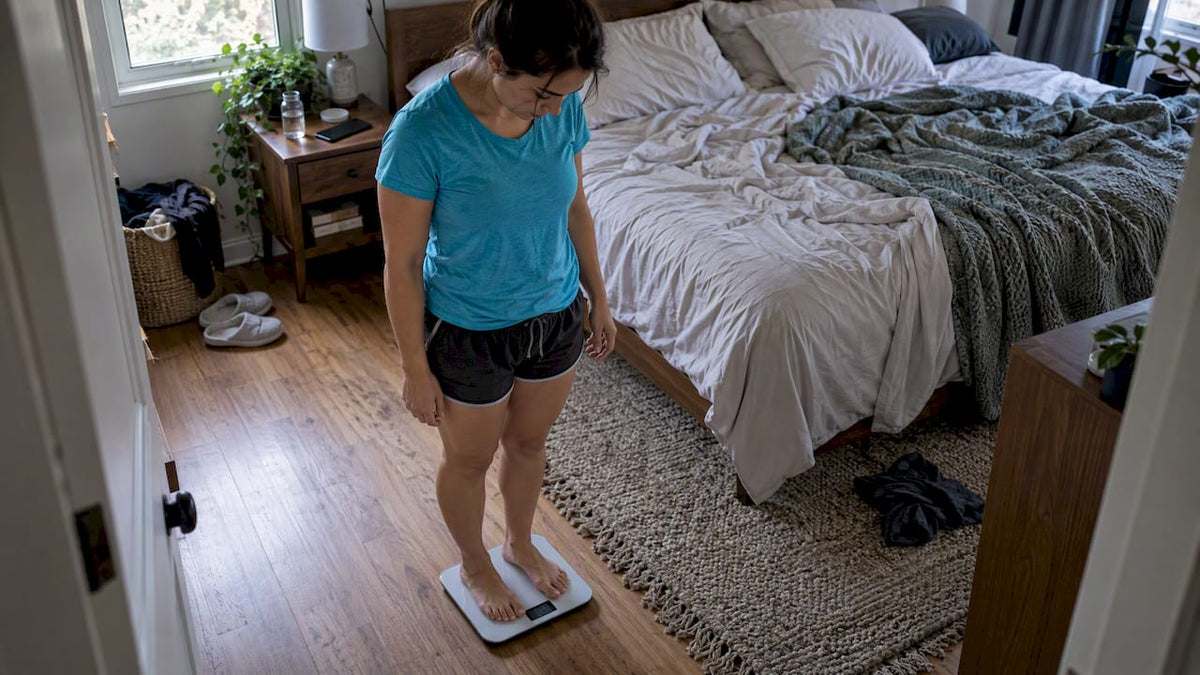
TDEE is the number to use when setting your daily calorie target: it covers everything your body burns in a day, while BMR only measures the energy you’d burn lying completely still. BMR tells you your resting baseline; TDEE adds activity, digestion and movement on top. For weight loss, maintenance or muscle gain, TDEE is the figure to build your plan around.
TL;DR:
- Mifflin St Jeor predicts resting needs within 10% for about 71% of participants, yet roughly one third receive less accurate individual estimates.
- Choose an activity multiplier that reflects your typical week: sedentary estimates use 1.2, while moderate exercise three to five days weekly uses 1.55.
- Track weight for two to four weeks, then adjust your calorie target by 100 to 200 calories if the trend misses your goal.
- For weight loss, the NHS recommends roughly a 600 calorie daily deficit; for weight gain, add about 200 to 300 calories above TDEE.
- Equations can miss for people with extreme BMI, unusually high muscle mass, or age related body composition changes; indirect calorimetry measures expenditure directly.
Table of Contents
- What is basal metabolic rate (BMR)?
- What is total daily energy expenditure (TDEE)?
- How to calculate BMR (formulas you can use right now)
- How to calculate TDEE (activity multipliers and realistic adjustments)
- BMR vs RMR: difference and practical choice
- How accurate are predictive equations? Limits, evidence and better validation
- Using BMR and TDEE for maintenance, weight loss and gain
- Worked example: calculate BMR, then TDEE, then set a daily target
- Publisher perspective: validate estimates with tracking and trend data
- An alternative approach: wearables and a free app for sharper TDEE estimates
- FAQ
- Sources
What is basal metabolic rate (BMR)?
BMR is the amount of energy your body needs to keep running when you’re doing absolutely nothing: breathing, circulating blood, repairing cells and keeping your organs working. It’s measured under strict conditions, typically lying down, fasted and fully rested, because any movement or digestion pushes the number up.
This resting energy isn’t a small slice of your daily total. According to the Cleveland Clinic, BMR typically accounts for 60 to 75% of total daily energy expenditure for most people, meaning the bulk of what you burn each day happens without you lifting a finger.
BMR isn’t fixed. It shifts with several factors:
- Age: BMR tends to decline as we get older, partly due to loss of lean muscle mass.
- Sex: men generally have a higher BMR than women, largely due to differences in average muscle mass.
- Body composition: more lean muscle raises BMR because muscle tissue burns more energy at rest than fat tissue.
- Genetics: some people naturally run a faster or slower metabolism than others of similar size and age.
Because BMR only reflects the resting portion of your energy needs, using it alone to set a calorie target would leave out everything you do once you get out of bed.
What is total daily energy expenditure (TDEE)?
TDEE is your BMR plus everything else your body burns across the day. It’s built from four components:
- BMR: the resting energy cost that forms the largest single share of TDEE.
- Exercise activity thermogenesis: calories burned during structured workouts or sport.
- Non-exercise activity thermogenesis (NEAT): energy spent on everyday movement like walking, fidgeting, standing and chores.
- Thermic effect of food (TEF): the energy your body uses to digest, absorb and process what you eat.
TDEE is calculated by multiplying BMR by an activity factor, often called a physical activity level (PAL), which summarises how active your lifestyle is overall. A sedentary office worker and a warehouse picker with identical BMR can have very different TDEE figures once activity is factored in.
This is why TDEE, not BMR, is the practical number for planning. BMR tells you what your body needs at rest, but nobody eats to match their resting rate alone. Setting a calorie target from BMR would systematically underfeed anyone with a job, a gym habit or even just a dog that needs walking twice a day. TDEE accounts for the life you actually live, which makes it a far more realistic baseline for deciding how much to eat.
How to calculate BMR (formulas you can use right now)
The most widely used formula today is Mifflin-St Jeor, and for good reason: research comparing prediction equations found it performed better than older formulas at group level, predicting resting metabolic rate within 10% accuracy for around 71% of participants in one study, according to a comparison of prediction equations.
The Mifflin-St Jeor equation, using metric units, works like this:
- For men: BMR = (10 × weight in kg) + (6.25 × height in cm) − (5 × age in years) + 5.
- For women: BMR = (10 × weight in kg) + (6.25 × height in cm) − (5 × age in years) − 161.
- Worked example: a 35-year-old woman weighing 68 kg and standing 165 cm tall gets a BMR of around 1,375 kcal/day.
Two older alternatives still appear in calculators. Harris-Benedict was the standard for decades but tends to overestimate BMR slightly compared with Mifflin-St Jeor. The Henry equation, developed using a broader international dataset, is sometimes preferred for populations outside the US and UK samples that Harris-Benedict and Mifflin-St Jeor were built on.
Whichever formula you use, stick to metric units (kilograms and centimetres) to avoid conversion errors, and round your final figure to the nearest whole number. Most online calculators will do the arithmetic for you, but understanding the inputs helps you spot an implausible result if you enter something incorrectly.
How to calculate TDEE (activity multipliers and realistic adjustments)
Once you have a BMR figure, multiply it by an activity factor that matches your typical week:
- Sedentary (little or no exercise): multiply BMR by around 1.2.
- Lightly active (light exercise one to three days a week): multiply by around 1.375.
- Moderately active (moderate exercise three to five days a week): multiply by around 1.55.
- Very active (hard exercise six to seven days a week): multiply by around 1.725.
- Extremely active (very hard exercise, physical job or training twice a day): multiply by around 1.9.
These multipliers are a starting estimate, not a precise measurement. NEAT varies enormously between individuals with similar jobs and exercise habits, which is one reason two people with the same BMR and the same gym routine can end up with noticeably different real-world TDEE.
The sensible method is to pick the multiplier that best matches your week, calculate an initial TDEE, then treat that number as a hypothesis rather than a fact. Track your weight over the following weeks and adjust the figure based on what actually happens, rather than assuming the first calculation is correct.

Pro Tip: Recalculate your activity multiplier every few months, especially after a significant change in job, training volume or season, since NEAT shifts more than most people expect.
BMR vs RMR: difference and practical choice
Resting metabolic rate (RMR) is closely related to BMR but measured under less strict conditions: you don’t need to be fasted overnight or lying in a lab, just reasonably rested.
The distinction exists mainly because of where and how the number is measured. BMR demands controlled laboratory conditions that most people never undergo; RMR is far easier to estimate in a clinic, gym or even at home, which is why most calculators and consumer devices are technically estimating RMR rather than BMR, even when they use the term “BMR”.
For everyday calorie planning, the difference rarely matters. Either figure can feed into your TDEE calculation as the resting baseline, as long as you understand which one you’re starting from and stay consistent when tracking progress over time.
How accurate are predictive equations? Limits, evidence and better validation
Predictive equations are useful starting points, not guarantees. Research comparing Mifflin-St Jeor against other formulas found that prediction errors still affect roughly one in three people at the individual level, even though the equation performs well on average across groups, according to the same comparison study.
Predictive equations show errors for about a third of individuals, with the discrepancy more pronounced in people with obesity or atypical body composition.
People most likely to see a meaningful gap between predicted and actual metabolic rate include those at the extremes of BMI, people with unusually high muscle mass, and older adults whose body composition has shifted significantly from the population the equations were built on.
The true gold standards for measuring energy expenditure are indirect calorimetry and doubly labelled water (DLW), both used in controlled research settings. A CALERIE study using DLW measured average TDEE in free-living, weight-stable adults at roughly 2,443 kcal per day, with men averaging around 580 kcal higher than women. The same study found that self-reported intake underestimated true energy intake by roughly 350 kcal a day, and self-reported activity underestimated true output by a similar margin, which shows how unreliable guesswork can be compared with measured data.
Since most people can’t access a metabolic chamber, the practical alternative is to use an equation as a starting estimate, then validate it by tracking real-world weight change over several weeks. If you want help turning weekly weight and activity patterns into a clear trend, our guide on wearable calorie accuracy walks through how to read that kind of data sensibly.

Using BMR and TDEE for maintenance, weight loss and gain
Once you have a TDEE estimate, it becomes the baseline for every goal:
- Maintenance: eat at your calculated TDEE and track weight weekly; a stable trend over two to four weeks confirms the number is close to accurate.
- Weight loss: the NHS suggests a sustainable approach uses roughly a 600 kcal daily deficit below maintenance, which for context sits below the NHS’s average maintenance guidance of about 2,000 kcal for women and 2,500 kcal for men.
- Weight gain: add a moderate surplus, typically 200 to 300 kcal above TDEE, and monitor the rate of gain to avoid excess fat gain.
- Adjustment: if weight isn’t moving as expected after three to four weeks, revise the calorie target by 100 to 200 kcal rather than making a drastic change.
While in a deficit, protect lean muscle by keeping protein intake relatively high across meals and continuing resistance training rather than cutting it when calories drop. This preserves the muscle mass that keeps your BMR from falling faster than expected during weight loss.
Pro Tip: Weigh yourself at the same time of day, ideally after waking and before eating, since day-to-day fluctuations from water and food can hide the real trend for a week or more.
Worked example: calculate BMR, then TDEE, then set a daily target
Take a 40-year-old man weighing 85 kg, standing 180 cm tall, who trains at the gym three times a week alongside a desk job.
- Calculate BMR using Mifflin-St Jeor: (10 × 85) + (6.25 × 180) − (5 × 40) + 5 = 850 + 1,125 − 200 + 5 = 1,780 kcal/day.
- Apply a moderately active multiplier of 1.55: TDEE = 1,780 × 1.55 = 2,759 kcal/day, rounded to 2,760.
- For weight loss, apply the NHS-style deficit of roughly 600 kcal: 2,760 − 600 = 2,160 kcal/day as a daily target.
- Track weight for two to four weeks at this target; if loss stalls, reduce the target slightly rather than cutting calories sharply.
This sequence, BMR first, then TDEE, then a goal-based adjustment, is the same process regardless of your own numbers.
Publisher perspective: validate estimates with tracking and trend data
No formula replaces watching what actually happens to your body. A calculator gives you a sensible starting point, but the only way to know if that number fits you is to track weight and activity over several weeks and adjust from there.
This is where consistent data earns its keep. Logging activity, sleep and recovery over time, without needing a subscription to see the full picture, turns a one-off calculation into an ongoing feedback loop, which is a far more reliable way to land on the right calorie target than trusting any single equation.
— Sam
An alternative approach: wearables and a free app for sharper TDEE estimates

Working out TDEE from a formula gets you close, but closing the gap between estimate and reality takes real data on how active you actually are, not just how active you think you are. That’s the gap we built our devices to close: continuous tracking of activity, sleep and heart health feeding straight into the same app, with no subscription needed to see any of it.
- VOLTRA AIR covers the essentials for tracking activity and sleep trends at £99.99.
- VOLTRA PRO extends into recovery and heart health tracking at £129.99.
- VOLTRA CORE adds deeper body composition metrics at £149.99.
Once your device data is logged, turning those numbers into an actual meal plan is easier with a structured prompt, something like the personalised nutrition plan tool can help organise that step. Browse the full range at Voltra and start logging the data that tells you whether your TDEE estimate is actually right.
This article is general information, not a substitute for advice from a qualified doctor. Consult a qualified healthcare professional about your own circumstances before acting on anything here.
FAQ
Does BMR count as calories burned?
Yes, BMR represents real calories your body burns, just the portion spent on resting bodily functions rather than movement or digestion. It typically makes up 60 to 75% of your total daily calories burned, with the rest coming from activity, exercise and digestion.
How accurate are BMR calculators?
BMR calculators give a reasonable group-level estimate, but individual accuracy varies. Research on the Mifflin-St Jeor equation found it predicted resting metabolic rate within 10% for about 71% of participants in one study, meaning roughly a third of people fall outside that range.
Why is my BMR 1,000 calories?
A very low BMR estimate usually reflects a smaller body size, lower muscle mass, or inputs entered incorrectly into a calculator, such as height in the wrong unit. Double-check your weight and height are in metric units, since calculators using Mifflin-St Jeor or similar formulas are sensitive to input errors.
What is a good resting energy rate?
There’s no single “good” BMR, since it depends on your age, sex, height, weight and muscle mass. A more useful goal is consistency over time: tracking whether your resting rate stays stable or declines as you age or change body composition matters more than comparing your number to someone else’s.
Sources
- BMR (Basal Metabolic Rate): What It Is & How To Calculate It
- Healthy eating when trying to lose weight - Better Health - NHS
- Prediction equation accuracy comparing Mifflin–St Jeor, Henry and others
Share:
Visceral Fat Scores: Why 13+ Needs Context in the UK