Cycle-aware training helps some women, but rigid phase-by-phase rulebooks are not backed by strong evidence.
TL;DR:
- Menstrual cycle effects on performance are minimal, with most women showing similar activity levels across phases and only small dips during early follicular days.
- Cycle syncing is mainly effective for women with regular cycles; irregular cycles or hormonal contraceptive use diminish the reliability of phase-based cues.
- Training should be adjusted to each menstrual phase, lowering volume during bleeding days and increasing intensity during the follicular phase if energy is high.
- Objective tracking of symptoms and physiological data over two to three cycles helps personalize training and distinguish hormonal effects from fatigue or illness.
- Rigid rules are unsupported by evidence; individual variation outweighs cycle phase effects, so self-monitoring and adaptive programming are best.
Table of Contents
- What is cycle syncing and which phases matter for training?
- Best workouts for each phase, with sample templates
- What does the research actually show?
- How do you track and personalise your own cycle-based training?
- Why I think the cycle-syncing conversation needs more nuance
- Using a wearable to speed up your own cycle experiment
- Further reading and primary sources
- Sources
- FAQ
What is cycle syncing and which phases matter for training?
Cycle syncing means matching training type and intensity to where you are in your menstrual cycle, rather than following the same plan every week regardless of hormones. Some versions use a four-phase model (menstrual, follicular, ovulation, luteal); others simplify it to two broad windows, follicular and luteal, split by ovulation.
The hormonal logic is straightforward. Oestrogen rises through the follicular phase and tends to correlate with better mood and lower perceived effort for the same workload. After ovulation, progesterone takes over, body temperature climbs slightly, and some women notice heavier legs, worse sleep or a higher heart rate during otherwise normal training. Dr Stacy Sims and other researchers now frame this less as a rulebook and more as one data input among several, alongside sleep, HRV and mood.
Cycle syncing fitness ideas apply most cleanly to women with regular, unmedicated cycles. If your cycle is irregular, or you use hormonal contraception that suppresses ovulation, phase-based cues become far less reliable, and tracking symptoms directly matters more than tracking calendar days.
Best workouts for each phase, with sample templates
Menstrual cycle workouts do not need a complete overhaul, just a few sensible dials to turn. Here is what to prioritise phase by phase.
Menstrual phase (bleeding days):
- Favour low-impact cardio: walking, swimming, easy cycling.
- Reduce overall training volume by around 20 to 30% if cramps, fatigue or heavy flow make full sessions uncomfortable.
- Prioritise sleep and mobility work over new personal bests.
Follicular phase and ovulation (rising energy window):
- This is often the best window to push intensity if you personally feel strong here: heavier lifts, sprint intervals, new skill work.
- Sample strength session: 4 sets of squats or deadlifts at a challenging but controlled load, followed by accessory work.
- Sample HIIT session: 6 to 8 rounds of 30 seconds hard effort, 90 seconds easy, if this intensity suits your normal training.
Luteal phase (post-ovulation to next period):
- Keep training moderate rather than maximal; RPE tends to feel higher for the same objective workload.
- Watch hydration and heat exposure. Basal temperature can climb by roughly 0.3 to 0.5°C in this phase, which lowers heat tolerance on hot days or in warm gyms.
- Steady-state cardio, moderate strength work and yoga or Pilates tend to sit well here.
A simple one-week template mixing phases might run: Monday strength (moderate), Tuesday easy cardio, Wednesday rest or mobility, Thursday strength (heavier if in follicular phase), Friday intervals or a longer steady run, Saturday active recovery, Sunday full rest. Adjust the heavy days to land wherever your energy actually peaks that month, not by the calendar alone.
What does the research actually show?
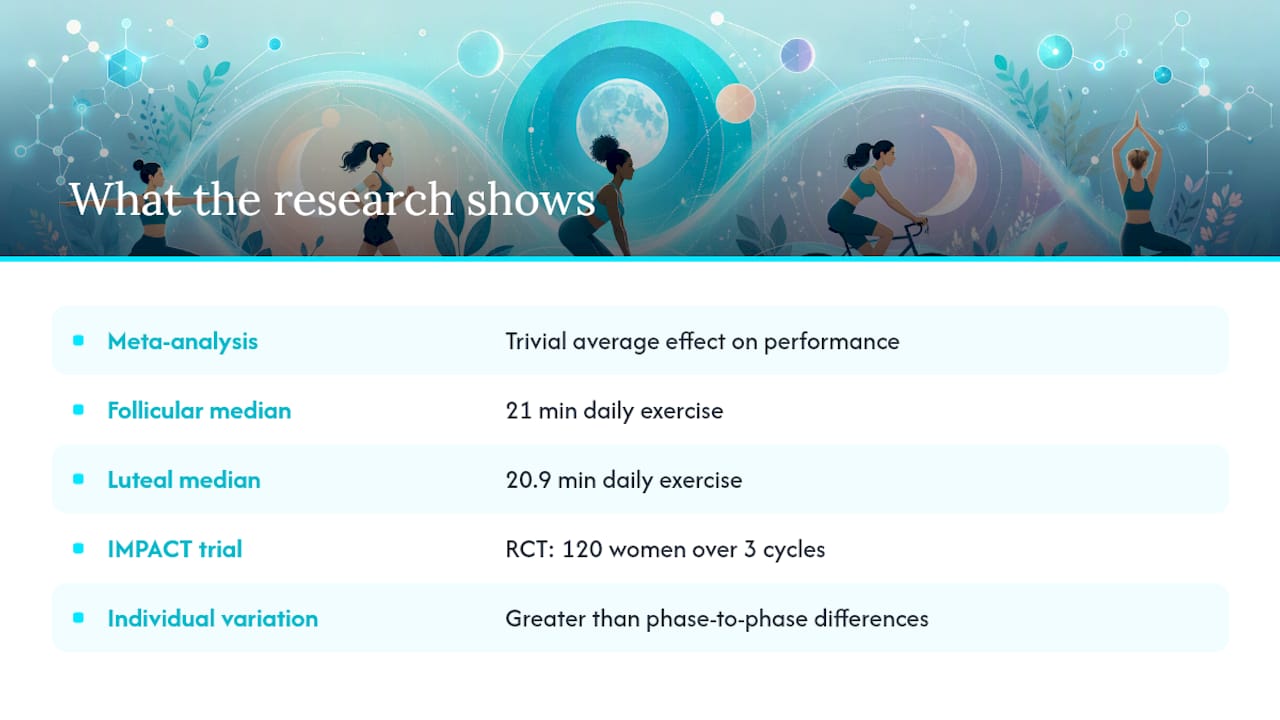
The honest answer is that the fitness and menstrual cycle relationship is weaker, on average, than most cycle-syncing content implies. A synthesis covering 78 studies found trivial average effects of cycle phase on exercise performance, with the clearest signal being a small performance dip in the early follicular phase for some women, not the boost many assume.
Large-scale activity tracking backs up the “stay consistent” message. A Harvard analysis of the Apple Women’s Health Study found median daily exercise minutes were almost identical across phases, 21 minutes in the follicular phase versus 20.9 in the luteal phase. Most women simply keep moving at a similar rate all month, whatever the hormones are doing.
Better causal evidence is coming. The IMPACT trial is a randomised controlled trial comparing follicular-based, luteal-based and regular training in 120 well-trained women over three cycles, and its results should clarify whether phase-based periodisation genuinely improves performance or just feels intuitive.
Until then, variation between individuals is larger than variation between average phases, which is why personal tracking beats blanket rules. Treat social-media cycle-syncing prescriptions as hypotheses to test on yourself, not facts to follow blindly. Strength training in particular is worth protecting: easing off resistance work for half of every month, cycle after cycle, risks undermining the long-term bone and muscle adaptations that BBC’s reporting on the trend flags as a real trade-off.
How do you track and personalise your own cycle-based training?
Tracking cycle for workouts works best over two to three full cycles, long enough to spot a genuine pattern rather than one unusually bad week. Each day, log your cycle day, bleeding and cramp intensity, mood, sleep quality, workout RPE, session duration, and, if you have a wearable, resting heart rate or HRV.
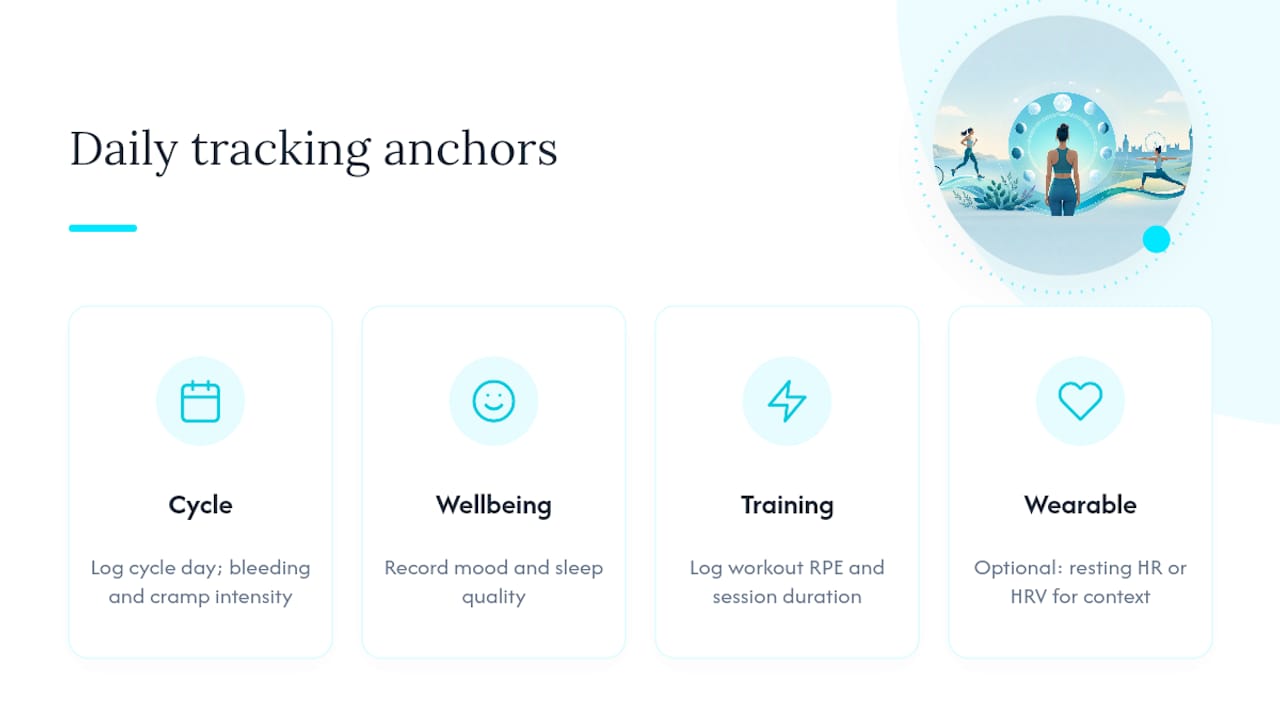
Objective metrics add useful context once you have subjective data. A dip in HRV or a spike in resting heart rate around ovulation or in the late luteal phase often tracks with how heavy a session actually felt, which helps you tell a bad training day from a genuinely bad hormonal day.
Run any change as a small experiment: adjust volume or intensity for one or two cycles only, then compare how sessions felt, how recovery scores moved, and whether you actually enjoyed training more. If pain is severe, your cycle is consistently irregular, or symptoms are disrupting daily life, that is a conversation for a GP or gynaecologist, not a training tweak.
Pro Tip: Trust perceived effort first and treat objective numbers as a second opinion, not the final word. A wearable can sharpen the picture, but it is not required to get useful results from this protocol.
Why I think the cycle-syncing conversation needs more nuance
Cycle syncing has exploded because women are, rightly, tired of training plans that ignore half their biology. That instinct is sound. But turning “be aware of your cycle” into rigid weekly rules trades one blunt approach for another. The evidence supports individualisation, not prescription, and the two get confused constantly online.
— Sam
Using a wearable to speed up your own cycle experiment
You do not need a device to run the tracking protocol above, but a wearable removes the guesswork from half of it. Voltra tracks sleep quality, resting heart rate, HRV and daily activity automatically, which covers most of the objective side of the checklist without you logging numbers by hand every morning.
During a two to three cycle trial, that data is what lets you separate “I feel tired because it’s day 24” from “I feel tired because I slept badly on Tuesday.” The app has no subscription fee, so there is no ongoing cost attached to running this experiment for as many cycles as it takes to see a real pattern. If you want something minimal to wear daily, Voltra Air is the lighter option; if you are tracking with a partner or want spares, the three-pack bundle covers a household. Either way, the device is optional infrastructure, not a requirement. Start by wearing it through your next cycle and comparing what it shows against how your sessions actually felt.
Further reading and primary sources
- IMPACT study protocol (PMC)
- Harvard T.H. Chan School of Public Health: exercise habits by cycle phase
- Cycle-syncing: Cleveland Clinic explainer
- BBC News: the rise of cycle-syncing workouts
- Baby Bare Essentials: tracking your fertile window
Sources
- IMPACT study protocol (PMC)
- Exploring exercise habits by menstrual cycle phase | Harvard T.H. Chan School of Public Health
- Cycle Syncing Exercise: Evidence vs. Hype (FeelGoodPal)
- Menstrual fitness: Why some women are ‘cycle-syncing’ their workouts — BBC News
- The evolution of menstrual cycle training — Dr Stacy Sims
FAQ
What workouts are recommended while cycle syncing?
Low-impact cardio and lighter sessions during your period, higher-intensity strength or interval work in the follicular phase and around ovulation if you feel strong, and moderate, heat-cautious training through the luteal phase.
What is the 3-3-3 rule for workouts?
There is no single agreed medical definition of a “3-3-3 rule” for cycle syncing, and the term is not part of the established research on menstrual cycle training. Rather than following an unverified rule, track your own symptoms and RPE over a few cycles to find your pattern.
How long does it take to see results from cycle syncing?
Most guidance recommends tracking for two to three full cycles before drawing conclusions, since a single cycle can be thrown off by illness, stress or poor sleep unrelated to hormones.
Is there a workout app or tool that can help me sync my cycle?
A wearable that logs sleep, HRV, resting heart rate and activity, such as Voltra, can support cycle tracking by supplying the objective data half of the picture alongside a symptom diary or period-tracking app.
Share:
Track Muscle Mass Percentage Right: See Real Gains in 4–6 Weeks
Subscription free smart scale: Make Apple Health your single source